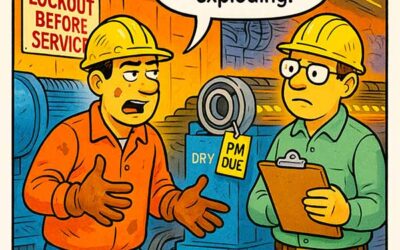


Every maintenance professional has seen it – the small puddle of oil on the grating that somehow survives every cleaning round. The cartoon of a worker mid-skid with his coffee airborne is funny because it’s painfully accurate. It captures the moment when confidence turns into panic and routine into risk. Behind the humor is an inconvenient truth: preventing workplace falls isn’t about luck or signs; it’s about how well we design, observe, and maintain our environment.
Slips, trips, and falls account for one of the largest categories of workplace injuries worldwide. Yet in most plants, they’re viewed as “minor” events rather than reliability issues. That mindset is the first hazard to fix.
The Hidden Psychology Behind Slips
Falls rarely begin with a single bad step. They begin when familiarity overrides attention. When a worker walks the same route every day, the brain filters out what it considers “known.” That’s why people trip over hazards they’ve walked past for weeks. Their eyes saw it, but their brain dismissed it.

The first step in preventing workplace falls is restoring awareness. Visual cues work not because they physically stop a fall, but because they interrupt complacency. High-contrast anti-slip treads, hazard stripes at transition zones, and reflective edge markings act as cognitive speed bumps. They tell the brain, “Pay attention here.”
Behavioral safety research shows that simple habit triggers, such as color-coded zones or texture changes underfoot, significantly reduce incidents. It’s the same psychology that keeps drivers alert when road rumble strips vibrate under the tires. We need the same sensory reminder in industrial settings where attention drifts fastest.
Design the Environment, Don’t Blame the Worker
Most incident reports cite “loss of footing” or “carelessness,” implying human failure. But humans act within systems, and systems are engineered. If the system tolerates oil leaks, poor drainage, or flat metal grating without traction, the next fall isn’t a surprise; it’s scheduled.
Preventing workplace falls begins at the design table, not during the post-incident meeting. The grating type, serration depth, spacing, and slope angle all affect how water, oil, and debris behave. A 5-degree difference in pitch can mean the difference between dry footing and a standing puddle.
Likewise, lighting matters. Glare on the metal grating hides slick spots. Upgrading to indirect LED lighting in walkways often exposes hazards that were previously invisible. This is reliability thinking applied to safety, design for the environment that exists, not the one you wish existed.
Even flooring material choices in high-traffic zones should be treated like a critical-asset decision. Coatings with high coefficient-of-friction ratings, modular anti-slip plates, or cleated covers should be selected based on empirical traction data, not catalog descriptions. That’s how you build safety into the infrastructure instead of onto it.
Shared Accountability: Everyone Owns the Floor
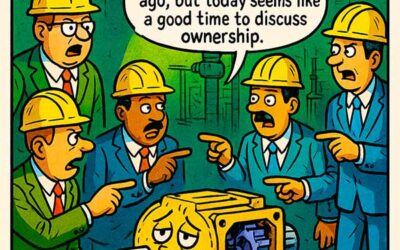
“Who greased the floor?” The cartoon’s line may sound like a joke, but it reflects a common mindset: safety belongs to someone else. Yet slips and trips exist in the blind space between departments: operations walks on it, maintenance cleans it, and EHS investigates it. In the meantime, everyone assumes someone else handled it.
A key principle in preventing workplace falls is distributed ownership. Every worker, from operators to supervisors, should have both the right and the mechanism to act. Digital hazard logs or QR-coded reporting boards make it easy to flag and track hazards in real time. When reports actually lead to quick corrective action, engagement surges.
Accountability grows in visibility. Post weekly updates showing how many slip hazards were corrected, how fast they were resolved, and what lessons were learned. Turning safety metrics into shared team victories changes the tone from blame to pride. The message becomes: “We fixed twenty hazards this week,” not “Someone slipped again.”
Built-In Solutions: When Engineering Meets Innovation
There’s a growing shift toward engineered anti-slip systems that combine performance with practicality. One example gaining attention in plants is the Titan Safety Anti-Slip Clip, designed specifically for metal grating.

Unlike adhesive coatings or paint-on traction layers that wear away, these clips mechanically lock into the grating surface, creating durable, replaceable traction zones that withstand oil, water, and chemical exposure.
This kind of engineered retrofit aligns perfectly with reliability-centered thinking, fixing the cause, not the symptom. By using modular clips instead of temporary coatings, maintenance teams can standardize traction control across multiple sites, reduce cleaning labor, and eliminate recurring downtime for reapplication. The installation takes minutes and provides an immediate, measurable improvement in slip resistance.
While preventing workplace falls always begins with awareness, tools like these extend that awareness into design, giving plants a way to make safety part of the physical infrastructure rather than a campaign that fades after the next toolbox talk.
Maintenance Is the First Line of Safety Defense
Lubrication leaks, condensation drips, and chemical overspray don’t just cause inefficiency; they’re slip factories. The maintenance team, more than anyone, is positioned to intercept these hazards before they reach the walking surface. Integrating fall prevention into maintenance planning connects safety directly to reliability.
Add floor condition inspections to preventive maintenance routes. When technicians complete lubrication tasks, include a visual check for residue or pooling. Simple absorbent mats or drip pans can eliminate an entire class of hazards. Likewise, tracking “slip incidents per 10,000 maintenance hours” as a KPI brings accountability to where it belongs: system reliability.
Condition monitoring can help, too. Moisture sensors under equipment, oil-detecting mats near reservoirs, or smart grating panels that flag contamination could soon become part of proactive plant design. It’s where safety meets predictive maintenance, a convergence long overdue.
Practical Actions That Strengthen Slip Prevention Programs
Turning awareness into prevention requires structure, not slogans. To move from theory to daily practice, maintenance and safety teams can focus on these proven actions for reducing slip and trip hazards in industrial environments:
1. Integrate floor safety into maintenance checklists
Add specific line items for grating inspections, walkway traction checks, and anti-slip surface maintenance in every PM schedule. Treat walking surfaces like assets, track their condition, failure modes, and maintenance intervals.
2. Use traction-improving solutions, not temporary fixes
Paint and tape wear out quickly in wet or oily areas. Instead, standardize the use of durable anti-slip flooring materials, modular clips, or grating traction control systems that resist heavy foot traffic and chemical exposure. Upgrading once often saves years of recurring rework.
3. Monitor and report every slip hazard
A slip hazard assessment should be part of every inspection round. Use QR-coded hazard logs or mobile apps to capture photos and locations of spills or surface wear. Transparent reporting builds accountability and visibility.

4. Train teams to recognize subtle risk indicators
Workers should learn to identify early signs of danger, such as a sheen on a surface, small residue pools, or uneven grating sections. Ongoing safety awareness training helps sharpen observation and connects physical conditions to potential causes, such as leaks or contamination.
5. Measure performance, not just compliance
Go beyond injury rates. Track slip incidents per maintenance hour, average response time to cleanups, or near-miss trends. These are safety performance metrics that reveal system reliability, not just regulatory adherence.
6. Reinforce with visual cues and reminders
Use color-coded safety zones, reflective stripes, and high-contrast markings to re-engage attention where routine dulls it. Each cue acts as a psychological guardrail, reminding workers to “reset awareness” when entering risk-prone areas.
7. Audit regularly for long-term improvement
A quarterly walkway safety audit provides trend data, showing where hazards recur, how long mitigations last, and whether new solutions, such as anti-slip cleats or drainage improvements, are performing as intended. Continuous improvement is the backbone of reliability-based safety.
By applying structure and metrics to prevent slips and trips, organizations transform safety from reactive cleanup to predictive control. It’s not about luck, posters, or toolbox talks: it’s about embedding reliable design and disciplined inspection into everyday work.
Each step taken safely is evidence of a more intelligent system; one that learns, adapts, and prevents failure before it happens.
Every Step Tells a Story
A single fall can cost a day, a career, or a life, but it can also teach an organization what it values most. Plants that treat slips as signals instead of accidents build resilience faster than those that just close cases.
Preventing workplace falls isn’t about walking slower or adding more warning signs. It’s about making the environment smarter, the workers more aware, and the system more responsive. Every safe step taken in a plant is a data point in a larger equation, one that balances safety, reliability, and human well-being.
Because gravity never sleeps. But neither should we.