

The Human Side of Predictive Maintenance Data Interpretation
Predictive maintenance thrives on precision: sensors, algorithms, and machine learning models all working in harmony to identify equipment issues before they cause downtime. Yet, one factor remains stubbornly unpredictable: human interpretation.
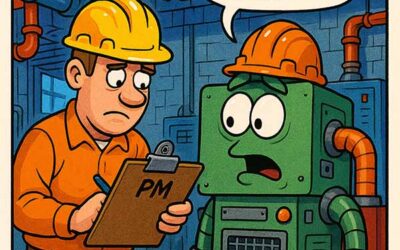
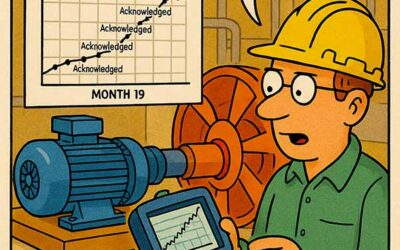
The cartoon “The Overthinking Sensor” captures this beautifully. A vibration sensor, sweating with anxiety, wonders whether the operator is upset. It’s funny, but it’s also true. Sensors don’t “overthink,” but maintenance teams often do. When faced with ambiguous signals or anomalous trends, people project assumptions, biases, or emotions onto the data.
This is the real-world challenge of predictive maintenance data interpretation: the information may be flawless, but the meaning we assign to it isn’t. Data doesn’t drive reliability; understanding does.
Predictive maintenance has matured beyond condition monitoring. It’s now a discipline that blends digital intelligence with human reasoning. As more organizations invest in advanced analytics, they’re realizing that sensor accuracy isn’t enough. The differentiator is how effectively maintenance professionals interpret those signals within their operational and cultural context.
How Predictive Maintenance Data Interpretation Shapes Reliability
At its core, predictive maintenance data interpretation is the process of translating raw sensor data into actionable insights. That sounds simple, but it’s rarely straightforward. Every maintenance engineer has experienced data that looks alarming but turns out to be irrelevant, or worse, data that seemed stable until the machine failed hours later.
Interpretation is where judgment enters the equation. A vibration spike might suggest misalignment, but a skilled analyst knows to check for resonance, load variation, or even software sampling errors before jumping to conclusions. This judgment is where predictive maintenance becomes both art and science.
Misinterpretation is the leading cause of wasted maintenance actions in predictive programs. Technicians often replace parts prematurely or chase “ghost failures” caused by incorrect trend analysis. These mistakes aren’t due to bad sensors; they stem from poor data context and a lack of interpretation standards.
When predictive maintenance data interpretation is done correctly, the benefits are transformative:
- Early, accurate fault detection with minimal false positives
- Reduced unplanned downtime
- Better prioritization of maintenance resources
- Improved trust between operations, engineering, and reliability teams
The key is understanding not just what the data says, but why it’s saying it, and whether it truly matters.
From Raw Data to Real Decisions: The Interpretation Chain
Every predictive maintenance workflow passes through three critical stages: data capture, data analysis, and data interpretation. The first two are increasingly automated, but the third still depends heavily on people.
- Data Capture – Sensors gather real-time information on vibration, temperature, oil quality, current, and more. The precision of this layer depends on correct sensor placement and calibration.
- Data Analysis – Algorithms process the data, looking for deviations, harmonics, or frequency peaks that indicate abnormal behavior.
- Data Interpretation – Humans apply context, operational loads, maintenance history, environmental factors, and production cycles to determine what action, if any, is necessary.
The last step is where predictive maintenance programs either succeed or fail. Algorithms can identify anomalies, but only humans can decide whether those anomalies are significant.
This is why many reliability teams are now training analysts in “interpretive thinking” – a mindset that merges data literacy with experiential knowledge. Engineers who understand both statistics and equipment behavior interpret signals more accurately and make better maintenance decisions.
The Communication Gap in Predictive Maintenance Programs
Even with the correct data and analytical tools, predictive maintenance data interpretation often fails due to communication breakdowns. The handoff between data interpretation and action is where reliability programs lose momentum.
Consider this common scenario:
A vibration alert triggers in the monitoring software. The analyst notes an increasing 1× rotational frequency component, suggesting an imbalance. The report is emailed to maintenance. The planner skims it, doesn’t fully understand the urgency, and schedules a check for next week. By the time the technician inspects the equipment, the bearing has failed.
Every step in that chain was logical, but communication failed. The data was correct. The analysis was proper. The interpretation may have been accurate. But the message didn’t connect with the people responsible for taking action.
Successful organizations combat this by embedding communication protocols directly into their predictive maintenance workflows:
- Context tagging in reports (“critical risk,” “monitor,” “verify”)
- Daily reliability huddles for cross-functional discussion of anomalies
- Feedback loops that confirm whether an interpretation was accurate after inspection
These small cultural shifts transform predictive maintenance from a data project into a human collaboration process.
In essence, predictive systems detect, but people decide. The clarity and tone of communication determine whether that decision drives uptime or regret.
Building Confidence in Predictive Maintenance Data Interpretation
Data interpretation confidence grows from repetition, calibration, and shared experience. High-performing reliability teams treat predictive maintenance interpretation as a continuous learning cycle rather than a one-time setup.
Four practical steps:
- Standardize interpretation frameworks. Define clear diagnostic categories (imbalance, misalignment, looseness, resonance, lubrication issues) and shared thresholds for when each requires intervention.
- Integrate multi-sensor correlation. Combine vibration, ultrasound, oil analysis, and thermography to validate findings across multiple sources before making decisions.
- Use post-event reviews. After a failure, trace back through the data stream and interpretations to see where signals were misread or ignored.
- Coach for cognitive bias awareness. Analysts should recognize when confirmation bias or recency bias affects judgment, for example, assuming every spike means imbalance because “the last one was.”
Equally important is psychological safety. If maintenance technicians fear blame for missed readings, they’ll hesitate to interpret data openly. Teams that feel safe discussing uncertainty are more likely to find real causes early.
The best reliability leaders reward curiosity, not just correctness. They understand that predictive maintenance data interpretation isn’t about eliminating human error; it’s about improving human reasoning.
The Role of AI: Partner, Not Replacement
AI-driven predictive maintenance systems can analyze terabytes of data in seconds, spotting patterns invisible to humans. But interpretation still requires human validation. Algorithms lack contextual understanding; they don’t know that a slight increase in vibration might be normal after a recent component swap or a temperature change.
The future isn’t about replacing analysts with AI but equipping them with more innovative tools. Hybrid interpretation – where algorithms detect and humans contextualize – delivers the highest reliability ROI.
Emerging trends include:
- AI-assisted dashboards that explain anomalies in natural language, suggesting probable causes and next steps.
- Self-learning models that improve accuracy based on technician feedback.
- Cross-platform integration so oil, vibration, and temperature data tell one cohesive story instead of three isolated ones.
As AI systems mature, they’ll handle the detection workload, allowing humans to focus on strategic decisions, when to intervene, how to balance production priorities, and what lessons each signal teaches.
The Future of Predictive Maintenance Data Interpretation
The evolution of predictive maintenance will hinge on how well organizations balance data automation with human interpretation. The most reliable plants of the future won’t just collect more data — they’ll cultivate a deeper understanding of what that data means in context.
Tomorrow’s reliability professionals will need three core competencies:
- Technical literacy – the ability to navigate analytics platforms and understand signal processing.
- Operational awareness – knowledge of real-world production dynamics that influence readings.
- Interpretive intelligence – the capacity to connect data, context, and human behavior into actionable insight.
The cartoon “The Overthinking Sensor” serves as both a laugh and a warning. Machines may never feel emotions, but the people who use them do. As long as humans remain part of the reliability equation – and they always will – interpretation will remain a blend of logic, intuition, and communication.
In the end, the goal of predictive maintenance isn’t prediction, it’s understanding. And that requires more than data. It requires discernment.