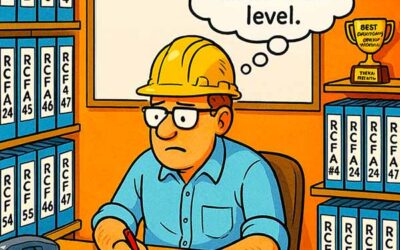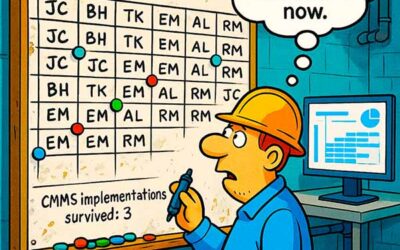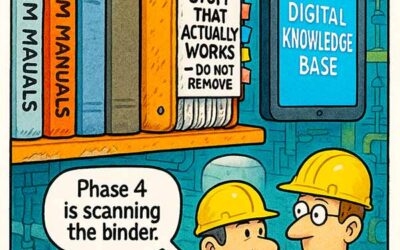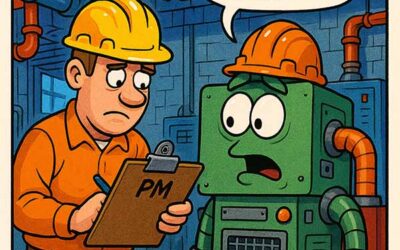
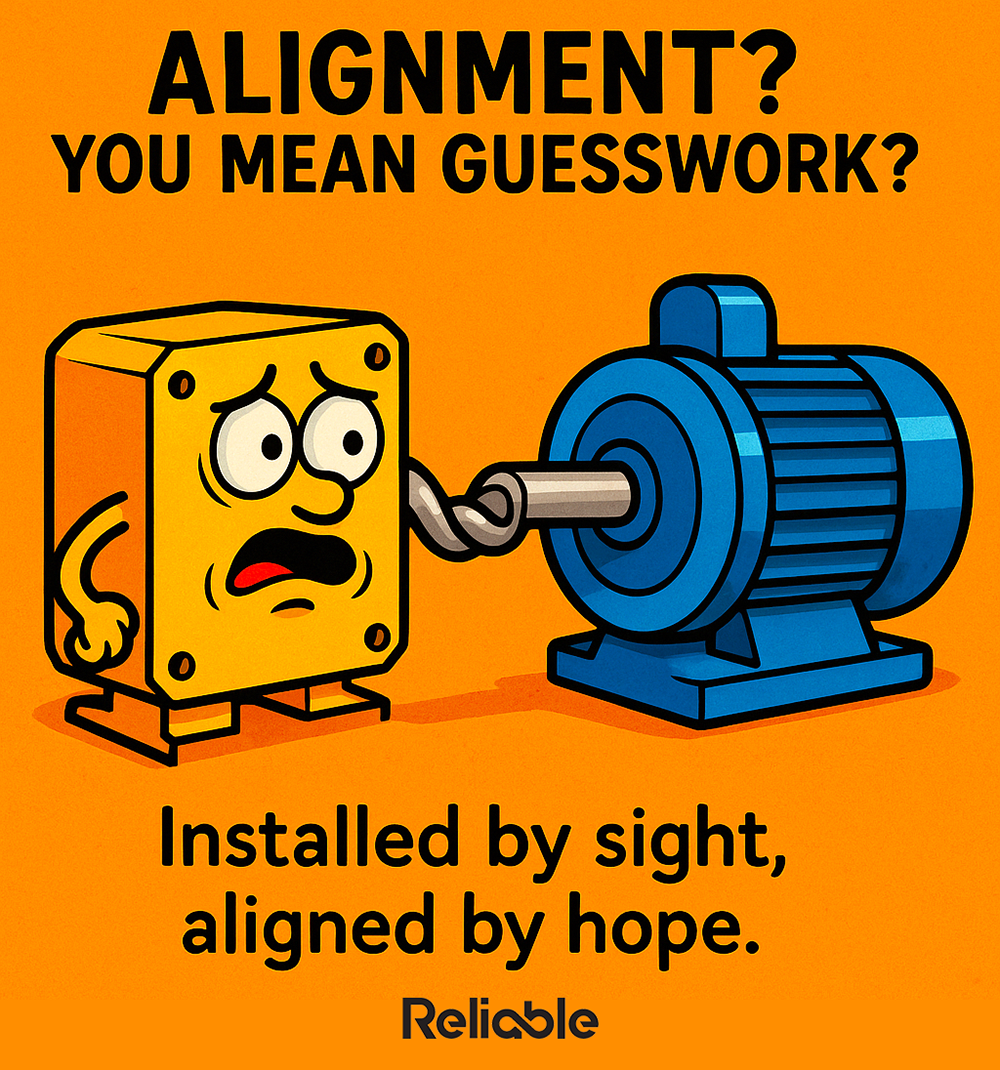

The cartoon is funny because it’s true. A lot of “alignment” out in the field is really just guesswork in disguise. Two flanges look like they match up? Good enough. The coupling spins without screaming? Let’s run it. And so begins the cycle of bearing failures, excessive vibration, seal damage, and lost productivity.
Shaft misalignment and equipment failure are tightly coupled—pun intended. Even slight misalignment can set off a chain of destructive forces inside rotating machinery. And when you ignore those forces, the machine returns the favor with unplanned downtime, unbudgeted costs, and relentless troubleshooting.
Misalignment is a reliability killer. And it’s one of the most preventable.
Shaft Misalignment and Equipment Failure: The Cause-and-Effect Chain
Shaft misalignment occurs when the centerlines of two connected rotating shafts are not colinear. That’s it. Seems simple—but the consequences are not. Misalignment puts uneven stress on machine components, causing:
- Premature bearing and seal wear
- Fatigue damage to shafts and couplings
- Increased vibration and noise
- Heat generation that degrades lubricants
- Inefficient energy use
- Elevated risk of catastrophic failure under load
Let’s say you’ve got a pump and motor that were aligned by eye. They run. Everything sounds okay—for a while. Then a bearing goes out. You swap it. Then the seal starts leaking. Then the coupling fails. You’re stuck in a reactive maintenance loop—and the root cause is still sitting there, uncorrected.
Precision alignment should not be optional. It is a strategic investment in equipment lifespan, energy efficiency, and uptime. Misalignment isn’t always dramatic. Often, it’s subtle. But it eats reliability from the inside out.
Why Eyeball Engineering Still Dominates (and Why It Fails)
Despite decades of awareness, too many alignments are still done the old-fashioned way—by sight, with a straight edge, or by “feel.” Why?
- Time pressure
- Lack of training
- Underappreciation of the impact
- Absence of tools or budget
- Misplaced confidence in tribal knowledge
The problem is that most of these methods don’t account for the factors that really affect alignment: soft foot, thermal growth, pipe strain, base distortion, and dynamic loads. That means your “good enough” alignment is usually a few thousandths off—and that’s all it takes.
Even worse, many machines aren’t rechecked after startup. Alignment done cold may be misaligned hot. And unless the coupling fails visibly, no one suspects misalignment until they’re replacing parts for the third time.
Remember: shaft misalignment and equipment failure aren’t coincidental—they’re cause and effect. Fix the root. Eliminate the guesswork.
Precision Tools Make Precision Alignment Accessible
You don’t need to spend $25k to get alignment right. Today’s entry-level laser alignment tools are:
- Affordable
- Easy to train
- Digitally precise
- Documentable
- Fast
They allow even junior technicians to complete accurate alignments quickly and consistently. Some modern systems include visual guidance, automatic report generation, and Bluetooth connectivity to your CMMS. The ROI is immediate—just do the math on avoided repairs and downtime.
Bonus: Many laser alignment systems now support vertical machines, cardan shafts, and thermal growth compensation. That means fewer excuses for not using them. If you’re still aligning by hope, it’s not a cost issue. It’s a culture issue.
Building Alignment Into Your Reliability Strategy
Fixing misalignment isn’t a one-time action—it’s a reliability discipline. Best-in-class plants treat alignment as a critical process, not a task. That means:
- Making it part of every install, rebuild, and PM
- Tracking alignment conditions historically
- Re-aligning post-foundation or piping work
- Validating alignment at operating temperature
- Holding people accountable for doing it right
Reliability leaders also understand the connection between shaft misalignment and equipment failure. They know poor alignment drives up energy use, maintenance labor, and unplanned downtime. So they attack it like a business issue—not just a mechanical one.
Some plants even track alignment-induced failures and tie them to KPIs. If your pump has three bearing failures in 18 months, you don’t just replace the bearings again—you ask why. Alignment is often the answer.
Conclusion: Hope Is Not a Strategy
The cartoon says it perfectly: “Installed by sight, aligned by hope.” Funny on the wall. Costly in real life.
If you want fewer breakdowns, longer mean time between failures, and less firefighting, start where the power enters your system—at the shaft. Get alignment right, and everything downstream gets easier. Ignore it, and your machines will keep teaching you the same painful lessons.
Shaft misalignment and equipment failure are connected. Break the cycle. Ditch the guesswork. Invest in precision alignment—and make hope obsolete.