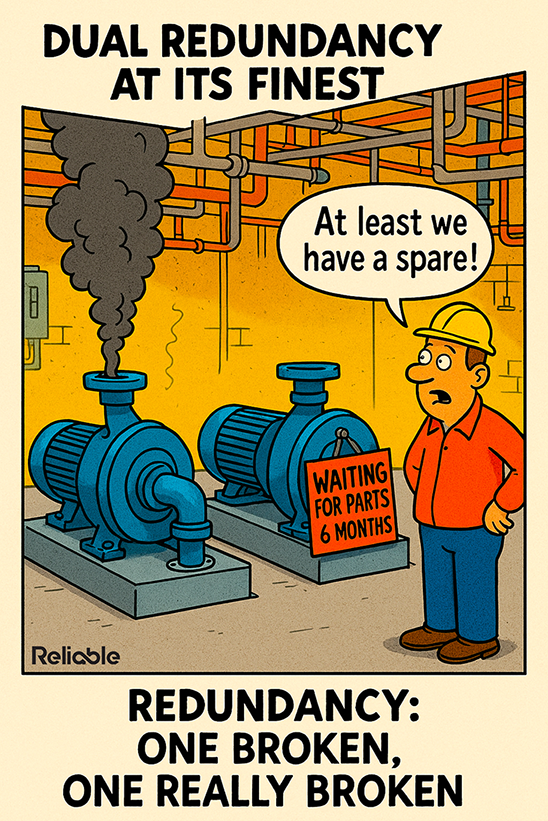

The cartoon shows a painful reality in maintenance and reliability: two pumps, one spewing smoke, the other sidelined with a sign reading “Waiting for Parts: 6 Months.” The operator, desperate for optimism, quips, “At least we have a spare!” But redundancy without spare parts isn’t redundancy at all.
It’s a ticking time bomb called dual redundancy failure, a problem that quietly drains millions in lost uptime and frustrated stakeholders every year.
Plants and facilities often assume redundancy is the silver bullet for reliability. Yet without parts, processes, and proactive planning, redundant systems offer only a false sense of security. Let’s explore why dual redundancy failure happens, why it’s so dangerous, and how to protect your plant against it.
The Illusion of Redundancy
On paper, dual redundancy looks foolproof: two identical assets capable of carrying the same load. If one fails, the other steps in seamlessly. In practice, things rarely unfold as smoothly.
Here’s the trap: one pump fails, the backup takes over, and management assumes the crisis is avoided. But because there’s now “a spare in service,” urgency to repair the broken unit fades. Work orders sit idle, parts are ordered on slow lead times, and maintenance teams prioritize other emergencies. Before long, the backup is under continuous strain and eventually fails, leaving both units out of service.
This is the essence of dual redundancy failure: the backup is treated as a safety net rather than a critical asset that requires equal care and proactive maintenance. Instead of buying time, redundancy becomes a setup for catastrophic downtime.
Spare Parts Strategy: The Weak Link in Reliability
A redundancy system is only as good as the parts that keep it running. Consider the cartoon’s six-month lead time. That isn’t redundancy; it’s an operational nightmare.
The weak link is often the spare parts strategy. Organizations cut costs by minimizing on-site inventories, assuming suppliers will deliver quickly. But global supply chains, geopolitical disruptions, or even routine vendor backlogs can stretch delivery times beyond tolerance when the needed seal, impeller, or motor isn’t in stock, and downtime balloons.
This highlights why dual redundancy failure is more about logistics than equipment. Without a smart spares strategy based on asset criticality, having a second pump on the floor is meaningless. Reliability leaders perform criticality analyses, identify must-have parts, and carry them on-site, even if that means higher inventory carrying costs. The cost of downtime dwarfs the cost of carrying parts.
Engineering Out Dual Redundancy Failure
Preventing redundancy disasters requires more than doubling the equipment. It requires building resilience into the entire system. That means treating redundancy as a component of reliability, not a substitute for it. Here’s how to start:
- Condition Monitoring: Use vibration, oil analysis, ultrasound, and thermography to detect early signs of wear. Monitoring both the primary and redundant units ensures that failures are caught before they escalate.
- Failure Mode Analysis: Run FMEAs to anticipate how assets will fail. If both pumps share the same vulnerability, like seal wear, then dual redundancy won’t prevent simultaneous failures.
- Critical Spares Management: Keep essential spares on-site for critical redundant systems. Stock the parts with the longest lead times and highest impact.
- Maintenance Discipline: Don’t delay repairs because “the spare is running.” Schedule and complete corrective work quickly to avoid overloading the redundant unit.
- System-Level Thinking: Remember that redundancy doesn’t exist in a vacuum. Pumps, motors, bearings, and drives all interact with each other. True reliability requires holistic strategies.
When reliability teams embed these practices, redundancy stops being a crutch and starts being a cornerstone of uptime.
True Reliability Means More Than Two Machines
It’s tempting to equate more equipment with more reliability. But true reliability isn’t about how many pumps you have, it’s about whether at least one is always ready to run. That requires disciplined maintenance, resilient supply chains, and organizational awareness of the hidden risks behind redundancy.
The cartoon’s punchline, “One broken, one really broken,” is funny because it’s true. But behind the humor lies a sobering message: dual redundancy failure is avoidable, but only when plants treat redundancy as a system supported by planning, spares, and proactive action.
Reliability isn’t built on hope, and it isn’t built solely on backups. It’s built on processes that ensure equipment is available when it’s needed most. If you’re relying on dual redundancy without spare parts and strategy, you’re not building resilience, you’re building downtime.