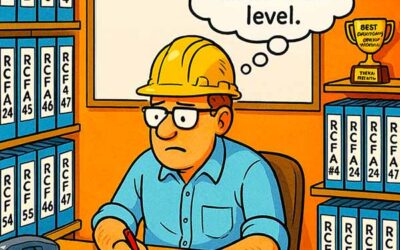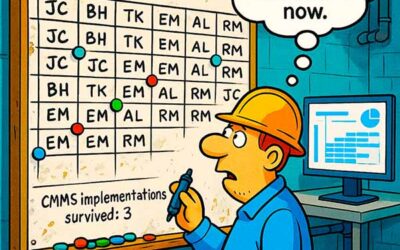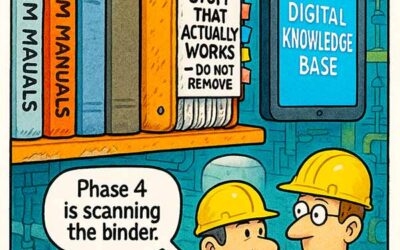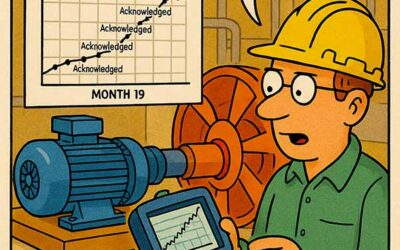


Walk into nearly any plant and you’ll find the term overall equipment effectiveness (OEE) on dashboards, in reports, and discussed in meetings. Yet ask ten people what OEE means, and you’ll likely get ten different answers. Some see it as a holy grail, others dismiss it as “just another confusing number.” The cartoon nails it – calculating OEE can feel like solving quantum physics.
But here’s the truth: OEE doesn’t have to be complicated. When properly applied, it is one of the most effective tools for identifying and eliminating waste in manufacturing. The challenge is not in the math, but in the mindset. We need to shift from treating OEE as a scorecard to using it as a roadmap for improvement.
Why Overall Equipment Effectiveness Matters
At its core, OEE answers a simple question: How effectively are we using this piece of equipment compared to its full potential?
The formula is well known:
OEE = Availability × Performance × Quality
- Availability: The percentage of scheduled time the equipment is actually running. Downtime, whether planned or unplanned, erodes this number.
- Performance: The speed at which the equipment runs compared to its design rate. Slow cycles, micro-stops, or reduced speeds drag performance down.
- Quality: The percentage of good units produced compared to total units. Scrap, rework, and startup losses cut into quality.
By multiplying these three factors, we arrive at a single percentage. A plant producing only good parts, as fast as possible, with no downtime, scores 100% OEE, a theoretical maximum. In reality, most operations land between 40% and 70%. World-class operations aim for 85%.
Why does this matter? Because OEE doesn’t just tell you how well you’re running; it exposes where you’re losing money. If availability is low, your assets sit idle. If performance lags, you’re leaving throughput on the table. If quality suffers, you’re bleeding costs through scrap. Each percentage point lost translates directly into dollars.
Common Pitfalls in OEE Measurement
If OEE is so valuable, why do so many plants struggle with it? The pitfalls are predictable:
- Overcomplication – Too many leaders try to make OEE overly scientific, piling on layers of formulas and sub-metrics. What begins as a simple diagnostic tool morphs into a math exercise no one on the shop floor understands. Complexity creates disengagement.
- Focusing Only on the Final Number – OEE is not a grade, it’s a guide. Chasing a high OEE percentage without understanding the underlying losses misses the point. For example, two assets may both show a 60% OEE, but one loses mostly due to downtime, while the other suffers from poor quality. The improvement strategies will be entirely different.
- Inconsistent or Unreliable Data – Bad data leads to bad conclusions. If downtime isn’t tracked consistently, or operators fudge cycle times, your OEE numbers become meaningless. Garbage in, garbage out.
- Weaponizing OEE – When OEE becomes a “gotcha” metric wielded by management against operators, it quickly loses credibility. The intent must be collaborative; OEE should be a mirror, not a hammer.
These pitfalls explain why many teams echo the cartoon’s sentiment: “OEE is confusing … or is it just me?”
Simplifying Overall Equipment Effectiveness in Practice
To unlock OEE’s value, you must simplify it. The phrase “simplifying overall equipment effectiveness” isn’t just SEO bait—it’s the essential step.
Here’s how to bring clarity:
- Focus on the Three Drivers First – Stick with availability, performance, and quality. Don’t overwhelm the team with advanced loss categorizations until the basics are understood and actionable.
- Translate Numbers into Stories – Instead of reporting “OEE was 58% this week,” tell the story: “We lost 18 hours to unplanned downtime, produced 2,000 fewer units due to slow cycles, and scrapped 1,200 parts.” Stories drive improvement; numbers alone don’t.
- Visualize the Losses – Pareto charts, downtime dashboards, and loss waterfalls make OEE tangible. A visual showing that 60% of lost time is attributed to changeovers is far more compelling than a spreadsheet full of ratios.
- Tie OEE to Root Cause Analysis – When performance dips, don’t stop at “the machine ran slow.” Ask why. Was it lubrication? Operator training? A failing sensor? Use OEE as the trigger for deeper reliability work.
- Benchmark Against Yourself First – It’s tempting to compare your OEE to industry “world-class” numbers, but every plant is different. Focus first on moving your own score upward by targeting your most significant losses.
Simplifying OEE means shifting focus from calculation to communication.
Turning OEE Insights into Business Results
The reason OEE matters isn’t academic—it’s financial. Simplifying overall equipment effectiveness exposes hidden capacity and cost savings:
- Increased Capacity Without CAPEX
Improving OEE by just 5% on a bottleneck line can free up production equivalent to millions of dollars in new equipment, without incurring any capital expenditures. - Lower Operating Costs
Eliminating downtime reduces overtime, contractor reliance, and firefighting expenses. Improved quality slashes scrap and rework, directly boosting margins. - Customer Impact
Better OEE means fewer late shipments, higher consistency, and improved customer satisfaction —factors that drive repeat business and a positive market reputation.
OEE isn’t just an engineering metric, it’s a business lever. Leaders who grasp this stop chasing numbers and start chasing value.
Final Thoughts: Clarity Over Complexity
OEE can often appear intimidating when reduced to formulas on a chalkboard. But the secret lies in simplifying overall equipment effectiveness into three clear questions:
- How often was the machine running?
- How fast did it run?
- How many good parts came out?
Answer these consistently, act on the losses, and OEE transforms from a confusing calculation into a robust continuous improvement engine.
Remember: reliability is not about achieving perfect scores, it’s about relentlessly reducing waste. And OEE, when simplified, is one of the best flashlights for finding that waste.
So the next time OEE gives you a headache, step back. Focus less on the math and more on the story it tells. That’s where the real value lies.