
The capital appropriation process is not designed to move fast. It’s designed to justify large expenditures, protect budgets, and create paper trails. That’s fine for a heat exchanger replacement or a building expansion. It’s a terrible framework for safety decisions that cost less than a round of golf.
Plants spend months building the business case for a $500,000 safety upgrade while a $400 fix sits uninstalled on the unit because it didn’t make the capital threshold. The result is a documented hazard with a documented approval gap, and someone eventually gets hurt in that gap.
Facilities that consistently outperform on safety metrics tend to share one habit: they close small gaps fast, without routing every fix through a six-month approval cycle.
Why Capital Projects Often Disappoint on Safety ROI
Large-scale safety capital projects have a structural problem: they take too long to deliver value.
A $200,000 machine guarding project that takes 14 months from approval to installation doesn’t prevent the injury that happens in month four. A $600 set of anti-slip clips installed on a Tuesday does. The math isn’t complicated, but the procurement process usually is.
Facilities that consistently outperform on safety tend to share one habit: they close small gaps fast, without routing every fix through a six-month approval cycle.
Capital projects also tend to address the dramatic hazards: confined spaces, explosive atmospheres, major machinery. Walking surfaces, stairway traction, and visual hazard cues rarely make the capital list. They’re too small to justify a line item, too pervasive to fix all at once, and too easy to ignore when nothing has gone wrong yet.
Until something does.
The average OSHA-recordable slip, trip, or fall costs between $40,000 and $60,000 when you factor in medical, lost productivity, investigation, and citation risk. A serious fall from elevation? Closer to $150,000 or more.
Compare that to what it costs to actually fix the problem.
High-ROI Safety Improvements That Skip the Capital Queue
Several categories of safety improvement share a common profile: low cost, fast installation, no permits required, and a direct connection to the walking surface and fall hazards that drive the majority of OSHA recordables in manufacturing and process industries.
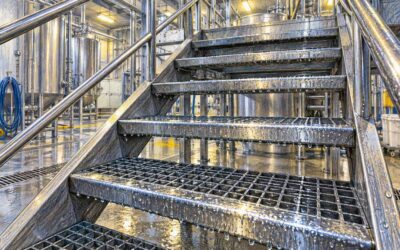
Bar grating traction is one of them. Virtually every industrial facility in North America has bar grating on stairways, mezzanines, and walkways, and the flat bearing bars get slippery fast in wet or oily conditions.

Photo courtesy Titan Safety
Clip-on anti-slip cleats, like the Titan Safety anti-slip clips, knock directly onto standard grating with no tools, no welding, and no hot work permit. A technician can cover an entire stairway in under an hour. Total material cost on a typical stair run: under $500.
A $600 fix deployed this week prevents the injury. The same fix routed through a capital approval cycle arrives twelve months too late.
Stairway lighting is another. Poor lighting contributes to roughly 30% of industrial slip-and-fall incidents, and a lot of those stairways are lit by aging fixtures that haven’t been replaced in a decade. LED retrofits for a single stairway run $500 to $2,000 installed, take a few hours, and improve visibility immediately. The energy savings are a bonus; the incident prevention is the point.
Floor marking is a third. Pedestrian lane markings fade in every facility; it’s a matter of traffic, chemical exposure, and cleaning frequency. A floor marking refresh using durable tape or epoxy coating rated for the environment costs $300 to $1,500 per work area and takes a day or less. More importantly, it forces a review of whether the current routing still makes sense given equipment changes, new traffic patterns, or forklift paths that didn’t exist during the last refresh.
None of these require engineering review, capital approval, or a project manager. They require a technician, a work order, and a willingness to act before the next incident report makes the case for you.
What the Numbers Actually Look Like
The chart below compares common low-cost safety improvements against a typical minor capital safety project. ROI estimates are based on a single avoided OSHA-recordable incident valued at $50,000 (conservative; does not include litigation or citation risk).
|
Safety Upgrade |
Typical Cost |
Payback Period |
Estimated ROI |
|
Anti-slip clips (grated walkways) |
$200–$800 |
< 1 week |
1,200%+ |
|
LED stairway lighting retrofit |
$500–$2,000 |
2–4 weeks |
800%+ |
|
Floor marking refresh |
$300–$1,500 |
2–6 weeks |
600%+ |
|
Guardrail repair/replacement |
$2,000–$10,000 |
1–3 months |
400%+ |
|
Safety signage overhaul |
$500–$3,000 |
1–2 months |
350%+ |
|
Minor capital safety project |
$25,000–$100,000+ |
6–18 months |
50–150% |
The green row isn’t an anomaly. Anti-slip clips simply have the lowest cost and fastest installation of any meaningful slip prevention solution on the market for grated surfaces. The ROI ceiling is high because the avoided incident cost stays constant regardless of what the fix costs.
Where Small Safety Spends Belong in Your Process
Stop Waiting for the Turnaround Window
One of the most common arguments against fixing small safety issues is that “we’ll get it done during the next outage.” That reasoning makes sense for jobs that actually require a shutdown: hot work, confined space entry, equipment isolation. It doesn’t make sense for fixes that require no permits and no downtime.
Anti-slip clips, floor tape, LED fixture swaps, and signage replacements don’t need a turnaround. Tying them to one just delays a fix that could be deployed this week.
Tying no-permit, no-downtime safety fixes to the next turnaround isn’t planning. It’s procrastination with a schedule.
Build a Low-Cost Safety Fix Budget
Some facilities handle this by creating a standing maintenance safety budget, separate from capital and separate from the main opex line, specifically for sub-threshold improvements. A reasonable starting point is $5,000 to $15,000 per year per operating unit, depending on size.
The intent is specific: move fast on the things that capital processes were never designed to handle.
The types of improvements that typically fit this bucket:
- Anti-slip clips and traction products for grated walkways and stairs
- Floor marking tape and epoxy refresh in pedestrian areas
- LED fixture retrofits in stairways, ladder cages, and transition zones
- Guardrail caps, mid-rail repairs, and high-visibility coatings
- Safety signage replacement and PPE requirement postings
- Ladder rung cover additions on fixed ladders
None of these items should require an engineering review, a capital request, or a project manager. They should require a work order and a technician with a free morning.
The Audit That Makes This Actionable
The problem with small safety fixes isn’t budget. It’s visibility. Most facilities don’t have a complete picture of where their walking surface hazards actually are.
A practical first step is a focused audit, separate from the general safety walk, that looks specifically at:
- Every grated stairway and walkway surface condition, graded by slip risk
- Stairway lighting levels at tread height, particularly in transitions between indoor and outdoor areas
- Guardrail integrity on all elevated platforms, especially bolted connections and base welds
- Floor marking condition in all pedestrian lanes and equipment exclusion zones
- Fixed ladder rung surfaces in outdoor and humid locations
The audit doesn’t have to be long. A two-person crew with a checklist can cover most process units in a day. The output is a prioritized list of fixes with estimated costs and expected installation time.
That list is what replaces the vague sense that “we should fix some of this stuff.” It’s a deployable work scope with a budget number attached.
The Compounding Effect
One avoided recordable incident doesn’t just protect one worker. It affects your OSHA 300 log, your EMR (Experience Modification Rate), your insurance premiums, and your ability to win contracts with clients who have safety prequalification requirements.
Plants with strong safety records built them through consistency, not through single large investments. They fix the small things before they become incidents. They don’t wait for a capital budget cycle to address a slippery stair tread.
The ROI on small safety spends is high because the cost of doing nothing is also high. It just doesn’t show up as a line item until something goes wrong.
Fix the grating. Replace the floor tape. Swap the bulb in the stairway. Unglamorous work, all of it, and exactly the kind that keeps the incident rate low and the workers on the floor doing their jobs.
And they’re almost always cheaper than one afternoon in the emergency room.