

The Paradox of Advanced Maintenance Systems
In recent decades, many asset-intensive industries – from energy and oil & gas to mining and manufacturing – have increasingly adopted maintenance management systems such as CMMS and EAM in order to implement condition-based maintenance (CBM), predictive maintenance (PdM), and data-driven analytics.
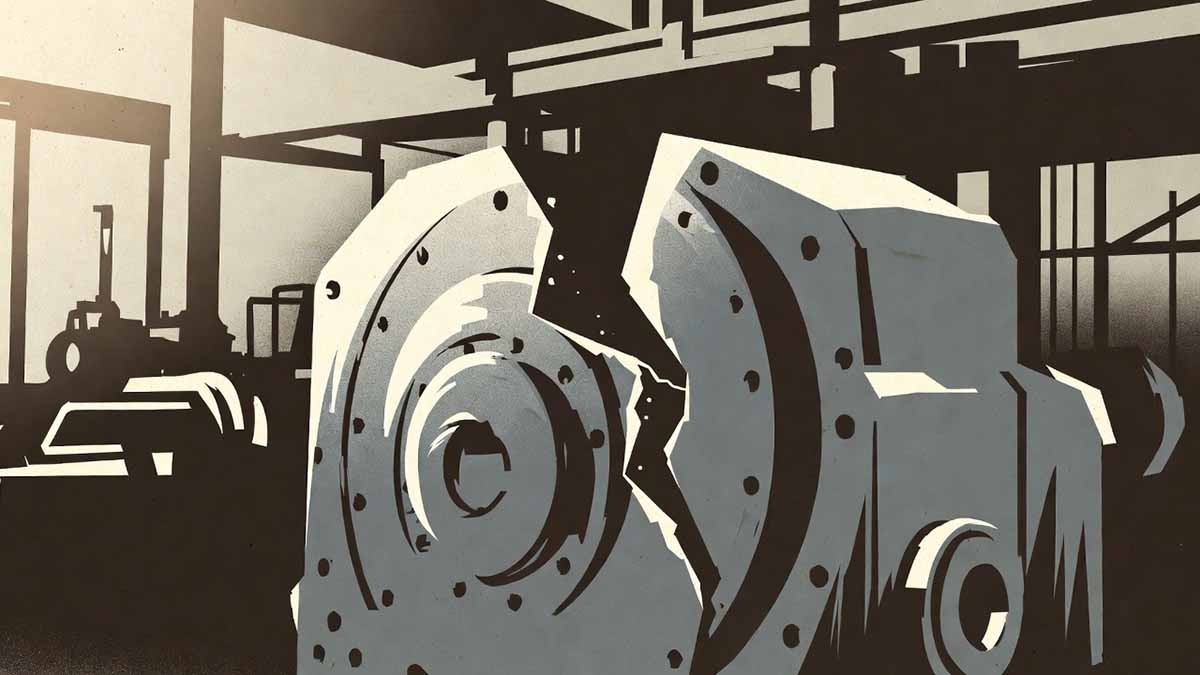
However, despite significant investments in these advanced tools, recurring failures, unexpected shutdowns, and run-to-failure patterns continue to affect operational performance and often result in unplanned production interruptions.
This article examines this paradox more closely in order to identify the root causes of these challenges and explore practical ways to address them.
It also examines why advanced maintenance systems sometimes fail to improve operational outcomes and presents a practical perspective on maintenance decision architecture.
The False Sense of Control in Modern Maintenance
Colorful dashboards, KPIs, and real-time reports often create a false sense of control in operations. Managers can instantly monitor indicators such as MTBF, MTTR, PM compliance rates, and numerous other performance metrics at a glance.
Data only creates value when it is properly analyzed and turned into decisions.
However, observing data is necessary but not sufficient. Data only creates value when it is properly analyzed and turned into decisions.
Consider a simple example. PM compliance may appear excellent, and all preventive maintenance tasks may be completed on schedule. But has anyone evaluated whether the number of defined routines is appropriate? Are the task lists actually designed to address known failure modes? Has any PM optimization (PMO) been carried out?
In many organizations, a significant gap exists between seeing the data and taking ownership of the decision. Systems generate alarms, but decisions are delayed. Reports are produced, yet structural corrective actions rarely follow.
As a result, adding more sensors, dashboards, or new AI algorithms does not necessarily lead to better decisions.
In some organizations, the problem is not a lack of data; it is the lack of a clear mechanism for decision-making and decision ownership.
This creates a false sense of control; the feeling that operations are being managed effectively, while the actual operational outcomes remain unchanged.
The Real Failure Point: Decision Architecture
If we look at decision failures in maintenance, they can generally be observed at three levels:
Operational Level
A technician or supervisor may recognize that an asset is approaching failure, yet production schedules do not allow the asset to be stopped for corrective action. This eventually leads to the build-up of maintenance backlogs, and when these backlogs grow beyond a manageable level, they can result in unplanned production interruptions.
Tactical Level
Middle management may have visibility into performance indicators, but resources are not prioritized based on actual operational risk. Every work order has its importance, and repeatedly postponing maintenance activities can progressively increase operational risk.
Strategic Level
At the strategic level, the core challenge is the lack of a clear decision architecture and defined accountability in maintenance. Organizations may invest significantly in advanced tools, but without a structured decision-making framework, these tools do not necessarily lead to effective decisions.
For example, condition monitoring systems – such as vibration analysis, temperature monitoring, or oil analysis – continuously generate data. However, the data may not be properly analyzed, or the necessary operational decisions are not made in time to prevent failures.
Across all three levels, these gaps can create progressive and often invisible costs whose combined impact may exceed the cost of a major equipment failure, including:
- Increased safety risks
- Energy losses caused by inefficient equipment performance
- Reduced asset life
- Workforce burnout and declining motivation
- The normalization of failure within the organization
You can evaluate the quality of your maintenance decision structure by answering the following questions:
- When a serious risk is identified for a critical asset, who is ultimately responsible for making the decision?
- Are operational and safety risks considered when prioritizing maintenance work orders?
- Are maintenance decisions documented and reviewed over time?
- Do systems such as CMMS support decision-making, or are they used mainly for reporting?
- Do lessons learned from failures lead to revisions in maintenance strategies?
If clear and structured answers cannot be given to these questions, organizations should review their maintenance decision structure across the three levels discussed above.
What Actually Works? A Practical Approach
What truly makes a difference is shifting the focus in maintenance management from system-centric thinking to decision-centric thinking.
In a decision-driven framework, data is not produced simply for reporting purposes; instead, it directly supports both operational and management decision-making.
Three key elements are essential for building such a structure:
1. Decision Ownership
In many organizations, it is not clearly defined who is ultimately responsible for decisions related to equipment risks.
When system alarms or condition monitoring results are generated, if there is no clearly defined owner for the decision, the data often remains only as reports.
Defining decision ownership ensures that every alarm or analytical insight is connected to a specific action.
2. Clearly Defined Levels of Responsibility
Maintenance decisions are made at different levels within the organization.
Some decisions can be addressed at the technician or supervisor level, while others require management-level decisions or even strategic decisions.
If these levels of responsibility are not clearly defined, many issues remain unaddressed across organizational layers and eventually lead to failures.
3. Maintenance Governance
Maintenance governance refers to creating a structured framework for decision-making, prioritization, and the continuous review of decisions over time.
Within such a framework:
- Decisions are documented
- Evaluation criteria are defined
- Decision results are periodically reviewed
In such a framework, tools such as CMMS, condition monitoring systems, and data-driven analytics can play their proper role—because the data they generate is directly connected to operational and management decisions.
Better Data Won’t Fix a Broken Decision Culture
Before assigning failures to maintenance tools or assuming that these systems are fundamentally ineffective, organizations must first reassess the quality of decision-making within their operations. Maintenance systems do not fail on their own; in many cases, the real problem comes from how decisions are made and acted upon.
This insight is also important for software providers. Decision structures vary across organizations, and the way workflows support maintenance decisions cannot follow a single standard approach.
Organizations that succeed in the digital era will not necessarily be those with the largest volumes of data. They will be the organizations that are able to make the best decisions from the data available to them.
The primary challenge of modern maintenance is not a lack of technology; it is the ability to turn data into well-timed and effective decisions.