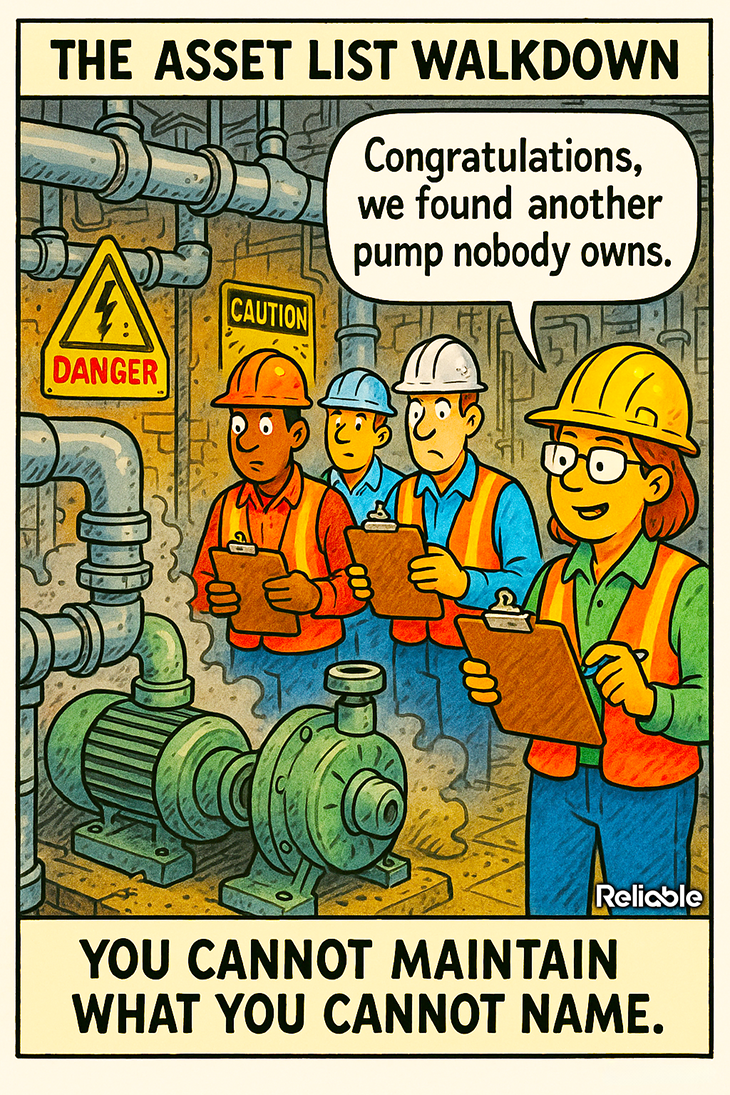

Walk any older plant long enough and you’ll find it: a pump, a valve, a small compressor that no work order has ever touched.
Nobody scheduled it. Nobody inspected it. On paper, it doesn’t exist. That blind spot is exactly why knowing how to build an asset registry matters more than most teams admit.
You can’t maintain equipment you’ve never named. A complete, accurate asset registry is the foundation many reliability efforts depend on, and a surprising number of plants are building on incomplete records.
The fix is unglamorous and usually within reach. It takes a walkdown, a naming convention, and the discipline to keep the list current. Many plants can stand up a usable registry in a few months of focused effort, depending on site size and data quality.
Why Knowing How to Build an Asset Registry Comes First
Many maintenance decisions trace back to the registry.
Your preventive schedule, your spare parts list, your failure history, your budget: much of it keys off a list of assets. If that list is incomplete, downstream records can become incomplete, duplicated, or misleading.
Missing assets also distort risk. A critical pump that never made the list gets no inspections and no spares, so when it fails, the plant discovers its importance the expensive way.
An asset that no one owns gets no inspections, no spares, and no warning, right up until the morning it stops the line.
Auditors and insurers care too. When a regulator asks for the maintenance history on a pressure vessel, a registry gap turns a routine request into a scramble. The list is the spine of many maintenance, inspection, and compliance records you keep.
Gaps in the registry are one of the clearest signs of an immature maintenance program, and they hide in plain sight until a walkdown drags them into the light.
How to Build an Asset Registry Step by Step
The work is methodical, and it rewards patience.
Decide what counts as an asset
Before anyone walks the floor, agree on where the list stops.
A registry can drown in detail if every bolt becomes a line item. Draw the line at the maintainable unit: the things you inspect, repair, replace, or track as a whole. A pump and its motor may each earn a line; their individual fasteners usually stay off the list.
Start with a physical walkdown
Documents drift out of date. Drawings can go stale soon after they’re approved, and the most reliable source is the equipment itself.
Send people into the field to physically find and tag maintainable assets. Pumps, motors, valves, instruments, tanks. If it can fail and affect production, safety, compliance, or cost, it belongs on the list at the right hierarchy level.
Go system by system so nothing gets skipped. Tag each asset in the field with a durable label, photograph the nameplate, and capture the data on the spot. A second pass to fill gaps always beats trusting memory back at a desk.
Capture at minimum for each asset:
- A unique ID and a clear, consistent name.
- Location, parent system, and what it connects to.
- Make, model, serial number, and key nameplate data.
- Criticality, based on safety, production impact, and replacement cost.
Build a hierarchy that mirrors the plant
A flat list of 4,000 tags is just a spreadsheet that happens to be long.
Structure it the way the plant actually runs: site, then area, then system, then equipment, then component. That hierarchy lets you roll costs up and drill failures down.
A good asset hierarchy answers two questions at once: where do this machine’s costs roll up, and what larger system is it part of?
Consistent naming carries the whole thing. Pick a convention, write it down, and enforce it, because a registry full of clever one-off names becomes unusable the moment its author leaves.
Lean on a recognized standard if you can. Frameworks like ISO 14224 can help standardize equipment classes, failure data, and reliability records, which saves reinventing the wheel and makes later analysis cleaner.
Set criticality before you set schedules
Not every asset deserves the same level of attention, and pretending otherwise wastes the budget.
Rank each asset by what its failure would cost in safety, downtime, and repair. That ranking decides where preventive work and asset condition monitoring go first, so your limited hours land on the equipment that matters most.
Keep the scale simple. Three or four tiers cover many plants, and a clean high-medium-low often beats a complex matrix nobody updates. Revisit the ranking when a process changes, production impact changes, or an asset surprises you.
Keep the Registry Alive
A registry built once and forgotten rots fast.
New equipment arrives. Lines get rerouted. Pumps get swapped. Without a rule that installations, removals, and major changes trigger a registry update, the list can drift back toward fiction within a year or two.
Keep it accurate with a few habits:
- Tie registry updates to your management-of-change process.
- Audit a slice of the registry against the field on a defined cadence, quarterly for critical areas where practical.
- Make the registry the single source of truth, so no rival spreadsheets grow in the dark.
Assign an owner. Someone, by name, has to be accountable for the registry’s accuracy, or it becomes everyone’s job and therefore no one’s. That owner reviews changes, runs the audits, and settles naming disputes.
Treat the registry as living infrastructure and it improves the return on every reliability dollar you spend after it. Knowing how to build an asset registry, and keep it honest, is the unglamorous groundwork that makes the rest of the program more dependable.
Done right, a clean registry can pay dividends for years. Every new technician inherits a map instead of a mystery, and every reliability initiative you launch has solid ground to stand on.
Name the equipment. Own it. Then you can finally maintain it.