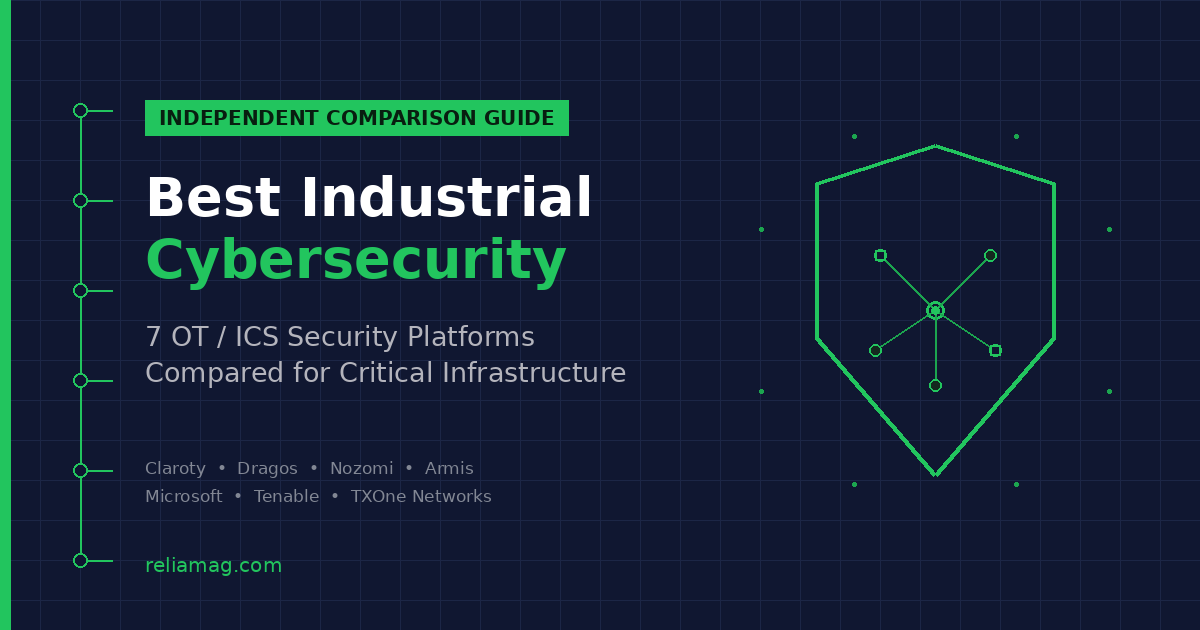

TL;DR: Industrial cybersecurity platforms – also called OT security, ICS security, or cyber-physical systems (CPS) protection platforms – protect the industrial control systems that operate physical processes: SCADA, DCS, PLCs, and related equipment. The category matured significantly when Gartner published its first Magic Quadrant for CPS Protection Platforms in February 2025, naming Claroty, Dragos, Microsoft, Armis, and Nozomi Networks as Leaders. The seven platforms covered here – Claroty, Dragos, Nozomi Networks, Armis, Microsoft Defender for IoT, Tenable OT Security, and TXOne Networks – represent the current operational state of the category.
Three regulatory drivers create genuine procurement urgency: NERC CIP for the electric sector (including the new CIP-015 internal network security monitoring requirement), the ISA/IEC 62443 international standards for industrial control system security, and TSA security directives for pipelines and rail.
The category divides into capability layers – visibility and detection, protection and enforcement, vulnerability management, asset intelligence – and most critical infrastructure operators deploy two or three platforms rather than relying on a single vendor. OT security is not IT security extended into the plant; it is a distinct discipline with different priorities, constraints, and consequences.
How We Evaluated
This guide is independent editorial analysis based on publicly available product documentation, the Gartner Magic Quadrant and Critical Capabilities reports for CPS Protection Platforms, verified customer references across Gartner Peer Insights and other review platforms, and conversations with OT security practitioners, plant engineers, and critical infrastructure operators across electric utilities, oil and gas, water, manufacturing, and transportation. Reliable Magazine does not sell OT security software and has no commercial interest in routing buyers toward any particular platform. Reliable does not accept payment for rankings. Read our editorial policy.
Industrial cybersecurity is genuinely under-covered by independent editorial media. The category is well-served by analyst firms (Gartner, Forrester, Verdantix) and by vendor-published content, but independent comparison content written for the operations and reliability audience – plant engineers, facility managers, reliability professionals who increasingly sit adjacent to OT security decisions – is thin. What Reliable Magazine adds is the operations lens: how OT security platforms interact with the asset management, maintenance, and reliability systems already running in industrial facilities, and how the regulatory drivers map to operational reality.
Why OT Security Is a Distinct Discipline
The single most important concept for anyone evaluating industrial cybersecurity platforms: OT security is not IT security extended into the plant. The two disciplines have different priorities, different constraints, and different consequences, and platforms built for one handle the other poorly.
Inverted priorities. IT security traditionally prioritizes the CIA triad in order – confidentiality, then integrity, then availability. OT security inverts this. Availability and safety come first because an OT system failure is not a data breach – it is a physical event. A compromised or crashed control system can cause equipment damage, environmental release, grid instability, or threats to human safety. The security tooling that protects OT must respect that an outage is itself a serious consequence.
Extended equipment lifecycles. OT environments run equipment with operational lifecycles of 15 to 30 years or more, compared to typical IT lifecycles of 3 to 7 years. A control system installed in 2005 may still be running in 2030. This means OT environments contain large populations of legacy equipment that cannot be patched, cannot run modern endpoint agents, and were designed before cybersecurity was an operational consideration.
Patching constraints. OT uptime requirements often preclude routine patching. A continuous process plant or a transmission operator cannot take systems offline on a monthly patch cycle. Patches are frequently deployed only during planned maintenance windows that may occur every 12 to 24 months, which means OT systems run with known vulnerabilities for extended periods as a matter of operational necessity rather than negligence.
Proprietary protocols. OT systems communicate using industrial protocols – Modbus, DNP3, IEC 61850, Profinet, EtherNet/IP, OPC, and many others – that traditional IT security tools do not understand. Detecting a malicious command in industrial protocol traffic requires deep protocol inspection capability that general-purpose network security tools lack.
Fragile devices. Active scanning that is routine in IT security can crash fragile OT devices. A vulnerability scanner probing a PLC can cause the PLC to fault, which in a production environment is a process upset. This is why OT security platforms emphasize passive network monitoring and carefully controlled, OT-aware active discovery rather than the aggressive scanning normal in IT.
The Purdue Model – the reference architecture that organized industrial networks into hierarchical levels with the control systems isolated at the bottom – was the traditional foundation of OT security. That foundation has eroded. Industrial environments are increasingly connected to enterprise networks, cloud services, and remote access paths. A 2024 SANS survey found that only a small minority of organizations maintain fully isolated OT systems. The result is that OT environments now need active security monitoring and defense rather than relying on isolation, and that is the operational problem the platforms in this guide address.
The Regulatory Drivers Creating Urgency
Three regulatory frameworks create genuine procurement urgency for OT security platforms in 2026.
NERC CIP for the electric sector. The North American Electric Reliability Corporation Critical Infrastructure Protection standards impose mandatory cybersecurity requirements on entities operating the Bulk Electric System. The newer CIP-015 standard specifically requires Internal Network Security Monitoring (INSM) – east-west traffic monitoring inside Electronic Security Perimeters – for high-impact and medium-impact BES Cyber Systems with External Routable Connectivity, with phased compliance deadlines through 2030. CIP-015 effectively requires the network monitoring capability that OT security platforms provide. Electric utilities subject to NERC CIP are a major buyer segment for OT security platforms specifically because of this regulatory requirement. Our NERC CIP compliance guide covers the full standard set in detail.
ISA/IEC 62443 for industrial control systems generally. The IEC 62443 series (developed jointly with the International Society of Automation, hence ISA/IEC 62443) is the international standard for industrial automation and control systems security. Unlike NERC CIP, IEC 62443 is voluntary and applies across all industrial sectors rather than just electric utilities. The standard introduces the zones and conduits model for network segmentation, security levels (SL 1 through SL 4) defining the strength of required protections, and maturity levels for security programs. IEC 62443 is increasingly referenced in procurement requirements, insurance underwriting, and emerging regulations worldwide, and most OT security platforms map their capabilities to its framework.
TSA security directives for pipelines and rail. Following the May 2021 Colonial Pipeline ransomware attack, the U.S. Transportation Security Administration issued mandatory cybersecurity directives for critical pipeline operators, later extended to freight rail, passenger rail, and rail transit. The directives have been renewed and revised annually – the most recent pipeline directive in the series was issued in January 2026. They require covered operators to report cybersecurity incidents to CISA, designate a cybersecurity coordinator, conduct vulnerability assessments, implement a TSA-approved Cybersecurity Implementation Plan, and maintain a Cybersecurity Incident Response Plan. TSA published a proposed rule in November 2024 to permanently codify cyber risk management program requirements. Pipeline and rail operators are a growing buyer segment for OT security platforms driven by these directives.
Beyond these three, additional drivers include the EU NIS2 Directive, sector-specific requirements in water and chemicals, cyber insurance underwriting requirements, and the general escalation of ransomware and nation-state threats against industrial targets. The regulatory environment is moving toward mandatory OT security across critical infrastructure sectors, and that trajectory is the structural reason the OT security market is growing rapidly.
7 Best Industrial Cybersecurity Platforms for 2026, Ranked by Use Case
1. Claroty – Best for Breadth Across Cyber-Physical Systems
Claroty is the most broadly capable platform in the category and was positioned highest in Gartner’s first Magic Quadrant for CPS Protection Platforms (published February 2025) for both Ability to Execute and Completeness of Vision. The Claroty Platform spans four capability areas – exposure management, network protection, secure access, and threat detection – and is deployable via Claroty xDome (cloud-based) or Claroty CTD (Continuous Threat Detection, on-premises), giving operations flexibility on deployment architecture.
Claroty’s asset discovery is among the deepest in the category, identifying assets down to firmware version and component level using multiple methods – passive monitoring, the company’s Safe Queries active discovery technology, and project file analysis. The platform’s coverage extends across IT, OT, IoT, and IIoT devices with automatic classification and risk scoring. Claroty has expanded beyond traditional industrial OT into broader cyber-physical systems including healthcare (where the company’s Medigate acquisition added medical device security) and commercial building systems, which is the basis of its “CPS protection platform” positioning rather than “OT security” alone.
Claroty’s threat research team, Team82, provides the threat intelligence and vulnerability research that informs the platform’s detection capabilities. For NERC CIP, IEC 62443, and TSA directive compliance, Claroty publishes capability mapping and provides the asset inventory, network monitoring, and INSM capability that the regulatory frameworks require.
Claroty is an independent private company headquartered in New York, founded in 2014. Rockwell Automation, Schneider Electric, and Siemens were early-stage strategic investors, which gives Claroty unusually strong relationships with the major industrial automation vendors, but the company is not owned by any of them. Claroty raised a Series F round in January 2026 and has been positioning for a potential public offering.
The trade-off is that Claroty’s response model is inherently visibility-and-detection-led. The platform produces rich telemetry and prioritized risk insight, but enforcement and containment generally depend on integration with external SIEM, SOAR, and network security systems rather than autonomous action by Claroty itself. Operations needing active enforcement deploy Claroty alongside a protection-and-enforcement layer.
Best for: Critical infrastructure and large industrial operators needing the broadest capability across cyber-physical systems, deep asset discovery, and flexible cloud or on-premises deployment. Strong fit for operations with mixed industrial automation infrastructure given Claroty’s vendor relationships.
Pricing: Custom enterprise pricing. Contact Claroty for quotes.
Deployment: Cloud (Claroty xDome) or on-premises (Claroty CTD).
Key differentiator: Broadest cyber-physical systems capability in the category, with the highest Gartner Magic Quadrant positioning for both execution and vision.
2. Dragos – Best for OT Threat Intelligence and Industrial Incident Response
Dragos occupies a distinct position in the category built on a threat-intelligence-first philosophy. The company was founded by former U.S. government industrial control system incident responders – people who worked OT security at the National Security Agency and U.S. Cyber Command – and that heritage shapes the entire platform. Dragos’s positioning is “built by defenders, for defenders,” and the company’s deepest differentiator is its industrial threat intelligence.
Dragos tracks named industrial threat groups – adversary clusters specifically targeting OT environments – and continuously updates the platform with intelligence from its threat research team. Where other platforms generate alerts from anomaly detection, Dragos emphasizes contextualized alerts tied to known industrial adversary behavior, paired with practitioner-authored response playbooks that tell defenders not just that something is wrong but what it likely is and how to respond. For critical infrastructure operators building threat-intelligence-driven security programs, this is the platform’s core value.
Dragos has historically relied on passive network monitoring, and the company has expanded its asset discovery to include active querying for more detailed device information and a lightweight collector to extend visibility into remote or constrained environments. The Network Perception acquisition added network architecture and segmentation analysis capability. Dragos also has a strong managed services and incident response practice, which matters for operations without large internal OT security teams.
Dragos is widely deployed across electric utilities, oil and gas, and other critical infrastructure, and is particularly well-regarded in the public sector and utility segment. For NERC CIP, the platform provides asset inventory, INSM, and the threat detection capability the standards require.
The trade-off, as with the other visibility-led platforms, is that Dragos is not designed for real-time autonomous enforcement. Containment depends on human-led incident response and integration with enforcement systems. This is consistent with Dragos’s philosophy – the platform is built to support skilled defenders rather than to replace them – but operations expecting automated containment should understand the model.
Best for: Critical infrastructure operators building mature, threat-intelligence-driven security programs, particularly electric utilities, oil and gas, and public sector operations. Strong fit for operations that value industrial threat intelligence and managed incident response.
Pricing: Custom enterprise pricing. Contact Dragos for quotes.
Deployment: On-premises and cloud.
Key differentiator: Deepest industrial threat intelligence in the category, with practitioner-authored response playbooks and a heritage in government ICS incident response.
3. Nozomi Networks – Best for Large-Scale OT and IoT Visibility
Nozomi Networks is a Magic Quadrant Leader known for large-scale OT and IoT visibility with strong AI-driven analytics. The platform’s foundation is the Guardian sensor line, deployed throughout industrial networks to provide both passive monitoring and Smart Polling, the company’s active querying technology, building a comprehensive asset inventory and detecting anomalous behavior.
Nozomi has invested in capability breadth around the core Guardian platform. Guardian Air adds wireless spectrum monitoring to detect devices communicating over wireless protocols – a capability that addresses a genuine blind spot in industrial environments where wireless instrumentation and devices proliferate. Vantage provides cloud-based aggregation and analytics across distributed deployments, which matters for operations running OT monitoring across many sites. The Nozomi Asset Intelligence service enhances device classification accuracy and vulnerability information.
The platform’s strength is scale. Nozomi is frequently selected by large, distributed industrial operations – multi-site utilities, large manufacturers, distributed energy and transportation operators – where the requirement is consistent OT and IoT visibility across many facilities aggregated into a unified view. The AI-driven analytics for anomaly detection and the breadth of distributed telemetry are the platform’s distinguishing capabilities at that scale.
For regulatory compliance, Nozomi publishes NERC CIP mapping and provides INSM capability, IEC 62443 alignment, and the asset inventory and monitoring capability that TSA directives require. The platform integrates with SIEM and SOC workflows for response.
The trade-off is that Nozomi, like Claroty and Dragos, is a visibility-and-detection platform rather than an enforcement platform. The competitive distinction among the three visibility leaders is genuine but situational – Claroty for breadth across cyber-physical systems, Dragos for threat intelligence depth, Nozomi for large-scale distributed visibility – and many operations evaluate all three before selecting.
Best for: Large, distributed industrial operations needing consistent OT and IoT visibility across many sites with AI-driven anomaly detection. Strong fit for multi-site utilities, large manufacturers, and distributed energy and transportation operators.
Pricing: Custom enterprise pricing. Contact Nozomi Networks for quotes.
Deployment: On-premises (Guardian sensors) with cloud aggregation (Vantage).
Key differentiator: Strongest large-scale distributed OT and IoT visibility, with wireless spectrum monitoring and AI-driven analytics across the Guardian sensor line.
4. Armis – Best for Agentless Asset Intelligence Across Converged IT, OT, and IoT
Armis approaches industrial cybersecurity from an asset intelligence foundation rather than an OT-pure-play heritage. Armis Centrix is a cyber exposure management platform designed for environments where IT, OT, and IoT have converged – and the company’s agentless approach is its defining characteristic. Rather than deploying agents on devices (impossible on most OT equipment) or relying solely on network sensors, Armis builds asset intelligence by aggregating and correlating data from many sources, which allows it to see and classify a very broad range of device types.
This breadth is the platform’s distinguishing strength. Operations that need unified visibility across the full asset estate – corporate IT, OT control systems, IoT devices, building systems, and increasingly medical or specialized equipment – find Armis well-positioned because it was built for the converged environment rather than for OT in isolation. Gartner positioned Armis as a Magic Quadrant Leader, scoring it strongly on Completeness of Vision.
Armis Centrix provides risk assessment, anomaly detection, behavioral analysis, and policy enforcement support, and integrates with existing security architectures to support compliance and real-time security management. For organizations whose security operations span IT and OT under a unified team – an increasingly common organizational model – Armis fits the operating structure well.
The trade-off is depth versus breadth. Armis’s converged IT-OT-IoT breadth is genuine, but operations whose dominant concern is deep OT-specific threat detection, industrial protocol inspection, or industrial threat intelligence sometimes find the OT-pure-play platforms (Claroty, Dragos, Nozomi) deeper in the specifically industrial dimensions. The platform fit depends on whether the operation’s priority is converged breadth or OT depth.
Best for: Organizations with converged IT, OT, and IoT environments needing unified asset intelligence and exposure management across the full device estate, particularly where security operations span IT and OT under a unified team.
Pricing: Custom enterprise pricing. Contact Armis for quotes.
Deployment: Cloud-based, with on-premises options; agentless architecture.
Key differentiator: Agentless asset intelligence with the broadest converged IT, OT, and IoT device visibility in the category.
5. Microsoft Defender for IoT – Best for Microsoft-Standardized Security Operations
Microsoft Defender for IoT is a Gartner Magic Quadrant Leader for CPS Protection Platforms, and its distinguishing characteristic is integration with the broader Microsoft security ecosystem. For organizations that have standardized their security operations on Microsoft – Microsoft Sentinel as the SIEM, the Defender suite for endpoint and identity, Microsoft Entra for identity management – Defender for IoT extends that unified security operations model into OT and IoT environments.
Defender for IoT provides OT and IoT asset discovery, vulnerability identification, and threat detection using passive network monitoring. The platform originated from Microsoft’s acquisition of CyberX, an OT security specialist, and has been integrated into the Microsoft security portfolio. The capability that matters most is the native connection into Microsoft Sentinel – OT alerts flow into the same SIEM and SOC workflows as IT alerts, which for a Microsoft-standardized security organization eliminates the integration overhead of running a separate OT security platform alongside the IT security stack.
The platform supports NERC CIP, IEC 62443, and other regulatory frameworks through its asset inventory and monitoring capabilities. For organizations whose security operations center already runs on Microsoft tooling, the operational simplicity of a unified platform is the core value proposition.
The trade-off is that Defender for IoT is most compelling specifically within the Microsoft ecosystem. Organizations not standardized on Microsoft Sentinel and Defender capture less of the integration value and may find the OT-pure-play platforms deeper on OT-specific capability. The platform’s strength is ecosystem fit rather than standalone OT-specific depth, and the evaluation should weight whether the operation is genuinely Microsoft-standardized.
Best for: Organizations standardized on the Microsoft security ecosystem (Sentinel, Defender, Entra) seeking to extend unified security operations into OT and IoT without deploying a separate OT security stack.
Pricing: Licensed within the Microsoft security portfolio. Contact Microsoft for quotes.
Deployment: Cloud and on-premises, integrated with Microsoft Sentinel.
Key differentiator: Native integration with the Microsoft security ecosystem, unifying OT and IT security operations for Microsoft-standardized organizations.
6. Tenable OT Security – Best for OT Vulnerability Management and Exposure-Driven Programs
Tenable OT Security brings Tenable’s vulnerability management heritage into the OT environment. Tenable built its business on IT vulnerability management (Nessus is one of the most widely deployed vulnerability scanners in the industry), and Tenable OT Security applies an exposure-management lens to industrial environments – the platform’s distinguishing strength is OT vulnerability identification and risk-based prioritization.
Tenable OT Security provides OT asset discovery, anomaly detection, and configuration tracking, but the capability that differentiates it is vulnerability management – identifying which OT assets carry which vulnerabilities, and prioritizing remediation based on risk. The platform integrates natively into Tenable One, the company’s unified exposure management platform, which gives organizations a single view of exposure across IT and OT. For operations whose security program is organized around exposure management and vulnerability prioritization, this integration is the core value.
Tenable supports NERC CIP, with particular relevance to the CIP-010 vulnerability assessment requirements and the CIP-015 INSM monitoring requirements, and the platform publishes compliance mapping. For operations whose dominant concern is understanding and reducing their OT vulnerability exposure in a structured, prioritized way, Tenable OT Security is purpose-built for that workflow.
Gartner positioned Tenable as a niche player rather than a Leader in the CPS Protection Platforms Magic Quadrant, which reflects the platform’s more focused scope – it is strongest specifically in vulnerability and exposure management rather than across the full breadth of CPS protection. This is a positioning observation, not a quality judgment: for the vulnerability-management use case the platform serves, it is a strong choice. Operations needing broad CPS protection beyond vulnerability management typically evaluate the Leaders alongside Tenable.
Best for: Operations whose OT security program is organized around vulnerability management and exposure-driven prioritization, particularly organizations already using Tenable for IT vulnerability management and Tenable One for unified exposure management.
Pricing: Custom enterprise pricing. Contact Tenable for quotes.
Deployment: Cloud and on-premises, integrated with Tenable One.
Key differentiator: Strongest OT vulnerability management and exposure prioritization, with native integration into unified IT and OT exposure management.
7. TXOne Networks – Best for OT-Native Endpoint Protection and Network Segmentation
TXOne Networks occupies the protection-and-enforcement side of the OT security category, which makes it a useful counterpoint to the visibility-led platforms above. Where Claroty, Dragos, and Nozomi excel at seeing and detecting, TXOne focuses on protecting and enforcing – OT-native endpoint security, network segmentation, and inspection. TXOne emerged from a partnership involving Trend Micro and the industrial automation vendor Moxa, which gives the platform a heritage in both cybersecurity and industrial operations.
TXOne’s endpoint protection is purpose-built for OT constraints. The platform provides endpoint security for both legacy OT assets (including systems too old to run modern security agents, addressed through approaches like application lockdown and trust lists) and modern OT endpoints. This matters because the legacy equipment population in OT environments is a genuine security gap that visibility platforms can identify but not directly protect. TXOne’s network segmentation and inspection capabilities support the zones and conduits model central to IEC 62443.
For operations building a defense-in-depth OT security architecture, TXOne fills the enforcement layer that the visibility-led platforms depend on external systems to provide. The platform is commonly deployed alongside a visibility and detection platform rather than as a standalone solution – TXOne handles protection and segmentation while the visibility platform handles asset discovery and threat detection.
Gartner positioned TXOne as a niche player in the CPS Protection Platforms Magic Quadrant, reflecting its focused scope on the protection and enforcement layer rather than full-breadth CPS protection. As with Tenable, this is a scope observation – for the endpoint protection and segmentation use case, TXOne is purpose-built and well-regarded.
Best for: Operations building defense-in-depth OT security architectures that need an enforcement and protection layer – OT endpoint security (including for legacy equipment) and network segmentation – alongside a visibility and detection platform.
Pricing: Custom enterprise pricing. Contact TXOne Networks for quotes.
Deployment: On-premises, purpose-built for OT environments.
Key differentiator: OT-native endpoint protection (including for legacy equipment) and network segmentation, filling the enforcement layer in defense-in-depth architectures.
Side-by-Side Comparison
| Platform | Primary Strength | Capability Layer | Gartner MQ Position |
|---|---|---|---|
| Claroty | CPS breadth, asset discovery depth | Visibility & detection | Leader (highest both axes) |
| Dragos | Industrial threat intelligence, IR | Visibility & detection | Leader |
| Nozomi Networks | Large-scale distributed visibility | Visibility & detection | Leader |
| Armis | Converged IT/OT/IoT asset intelligence | Asset intelligence | Leader |
| Microsoft Defender for IoT | Microsoft ecosystem integration | Visibility & detection | Leader |
| Tenable OT Security | OT vulnerability management | Vulnerability management | Niche player |
| TXOne Networks | OT endpoint protection, segmentation | Protection & enforcement | Niche player |
Gartner Magic Quadrant positioning is from the February 2025 Magic Quadrant for CPS Protection Platforms. Microsoft, Darktrace, and Forescout were also recognized in that report; Microsoft was a Leader. Positioning reflects Gartner’s evaluation methodology and is one input among several – operations should weight it alongside their specific operational and regulatory requirements.
How to Choose
The right platform depends on the dominant operational concern and the capability layer the operation most needs to fill.
- If breadth across cyber-physical systems is the priority, Claroty offers the widest capability and the highest Gartner Magic Quadrant positioning. Strong default starting point for large critical infrastructure operators.
- If industrial threat intelligence and incident response depth is the priority, Dragos is purpose-built for threat-intelligence-driven security programs. Strong fit for electric utilities, oil and gas, and public sector.
- If large-scale distributed visibility is the priority, Nozomi Networks is built for consistent OT and IoT monitoring across many sites with AI-driven analytics.
- If converged IT, OT, and IoT asset intelligence is the priority, Armis provides the broadest agentless visibility across the full device estate.
- If the security operations center runs on Microsoft, Microsoft Defender for IoT extends unified security operations into OT without a separate stack.
- If OT vulnerability management is the priority, Tenable OT Security is purpose-built for exposure-driven programs, particularly alongside existing Tenable deployments.
- If the operation needs an enforcement and protection layer, TXOne Networks provides OT-native endpoint protection and segmentation alongside a visibility platform.
For operations subject to NERC CIP, the CIP-015 INSM requirement should be a specific evaluation criterion – validate that the platform provides east-west traffic monitoring inside the Electronic Security Perimeter and publishes NERC CIP capability mapping. For operations subject to TSA security directives, validate asset inventory, network segmentation validation, and incident detection against the directive requirements. For operations building toward IEC 62443, validate zones-and-conduits and security-level alignment.
The Honest Middle Ground
OT security platform selection is a category where vendor positioning and analyst rankings can obscure the operational reality. A few honest assessments worth flagging.
Most operations need more than one platform. The OT security category divides into capability layers – visibility and detection, protection and enforcement, vulnerability management, asset intelligence – and no single platform dominates every layer. A mature OT security architecture typically combines a visibility and detection platform (Claroty, Dragos, or Nozomi) with a protection and enforcement layer (TXOne or network-security tooling), integrated through the security operations center. Operations evaluating platforms should plan for a layered architecture rather than expecting one vendor to cover every requirement, and should budget accordingly.
The visibility leaders are genuinely close. Claroty, Dragos, and Nozomi are all Gartner Magic Quadrant Leaders and all strong platforms. The differences among them – Claroty’s CPS breadth, Dragos’s threat intelligence, Nozomi’s distributed scale – are real but situational. Operations should run all three through a proof-of-concept in their actual environment rather than selecting on analyst ranking alone. The platform that performs best on a specific operation’s actual asset mix, network architecture, and use cases is not necessarily the one ranked highest in a general-purpose Magic Quadrant.
The network-security vendors are a legitimate alternative approach. Cisco, Palo Alto Networks, and Fortinet approach OT security from the network infrastructure side – using firewalls, switches, and routers as both sensors and enforcement points. This network-led approach has a genuine advantage the OT-pure-play platforms lack: direct control over network enforcement rather than dependence on third-party infrastructure for containment. Operations whose network infrastructure is standardized on one of these vendors should evaluate the vendor’s OT security capability as a serious alternative, weighing enforcement integration against the OT-specific depth of the pure-play platforms. This guide focuses on the OT-specialist platforms because they are the under-covered category, but the network-led approach is a legitimate path.
Deployment impact on production is the most underestimated factor. Vendor demonstrations show platforms in clean environments. The operational reality is that deploying OT security monitoring requires network changes – SPAN ports, network taps, sometimes switch replacements – and careful tuning to avoid false positives and avoid any impact on fragile OT devices. Operations consistently underestimate the deployment effort. The platform that is easiest to deploy in a specific environment may matter more than marginal capability differences, and deployment impact should be a proof-of-concept evaluation criterion.
The platform does not replace the program. An OT security platform provides visibility, detection, and in some cases protection. It does not provide the security program – the governance, the trained staff, the incident response capability, the network segmentation architecture, the patch and configuration management discipline. Operations that buy a platform expecting it to deliver OT security as a product are consistently disappointed. The platform is a tool within a program, and operations without the program to use it effectively capture a fraction of the value. For operations without internal OT security staff, managed services (Dragos and others offer them) are often a more realistic path than a platform alone.
OT security and asset management overlap more than either side recognizes. OT security platforms build detailed asset inventories. So do CMMS and EAM systems. The two inventories are rarely aligned, and the operational opportunity – a single accurate asset record serving both maintenance and security – is largely unrealized. Operations deploying OT security should consider how the platform’s asset discovery aligns with the existing CMMS or EAM asset master, both to avoid maintaining two divergent inventories and because security context (which assets are vulnerable, which are critical) is genuinely useful for maintenance prioritization.
Frequently Asked Questions
What is the best OT security platform in 2026?
The best platform depends on the dominant operational concern. Claroty leads for breadth across cyber-physical systems. Dragos leads for industrial threat intelligence and incident response. Nozomi Networks leads for large-scale distributed visibility. Armis leads for converged IT/OT/IoT asset intelligence. Microsoft Defender for IoT leads for Microsoft-standardized security operations. Tenable OT Security leads for OT vulnerability management. TXOne Networks leads for OT endpoint protection and segmentation. Most operations deploy two or three platforms across capability layers.
What is OT security?
OT security (also called ICS security or industrial cybersecurity) protects the industrial control systems that operate physical processes – SCADA, DCS, PLCs, intelligent electronic devices, and related industrial equipment. It differs fundamentally from IT security because OT environments prioritize availability and safety over confidentiality, run equipment with 15 to 30+ year lifecycles, have uptime requirements that limit patching, use proprietary protocols, and face physical consequences from both attacks and security tool failures.
How is OT security different from IT security?
OT security inverts the IT priority order – availability and safety come first because an OT failure is a physical event, not just a data breach. OT environments have far longer equipment lifecycles, run proprietary industrial protocols that IT tools handle poorly, have uptime requirements that preclude routine patching, and contain fragile devices that active IT-style scanning can crash. OT security requires purpose-built platforms rather than IT tools extended into the plant.
How do OT security platforms support NERC CIP compliance?
OT security platforms support NERC CIP through automated asset discovery (CIP-002), baseline configuration and security event monitoring (CIP-007), vulnerability assessments (CIP-010), and critically the Internal Network Security Monitoring required by the newer CIP-015 standard. Leading platforms publish NERC CIP capability mapping. Operations should validate that platform capabilities map to the specific standards and requirements applicable to their facilities.
What is IEC 62443?
IEC 62443 (also called ISA/IEC 62443) is the international standard series for industrial automation and control systems security. It introduces the zones and conduits model for network segmentation, security levels (SL 1 through SL 4), and program maturity levels. Unlike NERC CIP, it is voluntary and applies across all industrial sectors rather than just electric utilities. Most OT security platforms map their capabilities to its framework.
What are TSA security directives?
TSA security directives are mandatory cybersecurity requirements for critical surface transportation operators – pipelines, freight rail, passenger rail, and rail transit – issued by the U.S. Transportation Security Administration following the 2021 Colonial Pipeline attack and renewed annually since. They require incident reporting to CISA, a designated cybersecurity coordinator, vulnerability assessments, a Cybersecurity Implementation Plan, and a Cybersecurity Incident Response Plan. TSA published a proposed rule in November 2024 to permanently codify cyber risk management program requirements.
Should I deploy one OT security platform or several?
Most critical infrastructure operators deploy two or three platforms across capability layers. Visibility and detection platforms (Claroty, Dragos, Nozomi) excel at asset discovery and threat detection but depend on external systems for enforcement. Protection and enforcement platforms (TXOne, network-security vendors) handle endpoint protection and segmentation. A mature architecture combines a visibility platform with an enforcement layer, integrated through the security operations center.
How much do OT security platforms cost?
Pricing is custom and rarely published. Models vary – per site, per asset, per sensor, or by capability tier. Enterprise deployments across multiple sites commonly run into six and seven figures annually. Implementation costs include sensor hardware, network infrastructure changes, professional services, and ongoing operational cost. Operations should request total-cost modeling including hardware, implementation, and operations rather than software license alone.
Related Guides
- NERC CIP Compliance Guide for Electric Utilities
- Best CMMS for Utilities 2026: Independent Comparison
- Best CMMS for Power Generation 2026
- Best Industrial IoT Platforms 2026
- Best EAM Software for Utilities 2026
Sources
- Gartner Magic Quadrant for CPS Protection Platforms (February 2025)
- Gartner Critical Capabilities for CPS Protection Platforms
- Gartner Peer Insights – CPS Protection Platforms reviews
- Claroty product documentation – claroty.com
- Dragos product documentation – dragos.com
- Nozomi Networks product documentation – nozominetworks.com
- Armis product documentation – armis.com
- Microsoft Defender for IoT documentation – microsoft.com
- Tenable OT Security documentation – tenable.com
- TXOne Networks product documentation – txone.com
- NERC Reliability Standards – CIP-002 through CIP-015, nerc.com
- ISA/IEC 62443 series – International Society of Automation and International Electrotechnical Commission
- TSA Security Directives for pipeline and rail cybersecurity – tsa.gov
- SANS Institute – industrial control system security survey data
- Reliable Magazine independent editorial analysis
Last updated: May 18, 2026. This guide is editorial analysis by Reliable Magazine. No vendor paid for ranking consideration or editorial input. Gartner Magic Quadrant references are cited as published research and do not imply Gartner endorsement of this guide.