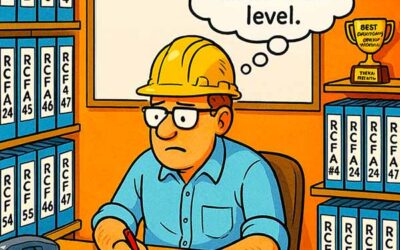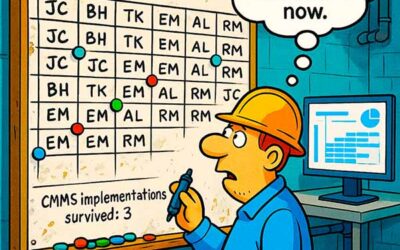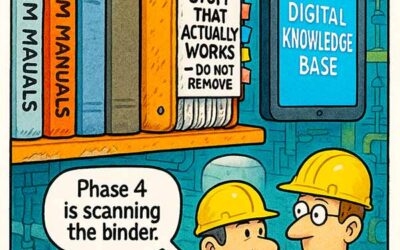
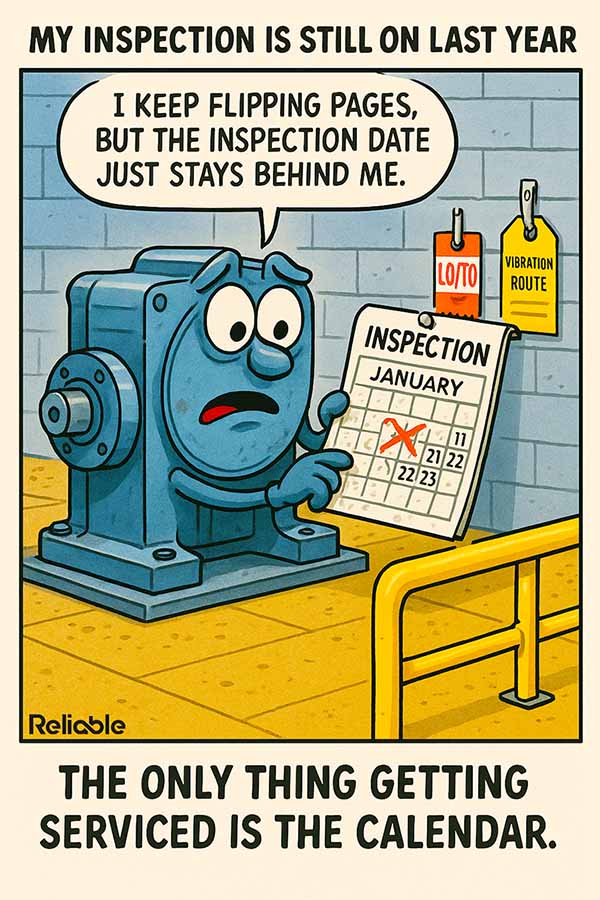

Somewhere in your CMMS right now, there’s an inspection work order that was due six months ago. It’s been rescheduled twice. The equipment looks fine from the outside. Nobody’s complaining. So the work order sits there, aging quietly, while the asset it was supposed to protect does the same.
This is how reliability programs die: one deferred inspection at a time.
The Compounding Cost of Deferred Inspections
Skipping or delaying an inspection feels harmless in the moment. The pump is still running. The vessel hasn’t leaked. The safety relief valve hasn’t lifted. Everything seems fine.
But inspections exist precisely because “seems fine” is an unreliable indicator. Internal corrosion, wall thinning, bearing wear, insulation breakdown: these failure modes progress invisibly until they don’t. By the time symptoms show up in operating data, you’re often past the point of a simple repair.
Inspections exist because ‘seems fine’ is an unreliable indicator. Internal corrosion, wall thinning, and bearing wear progress invisibly until they don’t.
A 2023 analysis by the National Board of Boiler and Pressure Vessel Inspectors found that facilities with overdue inspection rates above 15% experienced three times the rate of unplanned outages compared to facilities below 5%. The correlation held across industries: refining, power generation, chemical manufacturing, and food processing.
The pattern makes intuitive sense. Each deferred inspection is a bet that nothing has changed since the last one. Stack enough of those bets, and you’re running on assumptions instead of data.
Why Inspections Slip
If everyone agrees inspections matter, why do they keep getting pushed back? The reasons are depressingly consistent across facilities.
Production pressure tops the list. Taking equipment offline for inspection means lost output. When margins are tight and demand is high, the inspection window gets squeezed until it disappears entirely.
- Production schedules that don’t account for inspection downtime
- Insufficient inspection staff to cover the backlog
- CMMS systems where overdue work orders blend into the noise
- A culture that treats inspections as optional rather than essential
Staffing is another chronic issue. Many facilities have one or two inspectors covering hundreds of assets. When new projects and turnaround support eat into their availability, routine inspections are the first thing to slide.
Then there’s the CMMS problem. In too many plants, the computerized maintenance management system has become a graveyard of overdue work orders. When everything is overdue, nothing feels urgent. The inspection that’s six months late gets the same priority color as the one that’s six days late.
The Normalization of Overdue Status
This might be the most dangerous dynamic. When overdue inspections become normal, teams stop seeing them as a problem. “It’s always been like this” becomes the default response.
Once that normalization takes hold, it’s extremely difficult to reverse. New employees inherit the backlog and assume it’s acceptable. Supervisors stop asking about inspection compliance because the answers are uncomfortable. And leadership never sees the issue because reports focus on completed work, not the growing pile of deferrals.
When overdue inspections become normal, teams stop seeing them as a problem. New employees inherit the backlog and assume it’s acceptable.
Breaking out of this cycle requires making the invisible visible. That starts with honest reporting.
Building an Inspection Program That Actually Works
The fix isn’t complicated, but it requires discipline. Start by knowing exactly where you stand.
Step One: Face the Backlog
Pull every overdue inspection from your CMMS. Sort them by risk: what’s the consequence of failure for each asset? A deferred inspection on a low-pressure utility water line is a different conversation than one on a high-pressure steam header or a vessel in hydrogen service.
Prioritize ruthlessly. You can’t fix a years-long backlog in a quarter, but you can make sure the highest-risk assets get inspected first.
Step Two: Protect Inspection Windows
Inspections need protected time on the production schedule. Treat them like what they are: required maintenance activities that keep the plant running safely and legally.
- Schedule inspection windows at least 90 days in advance
- Assign specific inspectors to specific assets with clear deadlines
- Track inspection completion rate as a key performance indicator visible to leadership
- Escalate any deferral request to a manager who understands the risk implications
Some facilities have adopted “inspection days” where production voluntarily reduces throughput to enable access. It sounds radical until you compare the cost of a planned slowdown to the cost of an unplanned shutdown.
Step Three: Use Technology to Extend Intervals (Carefully)
Condition monitoring technologies like ultrasonic thickness testing, vibration analysis, and infrared thermography can provide data between formal inspections. In some cases, they can justify extending inspection intervals based on actual measured condition rather than arbitrary time periods.
But here’s the critical caveat: condition monitoring supplements inspections. It doesn’t replace them. A vibration sensor can tell you a bearing is wearing, but it can’t tell you about internal corrosion patterns or weld integrity issues that require physical access and hands-on examination.
Condition monitoring supplements inspections. It doesn’t replace them. A vibration sensor can tell you about bearing wear, but it can’t reveal internal corrosion or weld integrity issues.
The facilities that get the best results use condition monitoring data to prioritize their inspection schedules, not to eliminate inspections from the schedule entirely.
The Regulatory Reality
Beyond the reliability argument, there’s a regulatory one. OSHA’s Process Safety Management standard (29 CFR 1910.119) requires mechanical integrity programs with defined inspection frequencies for process equipment. The EPA’s Risk Management Program has similar requirements.
Falling behind on inspections doesn’t just increase failure risk. It creates regulatory exposure. An incident investigation that reveals a pattern of deferred inspections will go very badly for the facility and its leadership.
- OSHA can issue citations with penalties up to $156,259 per willful violation (2024 rates)
- Insurance carriers routinely review inspection compliance and adjust premiums accordingly
- Incident investigators specifically look for patterns of deferred maintenance as a contributing factor
The legal and financial exposure from deferred inspections dwarfs the cost of doing them on time. Every time.
Making It Stick
Fixing an inspection backlog is a project. Keeping inspections current is a culture. The difference matters.
The most reliable facilities treat inspection compliance the way they treat safety metrics: as a leading indicator that gets reviewed weekly by plant leadership. When the inspection completion rate drops, people notice and respond before the backlog becomes unmanageable.
Start by knowing your numbers. How many inspections are overdue right now? By how much? On which assets? If you can’t answer those questions immediately, that’s the first problem to solve.
The equipment in your plant is aging whether you inspect it or not. The only question is whether you’ll know about the problems before they become emergencies.