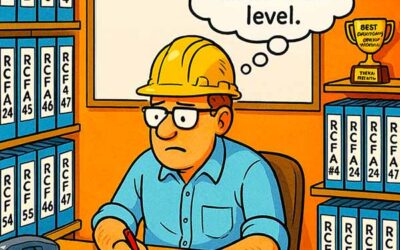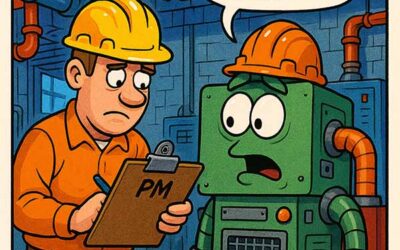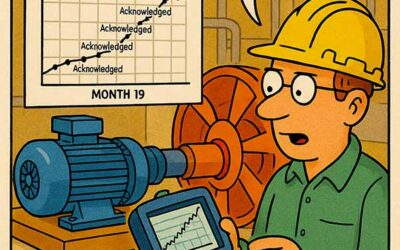


Imagine a bearing on a couch, notebook in hand, confessing its troubles: “I’m trying to balance load, speed, and expectations…”
It’s funny, but painfully accurate. Bearings, like people, are under constant pressure to perform flawlessly despite conflicting demands. They carry the mechanical equivalent of emotional stress: too much load, too little lubrication, misalignment, contamination, and the relentless drive for higher efficiency.
When a bearing fails, the damage extends far beyond a single component. It reflects the machine’s health, the lubrication strategy, and the plant’s overall reliability culture. That’s why bearing failure analysis isn’t just about fixing a part. It’s about decoding a system’s story. The goal is to uncover not only what went wrong, but why it happened and how to ensure it never happens again.
Bearing Failure Analysis: The Forensic Path to Reliability
Bearing failure analysis is the reliability engineer’s version of detective work. Each failure leaves behind physical evidence: patterns, colors, and residues that point to more profound operational truths. Done right, it identifies the root cause instead of merely addressing the symptom.
Common Failure Patterns
- Fatigue Spalling: Subsurface cracks from cyclic loading that eventually break through the surface.
- Brinelling: Indentations caused by static overload or shock during installation.
- Corrosion and Etching: Moisture or acidic lubricant breakdown leading to pitting.
- Electrical Erosion (Fluting): Damage from stray currents, often seen in motor-driven systems.
- Lubrication Starvation: Film collapse leading to metal-to-metal contact and accelerated wear.
Every mark tells a story. The analyst’s job is to interpret that story by combining visual inspection, dimensional measurement, and contamination testing. A cracked inner race may indicate over-tightened fits; discolored cages may suggest overheating from excessive speed or insufficient grease.
The essence of effective bearing failure analysis is curiosity. Asking why five times, not once.
Load, Speed, and Lubrication: The Balancing Act of Machine Life
The cartoon’s punchline: balancing load, speed, and expectations, mirrors one of engineering’s most brutal truths. Pushing one performance factor always stresses another. Bearings operate at the intersection of physics, chemistry, and human ambition.
Load
Too much load leads to compressive stress and surface fatigue. Misalignment amplifies contact pressure on one side of the raceway, creating early spalling and vibration. Overloading often originates not from poor design, but from unbalanced rotors, improper fits, or structural resonance.
Speed
High rotational speed raises temperature exponentially, demanding precise lubrication management. Excessive speed can shear oil films, deform cages, and increase centrifugal forces, altering load zones.
Lubrication
Lubricants act as the emotional stabilizers of the system—thin layers of calm between moving parts. Poor lubrication is the single most common cause of bearing failure. Viscosity mismatch, contamination, and excessive re-greasing all trigger cascading effects:
- Too little grease = boundary lubrication and metal contact.
- Too much grease = churning, heat, and oxidation.
- Wrong grease = base oil separation or additive clash.
The relationship among these three —load, speed, and lubrication —isn’t linear. It’s dynamic, and even minor deviations can disrupt the system’s harmony.
Predictive Insights Through Bearing Failure Analysis
Even the most advanced predictive maintenance programs rely on bearing failure analysis to confirm findings and fine-tune thresholds. Without physical verification, algorithms can drift into false assumptions.
Modern Tools for Root Cause Insight
- Vibration Analysis: Reveals imbalance, looseness, or early fatigue through frequency signatures.
- Infrared Thermography: Identifies frictional heating from poor lubrication or excessive preload.
- Ultrasound Testing: Detects high-frequency acoustic emissions before vibration levels rise.
- Lubricant and Wear Particle Analysis: Provides chemical and microscopic evidence of contamination, oxidation, and additive depletion.
- Microscopy and Metallography: Offers microscopic clarity into crack initiation and subsurface stress zones.
By correlating these technologies with inspection findings, maintenance engineers develop a predictive feedback loop. When a bearing fails, it validates or challenges their predictive model—refining alarm limits and improving diagnostic accuracy.
Data-Driven Storytelling
Every bearing failure adds a new data point to the plant’s reliability narrative. Over time, patterns emerge:
- Are failures concentrated on one motor type?
- Do certain bearings fail after lubrication changes?
- Is temperature rise correlated with seasonal humidity?
Connecting these dots transforms raw data into operational intelligence, a reliability team’s most valuable currency.
Turning Analysis into Proactive Reliability Action
The true purpose of bearing failure analysis isn’t forensic curiosity. It’s actionable prevention. The best reliability teams don’t just replace the failed part; they use each failure to strengthen the system.
Five Steps to Close the Loop
- Conduct a Structured Root Cause Review: Document observations, measurements, and operating conditions.
- Perform a Lubrication Audit: Review lubricant selection, re-lubrication frequency, contamination control, and storage practices.
- Verify Alignment and Mounting: Ensure that the shaft and housing fit meet tolerance standards; use laser alignment and precision torqueing.
- Implement Environmental Controls: Reduce dust, moisture, and electrical interference.
- Train Technicians: Teach them how to recognize early vibration, temperature, or noise patterns signaling bearing distress.
Each analysis should end with a tangible improvement, whether it’s a new inspection interval, a revised grease type, or a better storage protocol.
Every bearing failure is tuition. The only wasted one is the lesson you don’t learn.
When reliability teams adopt a continuous learning mindset, bearing failure analysis becomes less about what broke and more about how to prevent the next one.
Bearings Teach Balance and Perspective
Bearings are mechanical metaphors for reliability. They carry the weight, absorb the shocks, and quietly enable everything to move forward. The cartoon’s humor captures a universal truth: even bearings struggle to balance performance expectations.
Bearing failure analysis reminds us that reliability is not perfection. It’s harmony among competing forces. Load, speed, lubrication, and design all demand attention, but true success comes from equilibrium, not extremes.
When maintenance professionals treat every failure as feedback, they transform downtime into insight, frustration into foresight, and machinery into a mirror of disciplined reliability.