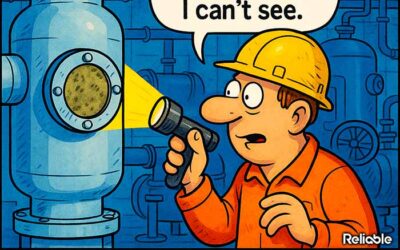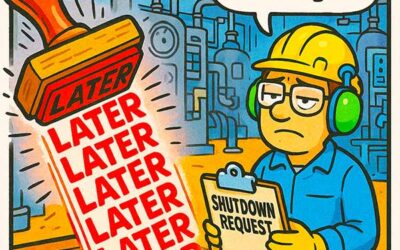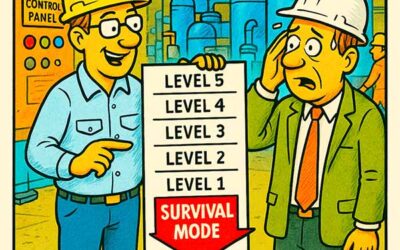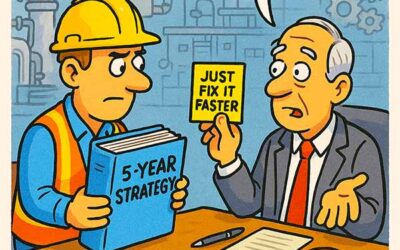
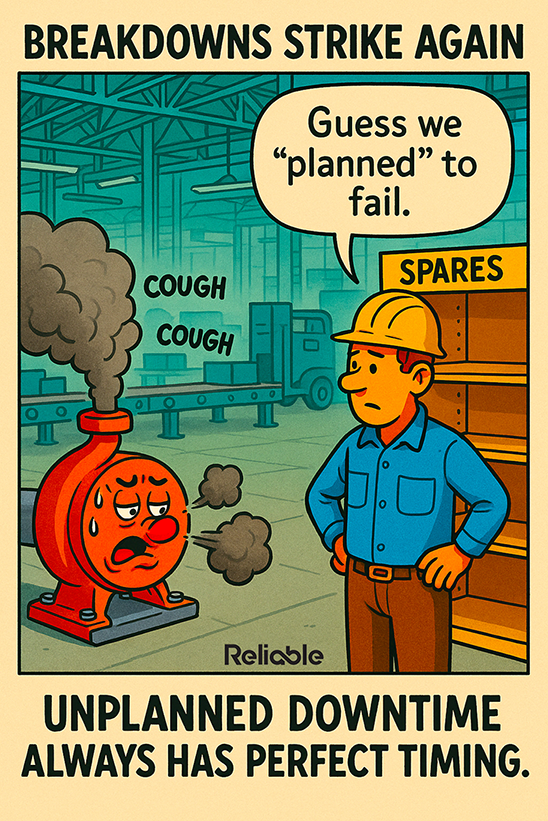

In the cartoon, a coughing, smoke-belching pump sits before an empty spares shelf, while a weary technician admits, “Guess we planned to fail.” It’s a painful truth wrapped in humor. Every maintenance professional recognizes this scenario: the machine fails, the part isn’t there, and everyone scrambles.
Unplanned downtime is rarely random; it’s the byproduct of neglected planning. Plants that ignore preventive maintenance planning best practices end up stuck in reactive firefighting, draining resources and morale. True reliability begins with prevention, not reaction. It’s not about doing more maintenance; it’s about doing the proper maintenance, intelligently, proactively, and consistently.
The Hidden Cost of Skipping Preventive Maintenance Planning Best Practices
Unplanned downtime doesn’t just stop production; it cascades through an entire operation. Production schedules collapse, customer delivery dates shift, quality issues multiply, and overtime budgets explode. A single machine failure can trigger a ripple effect that extends far beyond the plant floor.
Industry studies estimate that unplanned downtime costs manufacturers nearly $50 billion annually, with losses averaging $260,000 per hour. But even that number understates the whole picture. When a key asset fails, the organization pays in lost trust, safety risk, and the stress of emergency repairs.
A robust preventive maintenance plan mitigates these failures through structure, foresight, and discipline. That means:
- Identifying critical assets based on safety, production impact, and replacement cost.
- Documenting PM routines tied to each asset’s operating conditions and failure modes.
- Verifying spare parts availability and reorder levels through storeroom coordination.
- Scheduling tasks strategically, minimizing conflict with production runs.
Without these steps, maintenance is left guessing, and guessing is expensive. Following preventive maintenance planning best practices transforms reactive chaos into operational control.
How to Build a High-Performance Preventive Maintenance Planning System
Strong planning starts with strong foundations. Preventive maintenance is a process, not an event, and the planning component determines its success.
Step 1: Define Asset Priorities
Use a structured criticality analysis to rank equipment based on safety, cost, and process impact. This ensures planners invest time where reliability gains are most meaningful.
Step 2: Standardize PM Job Plans
Each PM task should have:
- Clear, measurable objectives (lubricate, inspect, calibrate, replace, test).
- Detailed instructions with torque specs, safety notes, and inspection tolerances.
- Complete materials lists including tools, consumables, and spare parts.
- Accurate labor time estimates for scheduling realism.
Step 3: Build a Living Schedule
A preventive maintenance schedule must evolve. Use CMMS data to refine frequencies, track missed work, and monitor completion rates. Too frequent, and you waste labor; too infrequent, and you miss early warnings. The goal is balance, using data, not habit, to guide frequency.
Step 4: Close the Feedback Loop
After each PM, technicians should report findings and propose improvements. This feedback strengthens job plans and allows planners to remove redundant or ineffective tasks.
Plants that embrace these preventive maintenance planning best practices achieve not only higher uptime but also more predictable labor allocation, safer work environments, and reduced overtime chaos.
The Data-Driven Evolution of Preventive Maintenance Planning Best Practices
Maintenance planning used to rely on tribal knowledge; now it’s driven by analytics. Smart plants treat data as a diagnostic tool, not just a reporting metric.
Key data-driven practices include:
- Tracking PM compliance: The percentage of planned tasks executed on time.
- Evaluating PM effectiveness: Comparing failure rates before and after PM optimization.
- Integrating predictive technologies: Using vibration, oil, and thermal data to extend or shorten PM intervals intelligently.
Predictive insights make preventive maintenance more surgical. For instance, vibration analysis may reveal early bearing defects, letting planners replace components before catastrophic failure. Oil analysis might detect oxidation, prompting schedule adjustments or lubricant changes.
When these predictive tools feed into preventive maintenance planning best practices, planners can shift from static intervals to dynamic, condition-based scheduling, reducing both wasted labor and surprise failures.
This hybrid model, where data informs PM execution, represents the modern frontier of reliability. It bridges the gap between “routine maintenance” and “true asset intelligence.”
Culture, Collaboration, and the Human Factor in Preventive Maintenance
Technical systems fail for human reasons, such as miscommunication, lack of ownership, or poor follow-through. The best preventive maintenance planning best practices succeed when the culture supports them.
Reliability is built on collaboration. Planners, technicians, storeroom staff, and operations must operate as a single system. When any part fails—delayed spares, rushed work orders, ignored feedback—the entire preventive maintenance chain weakens.
To reinforce culture:
- Communicate the why. Every technician should understand how their work prevents downtime.
- Empower planners. Give them authority to say no to reactive chaos when it threatens long-term reliability.
- Close information loops. Ensure post-job reviews and root cause feedback are consistently captured.
- Celebrate success. When preventive work prevents a breakdown, make it visible.
Culture makes reliability sustainable. Technology and procedures provide the framework, but people provide the discipline.
Turning “Planned to Fail” Into “Built to Last”
The cartoon’s humor hits hard because it’s accurate. Plants often plan everything, except reliability. They prepare budgets, production, and projects, but they don’t schedule maintenance with precision—the result: predictable failure masquerading as bad luck.
Every hour spent planning saves several hours of unplanned repair time – reliability isn’t about fixing machines faster; it’s about making failure irrelevant.
Preventive maintenance planning best practices turn that equation upside down. When spares are pre-staged, job plans are detailed, and feedback is continuous, downtime becomes rare and predictable instead of catastrophic.
Every hour spent planning saves several hours of unplanned repair time. The reliability elite understand that the best maintenance isn’t reactive, it’s invisible. The goal isn’t to fix machines faster; it’s to eliminate the need for fixing them at all.
Advanced Maintenance Scheduling Strategies for Maximum Reliability
Even the strongest preventive maintenance planning framework can fall short without a strategic maintenance scheduling system. Planning defines what needs to be done – scheduling determines when and how efficiently it gets done. The best-performing plants recognize that maintenance scheduling isn’t a clerical task; it’s a precision-engineered process designed to balance asset availability, technician productivity, and production demand.

To achieve true reliability excellence, organizations must evolve from simple work order calendars to integrated maintenance scheduling strategies that incorporate predictive analytics, asset criticality ranking, and workload leveling. When properly implemented, this approach not only prevents unplanned downtime but also maximizes wrench time, extends asset life, and reduces overall maintenance cost per unit produced.
Dynamic Maintenance Scheduling and Resource Optimization
Traditional maintenance scheduling relies on static intervals, weekly lubrication rounds, monthly inspections, and quarterly calibrations. But modern plants are replacing these fixed routines with dynamic maintenance scheduling systems driven by real-time data. By linking IoT sensors, SCADA data, and CMMS platforms, planners can automatically adjust work orders based on operating conditions, runtime hours, or equipment stress levels.
This approach, often referred to as condition-based maintenance scheduling, ensures that assets receive attention precisely when needed – not too early (wasting labor and materials) and not too late (causing avoidable failure). For example, a compressor running below its normal load profile may safely extend its oil change interval, while a heavily loaded gearbox may need inspection earlier than scheduled.
The integration of AI-assisted scheduling tools takes this further. Predictive algorithms analyze historical trends, environmental data, and performance metrics to recommend the optimal timing for each task. These innovative systems continuously learn, improving reliability and accuracy over time and aligning maintenance activity with production cycles to minimize disruptions.
Coordinating Maintenance Windows with Production Schedules
A common source of inefficiency in many facilities is the disconnect between maintenance and operations. Effective maintenance window coordination transforms this relationship from adversarial to strategic. By embedding maintenance planners directly into production planning meetings, maintenance tasks can be grouped and sequenced for maximum impact during planned outages or shift transitions.
When maintenance and operations plan together, downtime becomes opportunity – not disruption.
This practice, often called opportunistic maintenance, takes advantage of existing downtime – changeovers, quality checks, or production pauses – to perform preventive work without additional shutdowns. The outcome is higher asset uptime, smoother workflows, and stronger collaboration between departments.
An advanced scheduling system will also prioritize tasks by maintenance backlog management principles. High-priority work based on safety or production risk should be scheduled first, while low-risk tasks can be deferred without compromising reliability. Using key metrics like schedule compliance rate and planned vs. reactive work ratio, leaders can measure scheduling effectiveness and drive continuous improvement.
The Link Between Maintenance Scheduling, Spare Parts, and Reliability
A great schedule means nothing if the right materials aren’t available. Integrating spare parts forecasting and inventory optimization into the scheduling process eliminates last-minute chaos. CMMS and ERP systems should be synchronized so that when a work order is generated, parts availability is automatically confirmed or reorder points are triggered.
Advanced facilities use just-in-time (JIT) spares strategies combined with critical spares stocking models to ensure that maintenance teams always have what they need, exactly when they need it. This integration reduces carrying costs, prevents overstocking, and ensures that essential components for critical assets are never out of reach.
When maintenance scheduling optimization, spare parts logistics, and technician workload balancing work in harmony, maintenance teams achieve a state of planned reliability. Every resource – labor, time, and material – is allocated efficiently, turning maintenance into a competitive advantage rather than a cost center.
Digital Transformation and the Future of Maintenance Scheduling
The next frontier of reliability lies in digital maintenance scheduling platforms that use artificial intelligence, digital twins, and prescriptive analytics to forecast failures before they occur. These tools can simulate various what-if scenarios – production surges, staff shortages, spare shortages – and dynamically adjust schedules accordingly.
Digital maintenance scheduling transforms reliability from reaction to prediction – turning data into foresight and foresight into uptime.
Predictive maintenance and machine learning models enable planners to move from reactive firefighting to proactive asset lifecycle management, where the entire operation functions on predictive certainty rather than educated guesses.
Plants that embrace this digital shift in maintenance scheduling are rewriting the rules of reliability – replacing panic with precision, inefficiency with intelligence, and downtime with data-driven foresight.
Conclusion: The Power of Proactive Precision
The key takeaway from this cartoon, and from decades of reliability lessons, is that unplanned downtime always has perfect timing. It shows up when preparation doesn’t.
By mastering preventive maintenance planning best practices, you eliminate uncertainty, stabilize production, and build a culture of foresight. Reliability isn’t a department; it’s a discipline. And the plants that commit to it discover that the best maintenance plan isn’t reactive, it’s invisible, effective, and relentless in preventing chaos before it begins.