
Industrial Downtime Cost Benchmarks: What Published Studies Actually Show

by | Guides, Maintenance and Reliability, Manufacturing

Downtime costs get quoted like gospel. That’s risky.

A number that makes sense for an automotive assembly plant can look ridiculous inside a smaller food plant, a fabrication shop, or a regional packaging operation. Throughput, margin, labor model, inventory position, customer penalties, restart losses, and asset criticality all change the math.

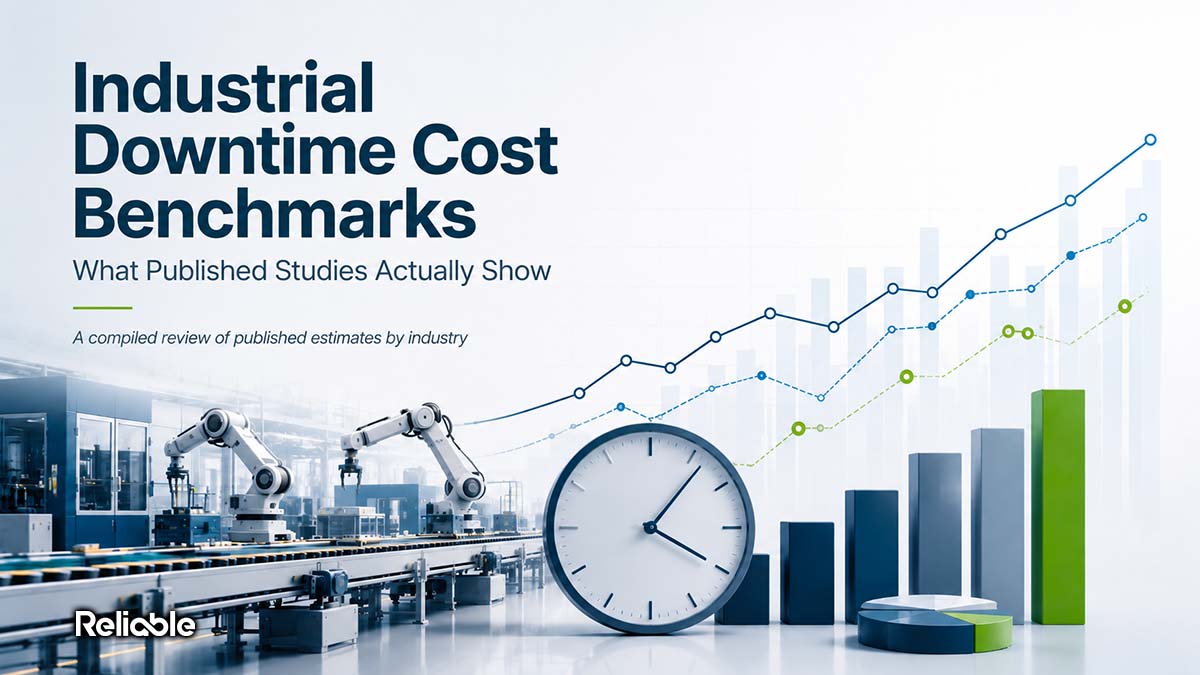
So this benchmark should be read as a compiled review of published estimates, not a universal calculator.

The goal is simple: give maintenance, reliability, operations, and finance teams a more realistic starting point for discussing downtime exposure.

Published Downtime Cost Benchmarks

Reliable Confidence Score: How safely each figure can be used in industrial maintenance and reliability discussions, based on source quality, clarity, context, and plant-floor relevance.
Siemens, 2024
Automotive
$2.3 million per hour
Confidence: High, specific use

Strong source and clear hourly figure, but best used for large automotive operations.

Siemens, 2024
FMCG / CPG
$36,000 per hour
Confidence: High, specific use

Strong source and clear hourly figure, but specific to FMCG/CPG operations.

Siemens, 2024
Oil & Gas
Varies by year and oil price environment
Confidence: Medium

Useful directional source, but the economics change heavily with commodity prices and operating context.

Siemens, 2024
Heavy Industry
Annual losses, not hourly losses
Confidence: Medium

Valuable source, but should be cited carefully because the usable figure is annualized, not hourly.

ABB, 2023
Industrial businesses
About $125,000 per hour
Confidence: High, broad use

Best general-purpose benchmark because it comes from a large survey of 3,215 plant maintenance leaders.

Splunk / Oxford Economics, 2024
Global 2000 digital downtime
$400 billion annually
Confidence: Low for plant downtime

Useful business context, but it covers broader digital downtime, not plant-floor production downtime.

The Big Takeaway

The safest benchmark for general industrial discussion is ABB’s $125,000 per hour figure.

It’s broad enough to be useful across industrial businesses, and the survey base is large: 3,215 plant maintenance leaders. ABB also reported that more than two-thirds of industrial businesses experience unplanned outages at least monthly, while 21% still rely on run-to-failure maintenance.

The Siemens numbers are more industry-specific.

That’s what makes them valuable, but also easy to misuse. The $2.3 million per hour automotive figure should stay tied to large automotive operations. The $36,000 per hour FMCG figure should stay tied to fast-moving consumer goods. Oil and gas needs more care because the economics move with commodity prices, production rates, and refinery or upstream context.

Why Downtime Numbers Vary So Much

Downtime cost is rarely just the repair invoice.

A serious outage can include:

  • Lost production
  • Idle labor
  • Scrap and rework
  • Restart losses
  • Overtime
  • Contractor premiums
  • Expedited freight
  • Missed shipments
  • Customer penalties
  • Quality holds after restart
  • Safety and environmental exposure

That’s why the same failed bearing can be a maintenance nuisance in one plant and a seven-figure event in another.

The asset matters, but the process around that asset usually decides how expensive the failure becomes.

The asset matters. The process matters more.

A Practical Way to Use These Benchmarks

For most plants, the published numbers are useful as a conversation starter. They shouldn’t replace a plant-specific downtime model. A better internal calculation should include:

What to Include in a Downtime Cost Model

A practical starting point for building a plant-specific downtime estimate.

Lost production
Units not produced, margin per unit, missed throughput.
Labor
Operators, maintenance, supervision, overtime.
Materials
Scrap, off-spec product, wasted packaging, raw material loss.
Recovery costs
Expedite fees, contractors, rentals, premium shipping.
Customer impact
Chargebacks, penalties, late delivery risk.
Restart impact
Startup losses, quality checks, stabilization time.
Risk exposure
Safety, environmental, compliance, reputation.

Even a rough internal estimate will usually beat a generic industry number.

The real value comes when reliability teams can say, “Here’s what one hour of downtime costs on this line, with our product mix, our labor model, and our customer commitments.”

That changes the conversation.

Where Maintenance and Reliability Teams Should Be Careful

A few common mistakes make downtime articles look weak to experienced practitioners:

First, don’t compare a global enterprise IT outage number directly to a plant production outage. They’re related concepts, but they measure different things.

Second, don’t cite annual downtime losses as hourly losses. That mistake can turn a useful article into something reliability people won’t trust.

Third, don’t pretend every outage hour costs the same. The first hour of downtime may cost less than the sixth hour if customer shipments get missed, cold chain is affected, a batch is lost, or restart requires extensive validation.

Fourth, don’t make predictive maintenance sound like magic. PdM can reduce certain failure modes, but it won’t fix poor planning, weak lubrication practices, bad installation work, missing spares, unclear asset criticality, or a backlog nobody is willing to fund.

The strongest downtime argument isn’t the biggest number. It’s the number your plant can defend.

Methodology

This article reviewed published downtime cost estimates from Siemens, ABB, and Splunk/Oxford Economics.

Figures were included only when the source clearly described a cost estimate, survey result, or downtime impact. Industry-specific figures were kept tied to their original context.

Digital downtime estimates were separated from plant production downtime because IT outages, cybersecurity incidents, and industrial asset failures do not share the same cost structure.

The benchmark table should be treated as a directional reference, not a substitute for a plant-specific downtime cost model.

Bottom Line

Downtime cost is one of the strongest arguments reliability teams have.

But the argument weakens when the numbers are exaggerated, mixed across industries, or taken out of context.

Use the big numbers carefully. Then build your own. A plant-specific downtime model will do more for reliability funding than another generic claim about downtime being expensive.

Sources

Author

  • Reliable Media

    Reliable Media simplifies complex reliability challenges with clear, actionable content for manufacturing professionals.

    View all posts
SHARE

You May Also Like