
The Short Version: An asset hierarchy in a CMMS is a structured classification of equipment that lets a maintenance and reliability team collect, navigate, and aggregate reliability and maintenance (RM) data. Two public reference frameworks are used here, and they answer different questions.
ISO 14224 provides a technical taxonomy for equipment in petroleum, natural gas, and petrochemical facilities, and represents that classification as a hierarchy. ISA-95 and its international counterpart IEC 62264 include a five-level activity and system stack (Levels 0 through 4) and, separately, an equipment hierarchy and a physical-asset equipment model. The Level 0 through 4 stack is not a CMMS parent-child naming recipe.
This guide stays inside public material: ISO and IEC abstracts, one public OTC conference paper on ISO/TC67 standards (OTC-28705-MS), hosted on the ISO/TC67 site, the ISA standards page, and ISO/TC251 briefing notes for ISO/TS 55010. The full standards are paywalled and are not reproduced here. Any tree shown below is labeled as an example, with parent-child rules kept inside the public facts.
Independence and scope
Reliable Magazine does not sell CMMS or EAM software, consulting, or certification. This guide is independent editorial analysis. It is not an ISO, ISA, IEC, or SMRP publication.
The material below draws on published abstracts and public briefing documents. Where a figure or rule comes from a specific source, that source is named in the text and listed at the end. The complete standards remain paywalled and were not copied into this guide.
What an asset hierarchy is, and what it is for in a CMMS
A taxonomy is a systematic classification of items into generic groups based on factors possibly common to several of the items, such as location, use, and equipment subdivision. ISO 14224 represents that classification as a hierarchy.
The purpose is practical. Subdividing an installation or plant into manageable taxonomic levels, based on function or hardware, simplifies identification of possible failure modes and failure mechanisms, and the OTC paper on ISO/TC67 standards states that such subdivision is needed in a CMMIS (a computerized maintenance management information system).
ISO 14224 organizes RM data into three main categories: equipment data (equipment taxonomy and equipment attributes), failure data (failure cause and failure consequence), and maintenance data (maintenance action, resources, maintenance consequence, and down time). Standardizing this collection facilitates exchange between plants, owners, manufacturers, and contractors.
One company application in the OTC paper (an offshore drilling contractor) describes the technical hierarchy as a logical representation of facilities. Its main elements are the asset register and the equipment boundary. The asset register structure includes administrative or grouping levels that help a team navigate to equipment and aggregate RM data by facility areas. Equipment structures are then installed within that asset register.
Two public models, kept distinct
They are described here separately so the ISO 14224 taxonomy is not collapsed into the ISA-95 Level 0 through 4 stack.
ISO 14224: a technical taxonomy for equipment
ISO 14224:2016 provides a comprehensive basis for collecting RM data in a standard format for equipment in petroleum, natural gas, and petrochemical facilities and operations during the operational life cycle. It describes data collection principles and terms that constitute a reliability language, and it sets requirements that any in-house or commercial RM data system is required to meet when designed for RM data exchange.
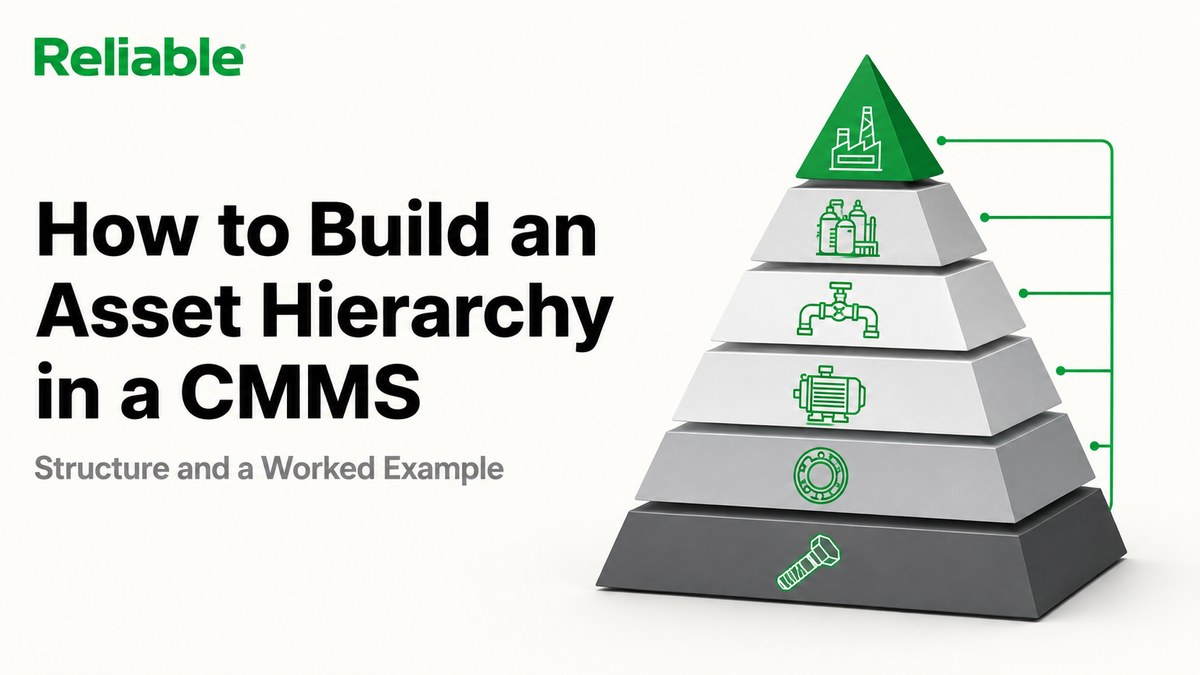
The taxonomy is expressed as a hierarchy of nine levels. The OTC paper shows that list in Figure 4 (ISO 14224:2016, Figure 3): (1) Industry, (2) Business category, (3) Installation, (4) Plant/Unit, (5) Section/System, (6) Equipment unit, (7) Subunit, (8) Component/Maintainable Item, and (9) Part. Figure 4 groups levels 1 through 5 as use/location and levels 6 through 9 as equipment subdivision. The equipment unit at level 6 is defined as the common reporting level for merging and assessment, and a failure of a component is also counted as a failure of its parent equipment.
For scale, the same paper describes the latest ISO 14224 as covering a total of 108 equipment classes, with special detailed focus on 46 equipment classes across upstream, midstream, downstream, or petrochemical categories. Those counts are the OTC paper’s description of the standard, not a measurement taken here.
ISA-95 and IEC 62264: activity layers and a physical equipment model
ISA-95 is an international set of standards for integrating logistics systems with manufacturing control systems, organizing technology and business processes into layers defined by activities. ISA-95 Part 1 includes a discussion of how the physical assets of a manufacturing enterprise are organized, and the ISA page notes that the equipment hierarchy model can be applied across discrete, continuous, and logistics industries.
The framework defines five functional levels: Level 0, the physical production processes (machinery and other assets); Level 1, sensing and manipulating (sensors, valves, and devices); Level 2, monitoring and supervising control (PLCs and DCS); Level 3, manufacturing operations management (MES and similar systems); and Level 4, business planning and logistics (ERP). The standard primarily deals with the interface between Levels 3 and 4.
IEC 62264-1:2013 describes the manufacturing operations management domain (Level 3) and the interfaces between Level 3 and Level 4. The 2013 edition extended the equipment hierarchy in clause 5.3 and added a physical asset equipment model in 5.3.
The Level 0 through Level 4 stack describes activity and system layers, and those five levels are not a CMMS parent-child naming scheme. Separately, ISA-95 Part 1 discusses how the physical assets of a manufacturing enterprise are organized and includes an equipment hierarchy model, and IEC 62264-1:2013 includes an equipment hierarchy and a physical-asset equipment model in clause 5.3. ISO 14224 is the public source used here for an RM data taxonomy of physical equipment.
How to build one: steps that stay inside the sources
The steps below are grounded in the public facts from ISO 14224, ISO 15926-2, and ISO/TS 55010. They describe structure and rules, and they leave product selection out.
1. Agree an explicit definition of asset
ISO/TS 55010 briefing material observes that organizations often maintain multiple asset registers for multiple purposes, financial or non-financial, and that these can duplicate or conflict. The briefing recommends agreeing an explicit definition of asset across departments before building structure, since organizations are typically arranged along hierarchical lines that can create functional silos.
2. Agree granularity, with cost in view
Asset granularity is often defined independently by different groups, which can reduce visibility. Finer granularity yields more accurate information, and it also requires more transactions and cost. ISO 14224 makes the same trade-off explicit at the RM data level: collecting RM data is costly, and the effort should be balanced against the intended use and benefits.
3. Assign unique identification
ISO/TS 55010 briefing material states that assets in all registers should carry the same unique identification and consistent life-cycle information.
4. Separate functional objects from installed equipment
One company application in the OTC paper (an offshore drilling contractor) distinguishes a functional object from a materialized object. In that write-up, the functional object represents equipment duty and the materialized object represents the installed serial number, installed 1:1, which the paper ties to the ISO 15926-2 concept of coincident individuals and cites ISO 14224, Table 5. Use and location characteristics are assigned to the functional object, because they describe application and duty. ISO 15926-2:2003 specifies a conceptual data model for computer representation of technical information about process plants, including specification, installation, operations, and maintenance and replacement of equipment.
5. Set equipment boundaries
Equipment boundaries use taxonomy levels for equipment subdivision. Main equipment items are identified, categorized as taxonomy level 6, and classified with the relevant equipment class. Figure 4 then subdivides that equipment as Subunit, Component/Maintainable Item, and Part. Equipment and components are classified the same way, and the class follows the item rather than its parent. The OTC paper gives one illustration of this rule: a lube oil pump serving a compressor is classified as a pump, not as a compressor.
6. Place parents and children
In the offshore-drilling-contractor application in the OTC paper, hierarchical positioning defines interrelationships between items. That write-up gives a concrete example: motors are structured subordinate to the equipment they drive. Because the equipment unit at level 6 is the common reporting level, a failure recorded against a component is also treated as a failure of the parent equipment, which keeps aggregation consistent.
A worked plant example
Everything below uses invented names for illustration. It is an example, not a real plant. The level names follow Figure 4 of the OTC paper: Industry, Business category, Installation, Plant/Unit, Section/System, Equipment unit, Subunit, Component/Maintainable Item, and Part.
- Example Industry (taxonomy level 1, use/location)
- Example Business category (taxonomy level 2, use/location)
- Example Installation (taxonomy level 3, use/location)
- Example Plant/Unit (taxonomy level 4, use/location)
- Example Section/System: Process Area A (taxonomy level 5, use/location; also used here as an administrative grouping level for navigation and for aggregating RM data by facility area)
- Example Gas Compressor, tag C-1001 (equipment unit, taxonomy level 6, classified with a compressor equipment class)
- Example Lubrication System (subunit, taxonomy level 7)
- Example Lube Oil Pump, tag P-1001A (Component/Maintainable Item, taxonomy level 8, classified as a pump, because the class follows the item rather than the parent)
- Example Part (taxonomy level 9): example placeholders beneath the Component/Maintainable Item.
- Example Lube Oil Pump, tag P-1001A (Component/Maintainable Item, taxonomy level 8, classified as a pump, because the class follows the item rather than the parent)
- Example Driving Motor, tag M-1001A placed subordinate to C-1001 in the offshore-drilling-contractor application in the OTC paper, because that write-up structures motors subordinate to the equipment they drive.
- Example Lubrication System (subunit, taxonomy level 7)
- Example Gas Compressor, tag C-1001 (equipment unit, taxonomy level 6, classified with a compressor equipment class)
- Example Section/System: Process Area A (taxonomy level 5, use/location; also used here as an administrative grouping level for navigation and for aggregating RM data by facility area)
- Example Plant/Unit (taxonomy level 4, use/location)
- Example Installation (taxonomy level 3, use/location)
- Example Business category (taxonomy level 2, use/location)
In this example, a failure logged against a component of C-1001 is also counted as a failure of C-1001, since the equipment unit is the common reporting level. The lube oil pump sits under the lubrication-system subunit as a Component/Maintainable Item and is classified as a pump. The driving motor sits under the compressor in the offshore-drilling-contractor application shown in the OTC paper.
Honest limitations
The full standards are paywalled. This guide relies on the ISO 14224:2016 abstract, one public OTC conference paper on ISO/TC67 standards (OTC-28705-MS), hosted on the ISO/TC67 site, the ISO 15926-2:2003 abstract, the ISA standards page, the IEC 62264-1:2013 abstract, and ISO/TC251 briefing notes for ISO/TS 55010. Figure 4 of the OTC paper supplies the nine taxonomy level names. Readers who need class definitions, boundary drawings, and the full standard text should obtain the standards themselves.
ISO 14224 is scoped to petroleum, natural gas, and petrochemical facilities. Applying its taxonomy in other industries is an extrapolation that the public abstract does not cover.
The OTC paper shows the complete nine-level taxonomy in Figure 4, with level 8 labeled Component/Maintainable Item and level 9 labeled Part. The worked example uses those Figure 4 labels.
The 108 and 46 equipment class figures are the OTC paper’s description of the standard, cited as such rather than independently verified here.
RM data collection carries real cost, and ISO 14224 states that the effort should be balanced against intended use and benefits. Finer asset granularity raises both accuracy and transaction load, a trade-off that ISO/TS 55010 briefing material also flags.
ISA-95 and IEC 62264 Level 0 through Level 4 are activity and system layers. They are useful for understanding how control and business systems relate, and they are not a CMMS parent-child naming recipe. The physical equipment hierarchy and physical-asset equipment model in those standards are a separate construct.
No industry averages, typical plant percentages, or market figures appear in this guide, because the public sources listed here do not supply them.
Frequently Asked Questions
What is an asset hierarchy in a CMMS?
It is a structured classification of equipment that lets a maintenance and reliability team collect, navigate, and aggregate reliability and maintenance data. ISO 14224 treats a taxonomy (a systematic classification of items into generic groups) as a hierarchy, and the OTC paper describing it states that this kind of subdivision is needed in a CMMIS.
What does the public paper say a technical hierarchy is made of?
In the offshore-drilling-contractor application, the technical hierarchy is a logical representation of facilities, and its main elements are the asset register and the equipment boundary. The asset register holds administrative or grouping levels for navigation and aggregation, while equipment structures are installed within it and subdivided by taxonomy levels.
How is ISA-95 different from ISO 14224 for hierarchy purposes?
ISO 14224 classifies physical equipment so that RM data can be collected and merged consistently. ISA-95 and IEC 62264 include a five-level activity and system stack (Levels 0 through 4), and they primarily address the interface between Levels 3 and 4. The same standards also include a physical equipment hierarchy and a physical-asset equipment model, which is a different construct from the Level 0 through 4 stack.
Which ISO 14224 taxonomy levels are shown in public material?
The OTC paper’s Figure 4 shows nine levels: (1) Industry, (2) Business category, (3) Installation, (4) Plant/Unit, (5) Section/System, (6) Equipment unit, (7) Subunit, (8) Component/Maintainable Item, and (9) Part. Levels 1 through 5 are grouped as use/location, and levels 6 through 9 as equipment subdivision.
Should a motor be its own top-level asset or sit under the equipment it drives?
In the offshore-drilling-contractor application in the OTC paper, motors are structured subordinate to the equipment they drive. In that write-up, a motor paired with a compressor sits under the compressor rather than standing alone at the top.
How granular should an asset hierarchy be?
Finer granularity yields more accurate information and requires more transactions and cost, according to ISO/TS 55010 briefing material, and ISO 14224 states that RM data collection is costly and should be balanced against intended use and benefits. Granularity is a deliberate trade-off rather than a fixed rule, and it should be agreed across departments alongside an explicit definition of asset.
Related Guides
- How to Calculate Asset Criticality
- How to Start a PdM Program
- How to Perform RCM
- How to Perform FMEA
- How to Calculate MTBF and MTTR
- CMMS vs EAM
- Preventive Maintenance
- Maintenance and Reliability Glossary
Sources
- ISO 14224:2016, Petroleum, petrochemical and natural gas industries, Collection and exchange of reliability and maintenance data for equipment. Public abstract
- OTC-28705-MS, OTC conference paper on ISO/TC67 standards, hosted on the ISO/TC67 site (Houston, 3 May 2018)
- ISO 15926-2:2003, Industrial automation systems and integration, Integration of life-cycle data for process plants including oil and gas production facilities, Part 2: Data model. Public abstract
- ISA-95 standard overview, International Society of Automation
- IEC 62264-1:2013, Enterprise-control system integration, Part 1: Models and terminology. Public abstract
- ISO/TS 55010, guidance on the alignment of financial and non-financial functions in asset management. ISO/TC251 project page ; ISO catalogue ; ISO/TC251 briefing notes and https://committee.iso.org/files/live/sites/tc251/files/guidance/ISO%20TC251%20WG5%20HAAM%20March%202019%20EN.pdf
Last updated: August 18, 2026. This guide is editorial analysis by Reliable Magazine.