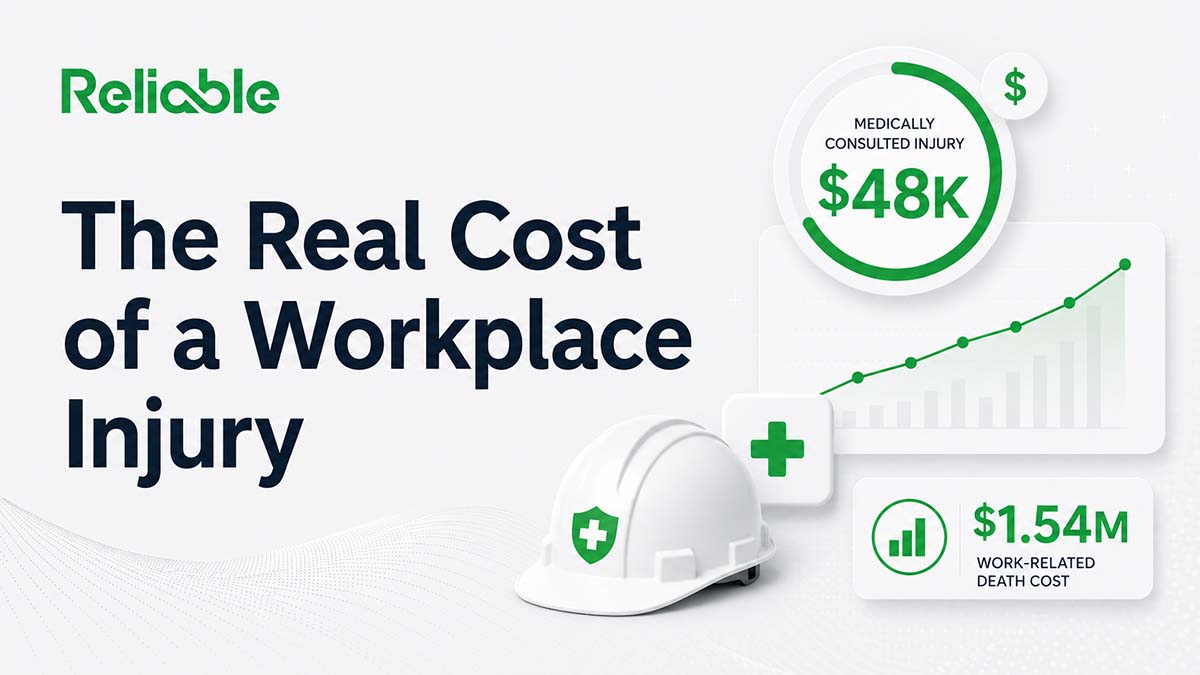

Search “cost of a workplace injury” and you’ll land on the same two numbers everywhere. A medically consulted injury runs about $48,000. A work-related death runs about $1.54 million. Many safety software vendors, training companies, and EHS blogs cite them, usually without saying where they come from or what they count.
They come from one place: the National Safety Council’s Injury Facts. The sourcing is unusually clean, the methodology is published, and the figures get refreshed every year. That’s rare in this space, and it’s why most rows below score High.
The catch is what people do with them. The NSC figures measure the cost to society. They don’t measure the bill that lands on an employer’s desk. Read them as a societal estimate and they’re solid. Read them as “what an injury costs your company” and you’re quoting them wrong.
What these numbers measure, and where they come from
The NSC defines its cost estimates as income not received or expenses incurred because of preventable injuries. They’re meant to be compared against things like GDP and personal consumption, not against a single company’s P&L. The NSC says it plainly on the page: the costs reflect the impact to society, not specifically to employers.
Here’s what each headline figure covers, for 2024:
Cost per medically consulted injury: $48,000. A “medically consulted injury” is one serious enough that a medical professional was consulted. For workplace figures, the NSC uses the BLS total recordable case count, which covers recordable injuries and illnesses under OSHA’s definition, and extrapolates it to include workers BLS leaves out, such as the self-employed and federal employees. The estimate includes wage losses, medical expenses, administrative expenses, and employer costs, and excludes property damage except to motor vehicles, consistent with the NSC’s published methodology.
Cost per death: $1,540,000. The fatality estimate covers the same broad cost categories, but it uses fatal-injury benchmarks rather than simply multiplying the nonfatal figure. Worth knowing: this is the economic cost. It does not include lost quality of life, which the NSC tracks separately and excludes from the headline number because it isn’t real income lost or expense incurred.
Total cost of U.S. work injuries: $181.4 billion. The NSC breaks this into wage and productivity losses ($54.9B), administrative expenses ($64.5B), medical expenses ($36.8B), employers’ uninsured costs ($15.5B), motor-vehicle damage ($6.0B), and fire losses ($3.8B). Those rounded components sum to $181.5 billion; the $0.1 billion difference from the published total reflects rounding.
Cost per worker: $1,120. This is the one that gets mangled most. It’s the value of goods or services each worker has to produce to offset total injury costs across the economy. The NSC states directly that it is not the average cost of a work-related injury. People quote it as exactly that.
If you’re trying to estimate insured claim costs, a different dataset is the closer benchmark. The National Council on Compensation Insurance (NCCI), surfaced through the same Injury Facts site, puts the average lost-time workers’ compensation claim for accident years 2022 to 2023 at $47,316.
These are average lost-time claim costs from workers’ compensation policies in states where NCCI collects data. By nature of injury, amputations top the NCCI list at $125,058 per claim. By cause, motor-vehicle crashes lead at $91,433. They’re a closer benchmark for insured claim severity than the NSC societal estimate, though they aren’t a company-specific forecast or a measure of every injury in every state.
Reliable Confidence Score
| Source or Claim | Figure (most recent) | Reliable Confidence | What It Really Means |
|---|---|---|---|
| NSC, cost per medically consulted injury (Injury Facts, 2024) | $48,000 | HighPrimary source, published method | Published primary source, transparent method. It’s a societal economic cost, not your company’s bill for one injury. |
| NSC, cost per work-related death (Injury Facts, 2024) | $1,540,000 | HighPrimary source, published method | Same clean sourcing. Economic cost only; excludes lost quality of life, so the “comprehensive” figure would be higher. |
| NSC, total U.S. work-injury cost (Injury Facts, 2024) | $181.4 billion | HighItemized by NSC | Fully itemized by the NSC (wages, admin, medical, uninsured, vehicle, fire). Easy to verify and cite. |
| NSC, cost per worker (Injury Facts, 2024) | $1,120 | HighStated plainly by NSC | The number is solid. The common usage is wrong: NSC says outright this is not the average cost of an injury. |
| NCCI, average lost-time workers’ comp claim (via Injury Facts, AY 2022–2023) | $47,316 | HighPrimary insurance data | Closer to the insured claim-severity measure people often assume the $48,000 represents. Largest U.S. workers’ comp database, limited to states where NCCI collects data. |
| OSHA $afety Pays, direct cost figures by injury type | varies by type | MediumDated, conflicting vintages | Useful for order-of-magnitude only. OSHA’s pages publish conflicting source years for the NCCI inputs: 2009–2011 on the tool inputs page, 2015–2017 on the estimator background page. Either way, the claim-cost inputs are dated. |
| “Indirect costs run several times direct costs” (iceberg multiplier) | 1.1x to 4.5x | LowThin, dated research | OSHA’s multipliers run on a sliding scale from 4.5x for minor injuries down to 1.1x for the most serious, and trace to a 1982 Business Roundtable/Stanford construction study. OSHA calls them “general estimates based on limited research” that vary by industry, severity, and company circumstances. |
The Big Takeaway
The headline NSC figures are some of the best-sourced statistics in the safety world. The trouble usually starts with a swap between two questions that sound alike: “what does an injury cost society” and “what will this injury cost my company.” The figures themselves hold up. The framing is where things slip.
The NSC’s $48,000 is real, current, and well-documented. It just doesn’t answer the question most people are asking when they cite it.
Use the NSC figures to size the national problem or to make the macro case for safety investment. Use NCCI workers’ comp averages to gauge insured claim severity by injury type. Mixing them up is how a defensible number turns into a number an expert can pick apart.
Why the numbers vary or disagree
Three reasons the figures you see floating around don’t match.
First, vintage. The NSC refreshes its estimates every year, so within the current model a page citing $42,000 per injury is usually quoting an older data year. The 2024 figure is $48,000. Comparisons with pre-2014 numbers need more caution, because the NSC substantially revised its cost model starting with the 2014 data year and says its newer estimates should not be compared to earlier ones. Always check the year.
Second, what’s being counted. The NSC societal estimate, the NCCI insurance-claim average, and the OSHA $afety Pays direct cost are three different measures. They should not be expected to agree, because they aren’t measuring the same thing. One is societal economic impact, one is workers’ compensation claim cost, and one is a modeled calculator estimate. NCCI describes its figures as average claim costs valued from statistical reports, not necessarily amounts already paid.
Third, the indirect-cost layer. Once you add “hidden” or indirect costs on top of a direct figure, you’re into soft territory. The multipliers vary enormously and rest on thin research, which is why that row scores Low.
How to use them safely
Cite the NSC figures with the year and the framing attached. “The NSC estimates a medically consulted injury cost $48,000 in 2024, measured as economic cost to society” is difficult to challenge. Dropping “to society” is where credibility leaks.
For employer-side estimates, reach for NCCI workers’ comp averages, and call it the “average lost-time claim” rather than “cost per injury.” If you use OSHA’s Individual Injury Estimator to model direct plus indirect costs, present the output as an awareness estimate, which is what OSHA itself calls it, rather than a precise forecast.
Where teams go wrong
The most common error is quoting cost per worker ($1,120) as the average cost of an injury. They’re off by roughly fortyfold, and the NSC explicitly warns against it.
The second is stacking an indirect-cost multiplier on the NSC per-injury figure to get a scarier total. The NSC number already includes administrative and employers’ uninsured costs, while OSHA’s indirect list covers investigation time, administration, overtime, training, and productivity losses. Applying an “iceberg” multiplier on top would mix incompatible methods and double-count at least some of those components.
The third is treating different aggregate totals as interchangeable. The Liberty Mutual Workplace Safety Index, a current annual series whose 2025 edition uses 2022 data, estimates the top ten causes of serious workplace injuries cost U.S. businesses $50.87 billion, roughly 86% of the $58.78 billion total direct cost of serious, nonfatal cases resulting in more than five days away from work. Overexertion is the number one cause at $13.7 billion.
Those are direct medical and lost-wage costs scaled to National Academy of Social Insurance totals. They measure something different from the NSC’s $181.4 billion, which is total societal economic cost including fatalities and administrative expenses. Cite each for what it counts, and don’t stack or compare them as if they’re the same figure.
And the familiar “indirect costs are X times direct costs” claims, including specific ratios you’ll see attributed to mid-century safety research, trace back to studies that are decades old and methodologically thin. They make a fine rhetorical point about hidden costs. They don’t make a defensible line item.
Methodology
The NSC builds its estimates by identifying a benchmark unit cost for each component, adjusting it to the current year, estimating the number of cases, and computing the total. Medical and work-loss costs draw on benchmarks including the CDC’s WISQARS cost data, the Pacific Institute for Research and Evaluation’s work on the federal Healthcare Cost and Utilization Project, and Blincoe et al. (2015), among other sources documented in the Injury Facts technical appendix.
This article rates confidence in each claim as stated by its primary source, not just in a number. The mix skews High here because the underlying sourcing is unusually clean: the NSC publishes its method, names its benchmarks, and updates yearly, and the NCCI claim data is primary insurance data. The soft spots are the indirect-cost multipliers, which carry their own published disclaimers, so they score Medium and Low.
Figures were taken from the live NSC and OSHA pages listed below and reflect the most recent year each source reports.
The Short Version
A medically consulted workplace injury cost about $48,000 in 2024, and a death about $1.54 million, per the National Safety Council. Those are clean, well-sourced economic costs to society. They are not the bill for one injury at your company. For that, the NCCI average lost-time workers’ comp claim ($47,316 for 2022 to 2023) is the closer number. Skip the indirect-cost multipliers unless you flag them as rough. Cite the year, keep “to society” attached to the NSC figures, and the numbers hold up to expert scrutiny.
Related benchmarks from Reliable
Reliable scores cited statistics the same way across the field. For the asset and cost side of performance, see the Industrial Downtime Cost Benchmarks, Maintenance Cost as a Percent of RAV, and Predictive Maintenance ROI Benchmarks.
Sources
- National Safety Council, Injury Facts, Work Injury Costs. https://injuryfacts.nsc.org/work/costs/work-injury-costs/
- National Safety Council, Injury Facts, Workers’ Compensation Costs (NCCI data). https://injuryfacts.nsc.org/work/costs/workers-compensation-costs/
- National Safety Council, Injury Facts, Technical Appendix: Costs. https://injuryfacts.nsc.org/technical-appendix/costs/
- National Safety Council, Injury Facts, Glossary (medically consulted injury, total recordable cases). https://injuryfacts.nsc.org/glossary/
- OSHA, Safety Management: $afety Pays. https://www.osha.gov/safety-management/safety-pays
- OSHA, Individual Injury Estimator: Background of Cost Estimates. https://www.osha.gov/safetypays/background
- OSHA, $afety Pays Individual Injury Estimator (program information). https://www.osha.gov/safetypays/estimator-info
- OSHA, $afety Pays tool inputs (NCCI policy-year basis). https://www.osha.gov/safetypays/tool/inputs
- Liberty Mutual, 2025 Workplace Safety Index (press release). https://www.libertymutualgroup.com/about-lm/news/articles/us-companies-spend-50.87b-year-top-ten-causes-serious-workplace-injuries-according-2025-liberty-mutual-workplace-safety-index