

Reliability and availability are fundamental objectives for electrical substations and industrial power distribution systems. As organizations continue to adopt condition-based maintenance strategies, predictive technologies play an increasingly important role in identifying developing defects before they result in equipment failures, safety incidents, or unplanned outages.
Among the various predictive maintenance technologies available today, Infrared Thermography (IRT) has become one of the most effective and widely utilized tools for evaluating the condition of energized electrical equipment. While thermographic inspections are commonly associated with detecting loose connections, overloaded circuits, and insulation degradation, another important source of abnormal heating often receives less attention: Eddy Current Heating.
Eddy current heating can create damaging hot spots even when the electrical conductors themselves appear to be operating normally.
Although often hidden by conventional inspection methods, eddy current losses can cause significant thermal stress in metallic structures, potentially affecting equipment performance, reliability, and service life. Understanding this phenomenon and implementing effective monitoring strategies can help maintenance teams identify problems early and take corrective action before damage occurs.
Understanding Eddy Currents
Eddy currents are circulating electrical currents induced in conductive materials when they are exposed to changing magnetic fields generated by alternating current (AC) systems.
Whenever electrical current flows through conductors, cables, or busbars, a surrounding magnetic field is produced. If nearby conductive metallic structures are exposed to this magnetic field, electrical currents may be induced within those structures. These induced currents circulate through the metal and encounter electrical resistance, producing heat in accordance with Joule’s Law.
Unlike normal load currents, eddy currents do not contribute to useful work. Instead, they represent unwanted energy losses that are converted directly into heat.
Under certain conditions, this heat can become sufficient to create localized hot spots that accelerate equipment deterioration and reduce overall reliability.
Where Eddy Current Heating Occurs
Eddy current heating can develop in various locations throughout electrical substations and industrial power systems.
Common examples include:
- Cable gland plates
- Metallic cable entry plates
- Switchgear enclosures
- Transformer support structures
- Metallic barriers between conductors
- Cable tray support systems
- Grounding and bonding assemblies
- Ferromagnetic mounting structures
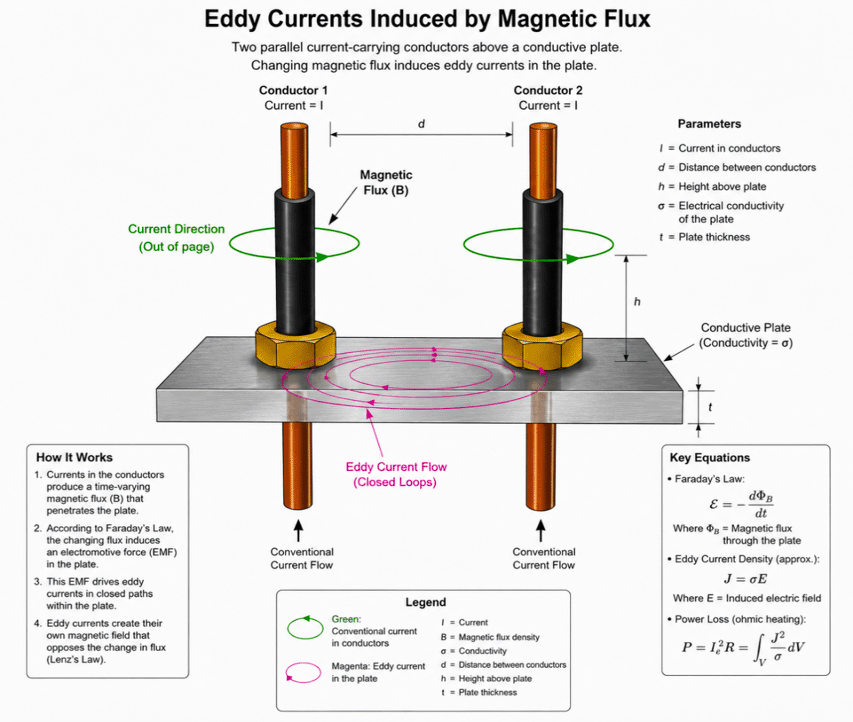
One of the most frequently observed scenarios involves single-core power cables passing individually through a ferromagnetic steel plate. The magnetic field surrounding each conductor induces circulating currents within the steel structure, resulting in localized heating around cable penetrations and gland plate openings.
Eddy current heating can remain hidden even when the cables themselves are operating normally.
Because the electrical conductors themselves may be operating normally, these thermal anomalies can easily remain unnoticed without thermal inspection.
Why Eddy Current Heating Matters
At first glance, a localized hot spot on a metallic structure may appear insignificant. However, prolonged exposure to elevated temperatures can have serious consequences.
Potential impacts include:
Accelerated Insulation Aging
Temperature remains one of the primary factors affecting insulation life. Continuous exposure to elevated temperatures can significantly shorten the expected lifespan of nearby cable insulation and electrical components.
Reduced Equipment Reliability
Repeated thermal cycling may contribute to premature deterioration of adjacent materials and components, increasing the likelihood of future failures.
Increased Maintenance Costs
Undetected thermal anomalies often progress until emergency corrective maintenance becomes necessary, resulting in higher repair costs and increased operational risk.
Energy Losses
Eddy currents represent wasted electrical energy. Although individual losses may appear small, long-term energy losses can become significant across large facilities.
Safety Concerns
Excessive temperatures can increase the risk of equipment damage, fire hazards, and unsafe operating conditions.
Infrared Thermography as an Early Detection Tool
One of the greatest advantages of infrared thermography is its ability to identify thermal anomalies while equipment remains energized and operating under normal load conditions.
Thermal imaging cameras detect infrared radiation emitted from equipment surfaces and convert it into visual temperature maps. This allows inspectors to quickly identify abnormal temperature patterns that may indicate developing problems.
For eddy current heating applications, thermography provides several key advantages:
- Non-contact inspection
- No interruption to operations
- Rapid identification of hot spots
- Early fault detection
- Verification of corrective actions
- Historical temperature trending
- Risk-based maintenance prioritization
Because heat is the primary symptom of eddy current losses, infrared thermography is particularly effective in identifying these hidden conditions before visible damage occurs.
Recognizing Eddy Current Hotspots
Experienced thermographers often recognize eddy current heating by distinctive thermal patterns.
Common indicators include:
- Localized heating around cable penetrations
- Elevated temperatures on metallic gland plates
- Symmetrical heating patterns surrounding conductors
- Hot spots on steel structures adjacent to energized cables
- Temperature anomalies that do not coincide with electrical connection points
These characteristics help differentiate eddy current heating from traditional resistance-related faults such as loose or deteriorated connections.
The Importance of Thermal Trending
A single thermographic inspection provides valuable information about the condition of equipment at a specific point in time. However, the true value of a thermography program emerges when inspections are repeated regularly, and historical data is maintained.
Thermal trending enables maintenance teams to:
- Monitor temperature progression
- Detect developing deterioration
- Evaluate repair effectiveness
- Identify recurring issues
- Support maintenance planning decisions
For eddy current heating, temperature trends often reveal increasing thermal activity long before temperatures reach critical levels.
Mitigation Strategies
Once eddy current heating is identified, corrective actions should focus on eliminating the root cause rather than simply addressing the thermal symptom.
Common mitigation measures include:
Use of Non-Ferromagnetic Materials
Where practical, aluminum or other non-ferromagnetic materials should be used for gland plates and cable entry structures.
Proper Cable Grouping
Phase conductors should pass through the same opening whenever possible to minimize magnetic flux imbalance.
Grounding and Bonding Review
Grounding arrangements should be evaluated to prevent unintended circulating current paths.
Design Verification
Engineering reviews should consider magnetic field effects during equipment installation and modification projects.
Routine Thermographic Surveys
Regular infrared inspections should be incorporated into maintenance programs to ensure developing anomalies are detected at an early stage.
Supporting Reliability-Centered Maintenance
Modern maintenance organizations increasingly rely on data-driven decision-making. Infrared thermography provides actionable condition information that supports reliability-centered maintenance (RCM), risk-based inspection (RBI), and asset management programs.
By identifying hidden thermal anomalies before failure occurs, thermography contributes directly to:
- Improved asset reliability
- Increased equipment availability
- Reduced maintenance costs
- Better resource allocation
- Enhanced operational safety
- Lower risk of unplanned outages
As facilities continue to pursue higher reliability targets, thermographic inspections remain one of the most practical and cost-effective predictive maintenance tools available.
Detecting Eddy Current Heating Before Failure
Eddy current heating is a frequently overlooked source of thermal anomalies in electrical substations and industrial power systems. Although often hidden from conventional inspection methods, its effects can significantly impact equipment reliability, operational efficiency, and safety.
Infrared thermography offers a powerful means of detecting these conditions early, allowing maintenance teams to identify abnormal heating before it develops into a more serious problem. When integrated into a structured condition monitoring program, thermal inspections provide valuable insight into equipment health and support proactive maintenance strategies.
As the industry continues to move toward reliability-focused asset management, infrared thermography will remain an essential technology for identifying hidden hot spots, reducing risk, and improving the long-term performance of critical electrical infrastructure.
References
- IEEE Standards Association – Electrical Equipment Maintenance and Thermal Assessment Guidelines.
- NFPA 70B – Standard for Electrical Equipment Maintenance.
- EPRI – Predictive Maintenance Applications for Electrical Substations.
- Infraspection Institute – Principles of Infrared Thermography.
- FLIR Systems – Electrical Inspection and Thermography Handbook.
- Balakrishnan, G.K., “Infrared Thermography for Condition Monitoring of Electrical Energy Systems,” Energies Journal.
- IEEE Transactions on Power Delivery – Studies on Eddy Current Losses in Power Equipment.
- CIGRE Technical Brochures on Substation Asset Reliability and Thermal Monitoring.