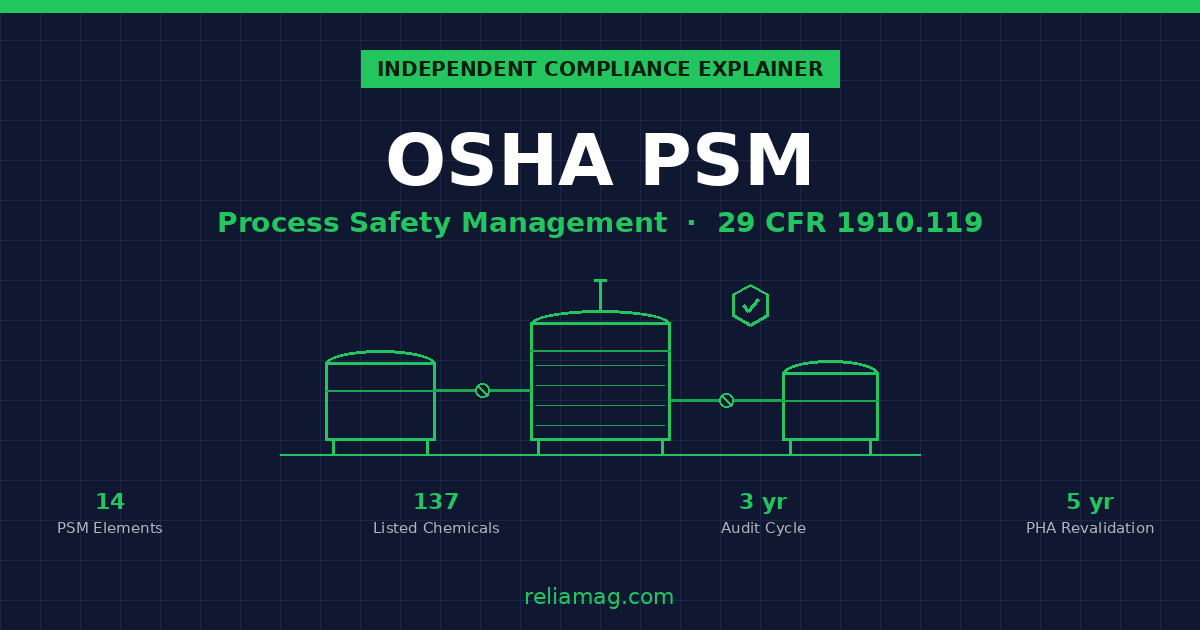

TL;DR: Process Safety Management (PSM) is the OSHA standard at 29 CFR 1910.119 governing facilities that handle highly hazardous chemicals above threshold quantities. Issued in 1992 under the Clean Air Act Amendments of 1990, PSM is the regulatory backbone of chemical plant, refinery, and process industry operations. It is a performance-based standard built around 14 required elements – employee participation, process safety information, process hazard analysis, operating procedures, training, contractors, pre-startup safety review, mechanical integrity, hot work permits, management of change, incident investigation, emergency planning and response, compliance audits, and trade secrets.
PSM applies to processes handling any of 137 listed chemicals in Appendix A at or above threshold quantity, processes with 10,000 pounds or more of a flammable liquid or gas, and explosives and pyrotechnics manufacturing. The 14 elements function as an integrated system, not a checklist: process safety information feeds the hazard analysis, the hazard analysis drives operating procedures and mechanical integrity priorities, and management of change governs every modification.
For maintenance and reliability teams, Mechanical Integrity (paragraph j) is the element where day-to-day work lives – inspection, testing, and repair of process equipment against API standards, documented to audit standard. A CMMS with PSM and API inspection workflow support substantially reduces the Mechanical Integrity documentation burden. PSM compliance audits are required at least every three years; process hazard analyses must be revalidated at least every five years. OSHA enforcement most commonly finds gaps between written programs and actual field practice.
The Short Answer
PSM is the OSHA regulation that governs how facilities handling highly hazardous chemicals prevent catastrophic releases. It applies to chemical plants, refineries, oil and gas processing facilities, and any operation handling listed chemicals above threshold quantities. Compliance is mandatory, OSHA inspections are routine under national emphasis programs, and the standard is built around 14 required elements that must be documented and verifiably implemented.
The single most important thing to understand about PSM is that it is a performance-based management system, not a prescriptive checklist. OSHA does not tell a facility exactly which inspection technology to use or exactly how to write an operating procedure. It specifies the safety outcomes that must be achieved and requires that the facility build and document a program that achieves them. This is why PSM compliance is genuinely difficult – it requires sustained organizational discipline across engineering, operations, maintenance, and process safety functions, not a one-time documentation exercise.
Why PSM Exists
PSM emerged from a series of catastrophic chemical incidents. The 1984 Bhopal disaster in India, where a methyl isocyanate release killed thousands, was the defining event. A series of U.S. refinery and petrochemical incidents through the late 1980s reinforced the recognition that accidental releases of highly hazardous chemicals could cause mass-casualty events affecting both workers and surrounding communities.
Congress responded through the Clean Air Act Amendments of 1990, which mandated that OSHA establish requirements for managing highly hazardous chemicals. OSHA issued the PSM standard as a final rule in 1992, codified at 29 CFR 1910.119. The same Clean Air Act Amendments also mandated the EPA’s Risk Management Program, the community-protection companion to PSM. The two regulations are deliberately complementary – PSM protects workers inside the fence, RMP protects the community outside it.
The standard has been amended since – notably in 1996 and 2013 – but the core structure of 14 elements has remained stable. OSHA has conducted modernization rulemaking activity over the past decade, including a 2013 Request for Information following Executive Order 13650, a Small Business Advocacy Review Panel in 2016, and a stakeholder meeting in 2022. As of 2026, that modernization rulemaking remains in the research and analysis phase – no revised PSM rule has been finalized, and the standard in force is the existing 1910.119. The most significant recent regulatory development affecting process safety is on the EPA side: the EPA finalized substantial RMP amendments, the Safer Communities by Chemical Accident Prevention rule, in March 2024.
PSM has measurably improved process safety in the United States, but major incidents continue to occur. Every significant process safety incident – and the investigations by OSHA and the U.S. Chemical Safety Board that follow – tends to trace back to failures in one or more of the 14 elements: an inadequate hazard analysis, a change that bypassed management of change, a mechanical integrity program that existed on paper but not in the field. The 14 elements are, in effect, a structured catalog of the ways process safety fails.
Which Facilities Are Covered
PSM coverage is triggered by three independent criteria. A facility is covered if it operates a process meeting any one of them.
Listed chemicals above threshold quantity. Appendix A of 1910.119 lists 137 highly hazardous chemicals, each with an individual threshold quantity. The chemicals are listed because of their toxicity and reactivity – chlorine, ammonia, hydrogen sulfide, hydrogen fluoride, and many others. If a process handles a listed chemical at or above its Appendix A threshold quantity, the process is covered.
Flammable liquids and gases at 10,000 pounds. A process involving 10,000 pounds or more of a flammable liquid or flammable gas in one location is covered, subject to specific exceptions. This threshold brings a large number of facilities into PSM scope beyond those handling Appendix A chemicals.
Explosives and pyrotechnics manufacturing. Processes involving the manufacture of explosives and pyrotechnics are covered.
The definition of a “process” under PSM is deliberately broad. A process is any on-site use, storage, manufacturing, handling, or movement of a highly hazardous chemical, or a combination of these activities. Critically, interconnected vessels are considered a single process, and separate vessels are considered a single process if they are located close enough that a highly hazardous chemical released from one could be involved in a release from another. This means PSM coverage extends beyond a single tank or a single line to the realistic boundary of a potential release event.
The standard includes specific exemptions. PSM does not apply to retail facilities, to oil and gas well drilling and servicing operations, or to normally unoccupied remote facilities. Certain fuel uses and certain flammable liquids stored in atmospheric tanks below their normal boiling point without chilling or refrigeration are excluded from the flammables trigger.
Industries commonly covered by PSM include chemical manufacturing, petroleum refining, oil and gas processing, pulp and paper operations, food processing facilities using anhydrous ammonia refrigeration, water and wastewater treatment facilities using chlorine, and pharmaceutical manufacturing. A facility determining its PSM coverage should evaluate every process against all three triggers, because a facility outside the Appendix A chemical list may still be covered by the flammables threshold, and a facility may have some processes covered and others not.
The 14 Elements of PSM
The 14 elements of PSM are the structure of the entire standard. Each element corresponds to a lettered paragraph of 1910.119 and carries specific documented requirements. The elements are presented below in the order of the regulation. The most important thing to understand is that they are an integrated system – the elements feed each other, and a weakness in one cascades into others.
1. Employee Participation – paragraph (c). Employers must develop a written plan of action for employee participation, consult with employees and their representatives on the conduct and development of process hazard analyses and other elements of PSM, and provide employees and their representatives access to process hazard analyses and all other PSM information. The principle is that the operators and maintenance personnel who know the process best must be involved in the program that protects them.
2. Process Safety Information (PSI) – paragraph (d). Before conducting a process hazard analysis, the employer must compile written process safety information covering the hazards of the highly hazardous chemicals (toxicity, permissible exposure limits, physical and reactivity data, corrosivity, and more), the technology of the process (block flow or process flow diagrams, process chemistry, maximum intended inventory, safe operating limits, and consequences of deviation), and the equipment in the process (materials of construction, piping and instrument diagrams, electrical classification, relief system design, ventilation system design, design codes and standards, material and energy balances, and safety systems). PSI is the foundation – every other element depends on accurate PSI. PSI accuracy is among the most frequently cited deficiencies in OSHA enforcement, typically because the documentation has drifted out of alignment with the as-built, as-operated plant.
3. Process Hazard Analysis (PHA) – paragraph (e). The employer must perform an initial process hazard analysis on all covered processes, using a recognized methodology appropriate to the complexity of the process – What-If, Checklist, What-If/Checklist, Hazard and Operability Study (HAZOP), Failure Mode and Effects Analysis (FMEA), Fault Tree Analysis, or an equivalent methodology. The PHA must address process hazards, prior incidents, engineering and administrative controls, consequences of control failures, facility siting, human factors, and a qualitative evaluation of the range of safety and health effects of control failure. The PHA must be performed by a team with expertise in engineering and process operations, including at least one employee experienced in the specific process and one knowledgeable in the methodology. The employer must establish a system to address the PHA team’s findings and recommendations and document resolution. PHAs must be updated and revalidated at least every five years.
4. Operating Procedures – paragraph (f). The employer must develop and implement written operating procedures that provide clear instructions for safely conducting activities involved in each covered process. The procedures must address steps for each operating phase (initial startup, normal operations, temporary operations, emergency shutdown, emergency operations, normal shutdown, and startup following a turnaround or emergency shutdown), operating limits and the consequences of deviation, safety and health considerations, and safety systems and their functions. Operating procedures must be reviewed as often as necessary to assure they reflect current operating practice, and they must be readily accessible to employees who work in or maintain the process. Procedure currency – the gap between the written procedure and how the unit is actually run – is a frequent enforcement finding.
5. Training – paragraph (g). Each employee involved in operating a covered process must be trained in an overview of the process and in the operating procedures, with emphasis on the specific safety and health hazards, emergency operations, and safe work practices. Refresher training must be provided at least every three years, or more often if necessary. The employer must document that each employee has received and understood the training.
6. Contractors – paragraph (h). Because contractors perform a large share of maintenance, turnaround, and construction work in process facilities, PSM imposes specific requirements on the use of contractors. The employer must evaluate contractor safety performance and programs when selecting contractors, inform contractors of the known potential hazards and the applicable provisions of the emergency action plan, and develop and implement safe work practices to control contractor presence in covered process areas. Contract employers in turn must train their employees, document that training, ensure their employees follow facility safety rules, and advise the host employer of hazards their work presents.
7. Pre-Startup Safety Review (PSSR) – paragraph (i). Before introducing a highly hazardous chemical into a new facility, or into a modified facility when the modification is significant enough to require a change in process safety information, the employer must perform a pre-startup safety review. The PSSR must confirm that construction and equipment are in accordance with design specifications, that safety, operating, maintenance, and emergency procedures are in place and adequate, that a process hazard analysis has been performed for new facilities and recommendations resolved or implemented before startup, that modified facilities meet the requirements of management of change, and that each affected employee has been trained. The PSSR is the last verification gate before hazardous chemicals enter the process, and a skipped or rubber-stamped PSSR has been a contributing factor in serious incidents.
8. Mechanical Integrity (MI) – paragraph (j). Mechanical Integrity governs the inspection, testing, and maintenance of process equipment to prevent loss of containment. MI is covered in detail in the next section because it is the element where maintenance and reliability teams do most of their PSM work.
9. Hot Work Permit – paragraph (k). The employer must issue a written permit for hot work operations – welding, cutting, brazing, and other spark- or flame-producing operations – conducted on or near a covered process. The permit must document compliance with fire prevention and protection requirements, indicate the date authorized, and identify the equipment on which hot work is performed. Hot work is a recurring ignition source in process safety incidents, which is why it carries its own dedicated element.
10. Management of Change (MOC) – paragraph (l). The employer must establish and implement written procedures to manage changes to process chemicals, technology, equipment, and procedures, and changes to facilities that affect a covered process. MOC is covered in more detail below because the boundary between a change requiring MOC and a replacement in kind is one of the most operationally consequential judgments in PSM.
11. Incident Investigation – paragraph (m). The employer must investigate each incident that resulted in, or could reasonably have resulted in, a catastrophic release of a highly hazardous chemical in the workplace. The investigation must begin as promptly as possible and no later than 48 hours after the incident, be conducted by a team including at least one person knowledgeable in the process, produce a report addressing the factors that contributed to the incident, and establish a system to address and resolve the report’s findings and recommendations. Investigation reports must be retained for five years. The “could reasonably have resulted in” language means PSM incident investigation extends to near-misses, not only actual releases.
12. Emergency Planning and Response – paragraph (n). The employer must establish and implement an emergency action plan for the entire plant in accordance with OSHA’s emergency action plan requirements. Depending on the facility’s chosen response strategy, emergency planning may extend to handling small releases and may require coordination with local emergency response authorities.
13. Compliance Audits – paragraph (o). The employer must certify that they have evaluated compliance with the PSM standard at least every three years to verify that the procedures and practices developed under the standard are adequate and being followed. The audit must be conducted by at least one person knowledgeable in the process. The employer must develop a report of the findings, document an appropriate response to each finding and that deficiencies have been corrected, and retain the two most recent compliance audit reports.
14. Trade Secrets – paragraph (p). The employer must make all information necessary to comply with PSM available to the persons compiling process safety information, those developing the process hazard analysis, those developing operating procedures, and those involved in incident investigations, emergency planning and response, and compliance audits – without regard to possible trade secret status. Employers may require confidentiality agreements, but trade secret status cannot be used to withhold process safety information from the people who need it to keep the process safe.
Mechanical Integrity in Depth: The Maintenance Team’s PSM Element
For maintenance and reliability teams, Mechanical Integrity is where PSM lives day to day. The other 13 elements involve maintenance to varying degrees, but Mechanical Integrity is the element built around inspection, testing, and repair of physical equipment – the core of the maintenance function.
Paragraph (j) of 1910.119 applies Mechanical Integrity to specific categories of process equipment: pressure vessels and storage tanks; piping systems, including piping components such as valves; relief and vent systems and devices; emergency shutdown systems; controls, including monitoring devices and sensors, alarms, and interlocks; and pumps. Identifying which equipment falls within the MI program – the covered equipment list – is the first MI requirement and a recurring point of enforcement scrutiny when the list is incomplete.
The MI program must include several specific components. The employer must establish and implement written procedures to maintain the ongoing integrity of process equipment. Maintenance personnel must be trained in an overview of the process and its hazards and in the procedures applicable to their job tasks. Inspections and tests must be performed on process equipment, using procedures that follow recognized and generally accepted good engineering practices, at frequencies consistent with applicable manufacturer recommendations and good engineering practice, and more frequently if operating experience indicates. Inspection and test results must be documented, identifying the date, the name of the person who performed it, the equipment identification, a description of the inspection or test, and the results. The employer must correct equipment deficiencies that are outside acceptable limits before further use, or in a safe and timely manner when necessary means are taken to assure safe operation. And the employer must establish quality assurance – for new equipment, that it is suitable for the process application; for maintenance materials, spare parts, and equipment, that they are suitable for the process application.
The role of API standards. PSM Mechanical Integrity is performance-based – it requires inspection at frequencies consistent with “recognized and generally accepted good engineering practices” but does not itself prescribe the specific inspection intervals or methods. In practice, chemical plants and refineries implement Mechanical Integrity through the American Petroleum Institute (API) inspection standards, which provide the recognized good engineering practice. API 510 governs pressure vessel inspection. API 570 governs piping inspection. API 653 governs aboveground storage tank inspection. API 580 and API 581 define risk-based inspection (RBI) methodology, which uses calculated risk to set inspection intervals and prioritization rather than fixed time intervals. API 579 provides fitness-for-service methodology for evaluating whether degraded equipment can remain in service. A chemical plant’s Mechanical Integrity program is, in operational terms, largely an implementation of these API standards within the PSM framework.
Where Mechanical Integrity fails. Mechanical Integrity is consistently among the most cited PSM elements in OSHA enforcement, and the failure mode is almost always the same: a gap between the program on paper and the program in the field. Inspection records that show identical readings year after year. Inspections scheduled but not performed. Deficiencies identified but not corrected. Covered equipment missing from the equipment list. The MI element only works when the inspection and testing actually happen, the results are honestly recorded, and the deficiencies are actually corrected – which is precisely why documentation infrastructure matters.
Management of Change: The Most Consequential Judgment in PSM
Management of Change deserves specific attention because the central MOC judgment – is this a change requiring MOC, or a replacement in kind – is made constantly in operating facilities and gets made wrong in ways that cause catastrophic incidents.
MOC under paragraph (l) requires that before any change to process chemicals, technology, equipment, or procedures (other than a replacement in kind), the employer’s written MOC procedure must address the technical basis for the proposed change, the impact of the change on safety and health, modifications to operating procedures, the necessary time period for the change, and authorization requirements. Affected employees and contractors must be informed and trained before the change is operated. Process safety information and operating procedures must be updated to reflect the change.
The critical phrase is “other than a replacement in kind.” A replacement in kind – replacing a component with one identical in specification – is not a change and does not require MOC. But the judgment of what constitutes “identical” is where MOC fails. A pump replaced with a pump of slightly different metallurgy. A gasket replaced with a different material. A relief valve replaced with one of a different set pressure. A procedure adjusted to accommodate a temporary operating condition. Each of these may look like a routine maintenance action but is in fact a change that should pass through MOC – and when it bypasses MOC, the process safety information becomes inaccurate, the hazard analysis no longer reflects the plant, and the conditions for an incident accumulate silently.
Inadequate management of change is one of the most common root causes identified in U.S. Chemical Safety Board investigations of process safety incidents. For maintenance organizations, the operational discipline is to treat the MOC determination as a required step in the work planning process, not an afterthought – every proposed change to covered equipment should be screened against the replacement-in-kind boundary before work proceeds.
How PSM Connects to CMMS and Maintenance Operations
PSM is a management system that spans engineering, operations, process safety, and maintenance functions. It is not a maintenance program and it is not something a CMMS delivers as a product. But several PSM elements are maintenance-intensive, and the maintenance management system is where the documentation for those elements is generated and retained.
Mechanical Integrity is the primary CMMS-PSM connection. The MI element requires inspection and testing at defined frequencies, documentation of results, tracking of deficiencies to correction, and a maintained covered equipment list. This is precisely the work a CMMS is built to manage – scheduling recurring inspections, capturing inspection results against equipment records, generating work orders for identified deficiencies and tracking them to closure, and producing the documentation an OSHA auditor will ask for. A CMMS or EAM platform with PSM-aware Mechanical Integrity functionality – inspection scheduling against API intervals, RBI workflow support, integration with thickness measurement and NDE data, and inspection certificate generation – substantially reduces the MI documentation burden compared to managing the program through spreadsheets.
The hot work permit element can be administered through CMMS permit workflows, linking the permit to the work order and the equipment, and retaining the permit record.
Management of change connects to the CMMS when MOC-approved changes generate maintenance work. The discipline worth building is a handshake between the MOC system and the work order system, so that work on covered equipment cannot proceed without confirmation that the MOC determination has been made, and so that completed changes trigger the required updates to process safety information.
Incident investigation draws on maintenance history – the work order record, inspection history, and equipment failure data that a CMMS holds are primary evidence in investigating an incident or near-miss.
Operating procedures and training for maintenance tasks – the maintenance procedures and the competency records for maintenance personnel – are PSM records that a CMMS or a connected training system maintains.
The honest framing is that the CMMS is the documentation and execution engine for the maintenance-intensive PSM elements, particularly Mechanical Integrity, but it is not the PSM program. Process safety information ownership, hazard analysis, the MOC determination itself, compliance auditing, and the overall management system sit above the CMMS. Operations evaluating CMMS or EAM platforms for a PSM-covered facility should weight Mechanical Integrity and API inspection workflow capability specifically – our independent chemical plant CMMS guide covers the platforms with the deepest PSM and MI capability.
Audits, Enforcement, and the National Emphasis Programs
PSM compliance is enforced by OSHA through inspections, and the inspection activity is concentrated by national emphasis programs (NEPs). OSHA operates a Process Safety Management National Emphasis Program directing programmed inspections at PSM-covered facilities, and a separate Petroleum Refinery Process Safety Management National Emphasis Program directing inspections at refineries. Under these programs, PSM-covered facilities face programmed inspections independent of any incident or complaint.
OSHA enforcement guidance for PSM is consolidated in OSHA Instruction CPL 02-01-065, which took effect in January 2024, superseding the prior 1994 enforcement instruction. The current instruction reorganizes OSHA’s PSM enforcement interpretations into a question-and-answer format with links to the letters of interpretation OSHA has issued since the standard was promulgated. The instruction did not change the PSM requirements themselves – it compiled and reorganized existing enforcement policy to support more uniform enforcement.
PSM citations are issued by violation type – other-than-serious, serious, willful, and repeat – with penalty amounts adjusted annually for inflation and willful and repeat violations carrying substantially higher maximums. Because PSM has 14 elements each containing multiple specific requirements, enforcement actions at facilities with systemic deficiencies routinely involve numerous citations, and aggregate penalties in significant PSM cases have reached into the millions of dollars.
The pattern in PSM enforcement is consistent and worth internalizing: the most commonly cited deficiencies are gaps between documentation and field practice. Process safety information that no longer matches the as-built plant. Process hazard analysis recommendations that were never resolved. Operating procedures that do not reflect how the unit is actually run. Mechanical Integrity inspections scheduled but not performed, or performed but not honestly documented. Pre-startup safety reviews, management of change, and incident investigations where the close-out and follow-through failed. A facility can have a complete set of written PSM programs and still receive serious citations if the programs are not verifiably implemented in the field.
PSM and EPA RMP: The Companion Regulation
PSM does not exist in isolation. Its companion regulation is the EPA’s Risk Management Program (RMP), codified at 40 CFR Part 68. Both PSM and RMP were mandated by the Clean Air Act Amendments of 1990, and they address the same underlying hazard – catastrophic releases of highly hazardous chemicals – from two different perspectives.
PSM, administered by OSHA, focuses on protecting workers inside the facility. RMP, administered by the EPA, focuses on protecting the surrounding community and the environment. An RMP-covered facility must develop and submit a risk management plan that includes a hazard assessment with an offsite consequence analysis (modeling worst-case and alternative release scenarios and their potential reach into the community), a prevention program, and an emergency response program. The RMP prevention program elements substantially overlap the PSM elements – process hazard analysis, operating procedures, training, mechanical integrity, management of change, and the rest – which is why facilities covered by both regulations typically operate a single integrated program that satisfies both.
The chemical lists and threshold quantities differ between PSM and RMP, so a given facility may be covered by PSM only, RMP only, both, or neither. Most large chemical plants and refineries are covered by both.
The most significant recent regulatory development on the RMP side is the EPA’s Safer Communities by Chemical Accident Prevention rule, finalized in March 2024. The rule strengthened RMP requirements in several areas, including expanded safer technology and alternatives analysis provisions for certain facilities, requirements for third-party compliance audits and root-cause incident investigations at facilities with prior accident history, and additional employee participation provisions. Facilities covered by RMP should track the implementation of this rule and its compliance timelines. The PSM standard itself was not changed by the EPA rulemaking – the two regulations are separate – but for a facility running an integrated PSM and RMP program, changes on the RMP side affect the combined program.
What to Do: Building and Sustaining PSM Compliance
PSM compliance is not a project with an end date. It is a sustained operating discipline. For maintenance and reliability leaders at PSM-covered facilities, the following priorities matter most.
- Confirm coverage accurately. Evaluate every process against all three PSM triggers – Appendix A chemicals at threshold quantity, flammables at 10,000 pounds, and explosives manufacturing. Coverage determinations should be documented and revisited when processes or inventories change.
- Treat the covered equipment list as a living document. The Mechanical Integrity covered equipment list is the foundation of the MI program. Equipment added through capital projects or management of change must be added to the list. An incomplete equipment list is a direct enforcement exposure.
- Close the documentation-to-field gap. The dominant PSM enforcement finding is the gap between written programs and field reality. Process safety information must match the as-built plant. Operating procedures must match how the unit is run. Mechanical Integrity inspections must actually be performed and honestly documented. Internal verification should include field observation, not only document review.
- Make the MOC determination a required work-planning step. Every proposed change to covered equipment should be screened against the replacement-in-kind boundary before work proceeds. Building this into the maintenance work planning process – rather than treating MOC as a separate parallel system – is the most effective way to prevent changes from bypassing MOC.
- Track PHA and audit cycles. Process hazard analyses must be revalidated at least every five years. Compliance audits must be conducted at least every three years with the two most recent reports retained. These cycles should be tracked formally so they do not lapse.
- Resolve findings and close the loop. PHA recommendations, audit findings, and incident investigation recommendations must be resolved and documented. Open findings that accumulate without resolution are both an enforcement exposure and a genuine safety risk.
- Invest in the documentation infrastructure. For the maintenance-intensive elements – Mechanical Integrity above all – a CMMS or EAM platform with PSM and API inspection workflow capability substantially reduces the burden of generating and retaining audit-ready documentation. Facilities running Mechanical Integrity through spreadsheets and disconnected records carry both higher administrative cost and higher enforcement risk.
- Protect the PSM program owner role. Process safety expertise is scarce, and many facilities have lost long-tenured PSM program owners to retirement. The PSM coordinator role is a single point of failure that should not be left vacant.
Frequently Asked Questions
What is OSHA Process Safety Management?
Process Safety Management (PSM) is the OSHA standard at 29 CFR 1910.119 governing facilities that handle highly hazardous chemicals above threshold quantities. Issued in 1992 under the Clean Air Act Amendments of 1990, PSM requires covered employers to implement a comprehensive, performance-based management program built around 14 required elements, with the goal of preventing catastrophic releases of toxic, reactive, flammable, or explosive chemicals.
What are the 14 elements of PSM?
The 14 elements are Employee Participation, Process Safety Information, Process Hazard Analysis, Operating Procedures, Training, Contractors, Pre-Startup Safety Review, Mechanical Integrity, Hot Work Permit, Management of Change, Incident Investigation, Emergency Planning and Response, Compliance Audits, and Trade Secrets. Each corresponds to a lettered paragraph of 1910.119 (paragraphs c through p) and carries specific documented requirements. The elements function as an integrated system rather than a checklist.
Which facilities are covered by PSM?
PSM covers processes handling a chemical listed in Appendix A of 1910.119 at or above its threshold quantity, processes with 10,000 pounds or more of a flammable liquid or gas in one location, and explosives and pyrotechnics manufacturing. Common covered industries include chemical manufacturing, petroleum refining, oil and gas processing, food processing using ammonia refrigeration, and water treatment using chlorine. Exemptions include retail facilities, oil and gas well drilling and servicing, and normally unoccupied remote facilities.
What is Mechanical Integrity under PSM?
Mechanical Integrity, paragraph (j) of 1910.119, governs the inspection, testing, and maintenance of process equipment – pressure vessels, storage tanks, piping, relief and vent systems, emergency shutdown systems, controls, and pumps – to prevent loss of containment. The program requires a covered equipment list, written maintenance procedures, trained maintenance personnel, inspection and testing at appropriate frequencies, documented results, and correction of deficiencies. In practice, MI is implemented through API inspection standards including API 510, 570, 653, 580, and 581.
What is Management of Change in PSM?
Management of Change (MOC), paragraph (l), requires written procedures to manage changes to process chemicals, technology, equipment, and procedures before they are made – addressing the technical basis, safety and health impact, procedure modifications, time period, and authorization. MOC does not apply to replacements in kind. The judgment of what constitutes a replacement in kind versus a change requiring MOC is one of the most operationally consequential decisions in PSM, and inadequate MOC is a frequent root cause in catastrophic incidents.
How often are PSM compliance audits required?
PSM compliance audits are required at least every three years under paragraph (o), conducted by at least one person knowledgeable in the process, with the two most recent audit reports retained. This is separate from process hazard analysis revalidation, which is required at least every five years under paragraph (e).
What is the difference between OSHA PSM and EPA RMP?
PSM (29 CFR 1910.119, OSHA) and RMP (40 CFR Part 68, EPA) are companion regulations from the Clean Air Act Amendments of 1990. PSM protects workers inside the facility; RMP protects the surrounding community and environment. The prevention program elements overlap heavily, so facilities covered by both typically run a single integrated program. The EPA finalized significant RMP amendments – the Safer Communities by Chemical Accident Prevention rule – in March 2024.
How does a CMMS support PSM compliance?
A CMMS supports PSM primarily through the Mechanical Integrity element – scheduling and tracking inspections against required intervals, documenting results, managing the covered equipment list, and tracking deficiencies to correction. It also supports hot work permit workflows, management-of-change-driven work, incident investigation through maintenance history, and maintenance training records. The CMMS is the documentation and execution engine for the maintenance-intensive PSM elements, but it is not the PSM program itself.
What are the penalties for PSM non-compliance?
OSHA issues PSM citations by violation type – other-than-serious, serious, willful, and repeat – with penalties adjusted annually for inflation and willful and repeat violations carrying substantially higher maximums. Because PSM has 14 elements with many requirements, enforcement actions at facilities with systemic deficiencies often involve numerous citations, and aggregate penalties in significant cases have reached millions of dollars. PSM enforcement is concentrated by OSHA’s national emphasis programs.
Related Guides
- Best CMMS for Chemical Plants 2026: Independent Comparison
- Best CMMS for Oil and Gas 2026
- Best EAM Software for Oil and Gas 2026
- Best Asset Performance Management Software 2026
- Best EHS / Safety Management Software 2026
- How to Calculate Asset Criticality
Sources
- 29 CFR 1910.119 – Process Safety Management of Highly Hazardous Chemicals, full standard text and Appendix A, ecfr.gov and osha.gov
- OSHA – Process Safety Management standard overview and background, osha.gov/process-safety-management
- OSHA Instruction CPL 02-01-065 – PSM enforcement instruction (effective January 2024)
- OSHA Process Safety Management National Emphasis Program and Petroleum Refinery PSM National Emphasis Program
- U.S. Chemical Safety and Hazard Investigation Board (CSB) – incident investigation reports
- EPA – Risk Management Program, 40 CFR Part 68
- EPA – Safer Communities by Chemical Accident Prevention final rule (March 2024)
- Clean Air Act Amendments of 1990 – statutory authority for PSM and RMP
- API 510 – Pressure Vessel Inspection Code
- API 570 – Piping Inspection Code
- API 653 – Tank Inspection, Repair, Alteration, and Reconstruction
- API 580 and API 581 – Risk-Based Inspection methodology
- API 579 – Fitness-For-Service
- Reliable Magazine independent editorial analysis
Last updated: May 19, 2026. This guide is editorial analysis by Reliable Magazine and is not legal or compliance advice. Facilities covered by PSM should consult qualified process safety professionals and current OSHA guidance for specific compliance determinations.