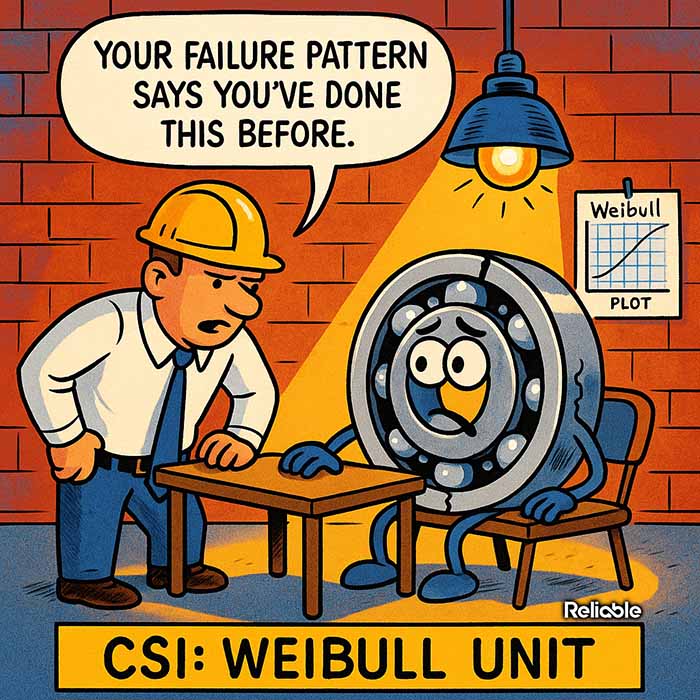

Every bearing, gearbox, and pump tells a story through its failures. Knowing how to interpret Weibull analysis results turns that story into something actionable: a maintenance interval, a design change, a purchasing decision. The math behind the Weibull distribution has been around since the 1950s, but most reliability teams still struggle with the practical side of reading and applying what the numbers actually mean.
That gap between generating a Weibull plot and making a smart decision based on it costs plants thousands of hours in unnecessary downtime every year.
The Basics: How to Interpret Weibull Analysis Results
A Weibull plot distills failure data into two parameters that matter: beta (β) and eta (η). Beta describes the shape of the failure distribution. Eta represents the characteristic life, the point at which roughly 63.2% of a population will have failed.
Beta gets most of the attention, and for good reason. Its value tells you why things are breaking.
- Beta < 1: Infant mortality failures. Components are failing early, often due to installation errors, manufacturing defects, or contamination introduced during assembly.
- Beta = 1: Random failures. The failure rate is constant over time, which points to external events (operating overloads, foreign object damage, human error) rather than wear.
- Beta > 1: Wear-out failures. Components are degrading with age or use. The higher the beta, the steeper the wear curve and the more predictable the failure timing.
This single number reshapes your entire maintenance approach. A beta below 1 means your time-based replacement program might be causing failures by introducing new components into their most vulnerable period. A beta above 3 means you can set a replacement interval with high confidence and very few surprises.
A Weibull beta value below 1 means your scheduled replacements may be introducing more failures than they prevent.
Eta, the characteristic life, anchors your timing. If eta for a pump seal is 14,000 operating hours, you know 63.2% of those seals will fail by that mark. Combine eta with your acceptable risk threshold (say, 10% probability of failure) and you can back-calculate a replacement interval that balances cost against reliability.
Reading the Plot: Slope, Scatter, and Subpopulations
The Weibull plot itself, with ln(ln(1/(1-F(t)))) on the vertical axis and ln(time) on the horizontal, offers more than just beta and eta. The fit of your data points to the regression line matters enormously.
Tight clustering along the line means your failure mode is consistent. Scatter means something else is going on: mixed failure modes, inconsistent operating conditions, or data quality problems. A curve that bends or shows distinct segments often indicates two or more competing failure mechanisms.
Suppose you plot bearing failures across a fleet of 40 identical fans. The data hugs the line from 2,000 to 8,000 hours, then a cluster of points breaks sharply upward. That inflection point is a signal. You likely have a subpopulation: one group failing from weibull analysis of normal fatigue, and another group failing prematurely from a different root cause (misalignment, lubrication breakdown, or a bad production batch).
When data points break away from the Weibull regression line, you’re looking at a second failure mode hiding inside the first.
Splitting the dataset and running separate Weibull analyses for each subpopulation gives you two distinct betas and etas, and two distinct maintenance strategies.
Suspension Data: The Survivors Matter Too
One of the most common mistakes in Weibull analysis is ignoring suspension data (also called censored data). These are the components that haven’t failed yet. Leaving them out biases your results toward shorter life estimates.
If 12 out of 50 bearings have failed and 38 are still running, those 38 survivors carry real statistical weight. Including them as suspensions shifts your eta estimate upward and sharpens your confidence bounds. Excluding them makes your equipment look less reliable than it actually is.
Turning Weibull Analysis Results into Maintenance Decisions
Interpreting the numbers is only half the job. The other half is translating them into actions that save money and prevent unplanned downtime.
- For beta < 1: Stop replacing on a fixed schedule. Focus on quality control during installation, commissioning procedures, and early-life condition monitoring to catch defective units before they cascade into bigger problems.
- For beta near 1: Time-based replacement adds no value here. Invest in condition monitoring technologies (vibration, oil analysis, thermography) to catch random failures as they develop.
- For beta > 1: Set a preventive replacement interval based on your risk tolerance. Use the B10 life (the age at which 10% of components will have failed) as a starting point, then adjust based on consequence of failure and replacement cost.
A facility running 200 identical motors can use fleet-level Weibull results to schedule batch replacements during planned outages rather than reacting to each failure individually. The math gives you the window; maintenance planning fills it with the right work orders, parts, and labor.
Fleet-level Weibull data lets you schedule batch replacements during planned outages instead of chasing individual failures.
The B10 life is particularly useful for critical assets where any failure triggers a significant production loss. Setting a replacement interval at B10 means accepting a 10% chance of failure before replacement. For a $50 turbine blade, that might be too aggressive. For a $2 coupling on a redundant pump, it might be perfectly rational.
Common Pitfalls When Applying Weibull Results
Small sample sizes distort everything. Running a Weibull analysis on four failures produces a plot, but the confidence interval will be so wide it’s functionally useless. Most practitioners need at least 10 to 15 failures (plus suspensions) before the results become trustworthy enough to base decisions on.
Mixing failure modes is another trap. If you lump bearing fatigue failures together with seal leaks and electrical faults, the resulting Weibull plot tells you nothing meaningful about any of them. Root cause failure analysis should happen before the data ever touches a Weibull spreadsheet.
- Always separate failure modes before plotting. One failure mode per analysis.
- Record suspension data religiously. Every survivor improves your estimate.
- Revisit your analysis as new failures accumulate. A Weibull curve built on 2023 data may not reflect 2026 operating conditions.
Weibull analysis rewards patience and discipline. The teams that get the most value from it are the ones that collect clean data over years, update their models regularly, and treat the results as living inputs to their reliability programs rather than one-time reports filed away in a shared drive.
The distribution itself is simple. The discipline to collect the right data, separate the failure modes, and act on the findings is where most organizations fall short. Closing that gap turns Weibull analysis from an academic exercise into one of the most powerful tools in a reliability engineer’s toolkit.