How to Test Standby Equipment So It Runs on the Day It Actually Matters
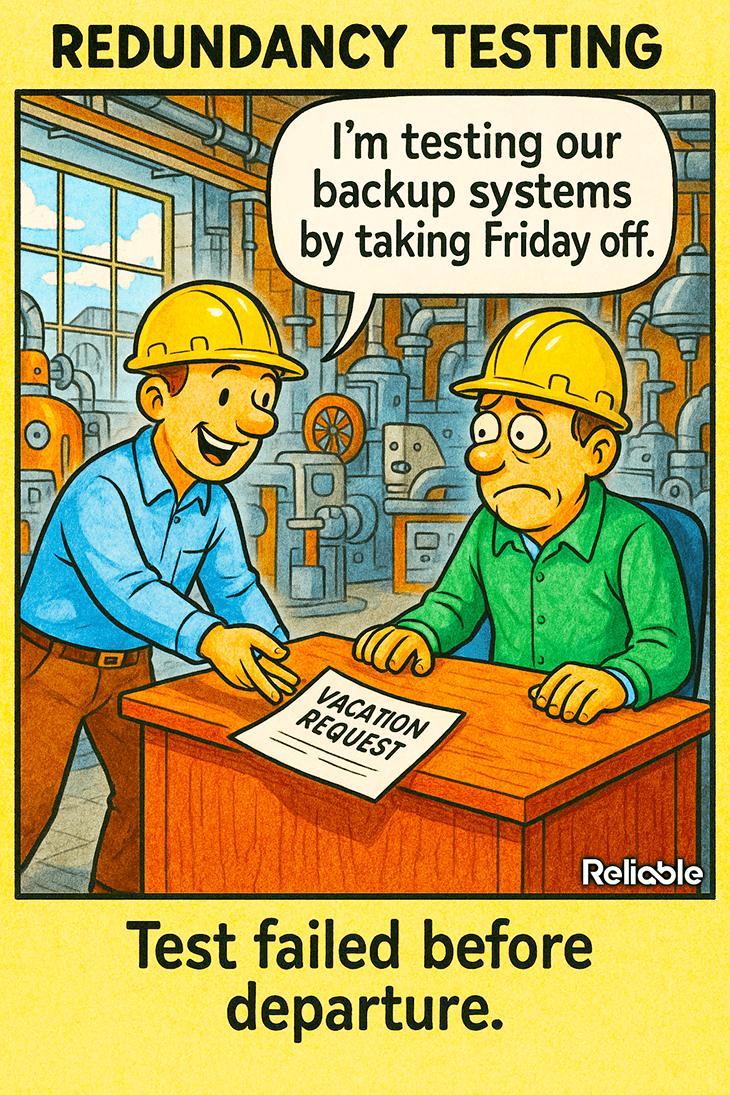
A standby pump has one job, and nobody finds out whether it can do that job until the duty pump trips. Knowing how to test standby equipment is what separates a backup that starts from a backup that exists on paper.
The reliability term for this is a hidden failure: a failure that is not apparent to the operating crew under normal conditions. The spare failed silently, weeks or months ago, and the plant has been running with no redundancy while the dashboard shows two pumps.
Standby pumps, backup compressors, emergency generators, spare transformers, fire pumps, and relief valves all share the trait. Each one is a promise the plant made to itself, and each one gets tested far less often than the promise deserves.
How to Test Standby Equipment: Start With the Hidden Failure
First, list what can fail silently on the standby unit. On a pump, that could be a seized shaft after months without rotation, a dry mechanical seal, a discharge check valve stuck shut, an isolation valve someone closed during the last outage, or an auto-start relay that nobody has energized since commissioning.
Idle equipment also develops its own failure modes. A standby pump bolted to the same base as a running pump picks up vibration through the foundation while its own shaft sits still, and small oscillations wear depressions into the raceways at the rolling-element contacts. False brinelling means the spare can arrive at its first start with damaged bearings and zero run hours.
A standby pump can arrive at its first start with damaged bearings and zero run hours.
An idle pump gives a vibration route little to trend, but the P-F interval is not limited to running machines. Inspection can reveal deterioration during idleness; a functional test is needed to confirm the standby can do its job.
Reliability-centered maintenance treats this as its own task type, the failure-finding task, and the guide on how to perform RCM shows how it falls out of the analysis. The logic is simple: when a failure is hidden, condition monitoring on the duty unit protects nothing on the standby, so the standby gets a scheduled test.
Setting the Test Interval
For a single standby device with a constant hidden-failure rate, short effective tests, and prompt repair, a useful approximation is: test interval equals twice the acceptable average unavailability multiplied by the mean time between hidden failures. A standby pump with a 10-year mean time between hidden failures and a 5 percent tolerable unavailability gets tested roughly every 12 months. Cut the acceptable unavailability to 1 percent, and the interval drops to about 10 weeks.
Three inputs drive that number, and the plant controls two of them:
Acceptable unavailability: the tolerated average probability that the spare is unavailable when needed, set by the frequency and consequence of demands with no backup
Mean time between failures of the standby itself, which depends on rotation, isolation from vibration, and seal and bearing design
Test effectiveness: a test that only proves the motor turns does little for the failure modes hiding in the valves and controls
Critical standby systems such as emergency generators come with standards that set the interval for you, typically a monthly run under load. For a spare cooling-water pump, the number is the plant's to calculate, and it is almost always shorter than the current practice of 'whenever we remember.'
Write the calculation on the task itself. A test interval that traces back to a consequence and a failure rate survives budget reviews; an interval that traces back to habit gets stretched to quarterly, then annual, then dropped.
Designing a Test That Proves Something
Much of the advice on how to test standby equipment stops at a bump test. A test that starts the standby from the local switch, watches it run for two minutes, and stops it proves the motor turns. It says nothing about the auto-start, the transfer logic, the check valve, or whether the pump can carry the full process load for a shift.
The useful test mimics the real event. Under an approved test plan that controls process risk, trip the duty unit or simulate the trip, and let the standby start on its own signal. Leave it carrying the load long enough to reach operating temperature, and record pressure, flow, amps, vibration, and bearing temperature against the duty unit's numbers.
The useful test proves the standby starts on its own signal and carries the load under controlled conditions.
Those readings are valuable condition monitoring data, so treat them that way. A spare that starts fine but pulls 15 percent more current than its twin at comparable flow, head, speed, and voltage deserves investigation before the next demand.
Record a failed standby test as a failure, with a work order and a cause code, even though nothing went down. A dead standby found on a Tuesday afternoon is the system working. A dead standby found at 3 a.m. with the duty pump in pieces is the reason the test existed.
Rotation, Records, and the Day It Matters
Rotation is cheap insurance, but it does not replace a test of the automatic start and transfer functions. Swapping duty and standby on a fixed schedule, weekly or monthly, gives both units run hours, keeps seals wet and bearings turning, and turns a hidden failure into an evident one on the day of the swap. A dual redundancy arrangement only delivers its promised availability when both machines are proven, and a controlled rotation can supply part of that proof.
Rotation has a cost worth naming. Two units sharing duty equally each accumulate about half the running hours of a dedicated duty pump, and the plant gives up the idea of a spare that has never run. Set the rotation schedule around the equipment's failure modes and the manufacturer's guidance, balancing damage from idleness against wear and stress from starts and running.
Keep the records where the on-call technician can find them:
Date, type of test (manual start, auto-start, loaded run), and who ran it
Readings taken, with the duty unit's numbers alongside for comparison
Any failure found, the work order raised, and the retest date
Current duty and standby assignment, and the next scheduled swap
A backup is a claim until it has been tested, and the test is the only thing that turns the claim into a number the plant can plan around.