How to Dispose of Surplus MRO Inventory When the Machine Left Years Ago
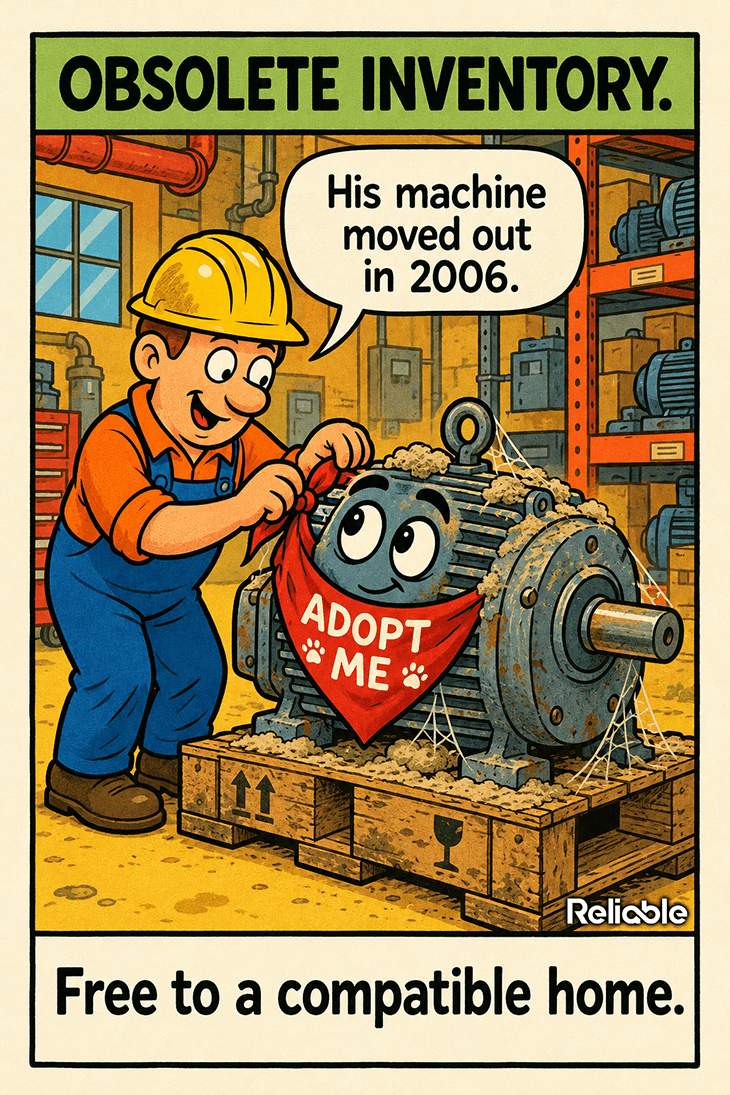
Somewhere in your storeroom there's probably a spare gearbox, drive, or control board that was bought for a machine the plant scrapped a decade ago. It still has a bin location. It still gets cycle counted. It still sits on the balance sheet at the price somebody paid for it in 2009.
Knowing how to dispose of surplus MRO inventory starts with admitting that part has no job left to do. The money was spent long ago; you're still paying the carrying cost. Here's a working method: find the stranded spares, pick an exit for each one, get the write-off approved, and shut off the supply of new ones.
Why the Shelf Fills With Stranded Spares
A decommissioning project removes the asset and leaves its spares behind. The equipment gets a retirement work order, the foundation gets grouted over, and the bill of materials that tied a dozen stocked parts to that asset is never touched. The parts stay active in the CMMS with a min/max that keeps them replenished.
That reorder logic is the quiet villain. A part set to min 1, max 2 can be reordered when a quick test or a borrowed fit takes available stock below the minimum, whether or not a matching machine still exists. In many storerooms, the only thing keeping a dead part from being reordered is that nobody has touched it.
A reorder point can keep buying for a machine that left in 2009, because it tracks stock levels, not whether the machine is still there.
Then there's the number on the tag. A $14,000 spindle drive sits on the books at $14,000, and the person who signs off on scrapping it has to explain where $14,000 went. (It went out the door with the machine. The accounting just hasn't caught up.)
Carrying cost is the part nobody prints on the tag. Rough planning estimates for spare parts inventory management commonly put it between 20 and 30 percent of item value per year once you count space, insurance, cycle counting, shelf-life losses, and the capital tied up. At an assumed annual 20 percent of purchase price, 15 years adds up to three times that price in carrying cost, including allocated and opportunity costs that may not turn into cash savings.
So the stranded part stays. It's counted, insured, and occasionally moved to a new shelf, and it protects nothing. Any serious plan for how to dispose of surplus MRO inventory starts by naming that part for what it is: a cost center with a bin location.
How to Dispose of Surplus MRO Inventory: Find the Stranded Parts First
You can't dispose of what you can't see, and the standard CMMS reports hide these parts well. The slow-moving report sorts by last issue date, which catches stranded parts but also catches legitimate insurance spares that are supposed to sit still for years. The two look identical on that report.
The separating question, and the real first step in how to dispose of surplus MRO inventory, is whether the part still has an active asset to serve. Answering it takes a cross-reference the system rarely runs on its own: every stocked part against the asset bill of materials, filtered to assets whose status is retired, sold, or scrapped. Pull these lists and stack them:
Parts whose only linked assets carry a retired or disposed status in the CMMS
Parts with no asset link at all and no issue transaction in 36 months
Parts linked to equipment the plant floor says left years ago (the data lags the floor, so walk it)
Parts with an active reorder point whose vendor no longer lists the item
Then take the list to the people who've been there longest. A 20-year storeroom attendant or electrician will tell you in an afternoon which of those 400 line items belonged to the line that was torn out in 2011. That walk-through is also where you'll find the parts that still fit something running, which changes their fate entirely.
Pick an Exit Route for Each Part
Once a part is confirmed stranded, you need to decide what to do with it, and disposing of surplus MRO inventory should follow the money. Rank the exits by how much value comes back, and work down the list until one sticks.
Internal transfer comes first. A sister plant that needs a compatible, serviceable gearbox can avoid a purchase, and the company puts the spare back to work. Corporate storeroom networks exist for exactly this, and the ones that work publish a shared surplus list every month.
A transfer to a sister plant can avoid a new purchase; an auction turns the part into cash at market value.
Vendor return comes next, with a caveat: restocking fees can take a substantial bite, and suppliers set their own age, packaging, and condition limits. For a part bought in 2009, that door is usually closed. Ask anyway; some distributors run buyback programs for discontinued lines because other customers still run them.
Resale through a surplus dealer, an industrial auction site, or a broker can recover cash, but the amount depends on condition, documentation, and market demand. Record the item honestly (nameplate data, storage history, whether it has ever been energized), and the price can improve. Unlabeled bins at an auction tend to go for scrap value.
Repurpose, donate, and scrap fill out the bottom of the list. A trade school or apprenticeship program will take a serviceable drive for training. Controlled cannibalization can recover compatible components that pass inspection and are approved for reuse. And scrap metal pays something, which beats paying to store it.
Make the Write-Off Survivable
The piece of how to dispose of surplus MRO inventory that stalls most efforts is the ledger, so bring finance in before the list is final, not after. Have finance confirm each spare's book value and classification first; a major spare may sit in fixed assets rather than inventory. Show them what use or resale value remains; carrying-cost savings help make the disposal case.
Sunk cost is the argument that lands. The purchase price left the bank account years ago; the disposal decision turns on the part's remaining use, resale value, and avoidable carrying costs. A write-down records lost value, and finance determines the required amount and timing.
Agree on a disposition authority with dollar thresholds. A storeroom supervisor can scrap anything under $500 with their own signature, a maintenance manager up to $5,000, and above that it goes to the plant controller. Without thresholds, decisions escalate by default, and escalated decisions age on someone's desk.
Stage the physical cleanup if the workload is large. A required $600,000 write-down belongs in the period the loss occurs, even if clearing the shelves takes four quarters. In every case, the record behind each decision should give an auditor two years from now enough to follow it:
Part number, description, quantity, and book value at the time of the decision
The retired asset it served and the date that asset left the plant
The exits attempted (transfer list posted, vendor contacted, auction lot) and the outcome
Who approved the disposition and under which threshold
Recovered value, if any, and where it was credited
Close the Loop So the Surplus Stops Coming Back
Disposal is a one-time cleanup unless the process that created the surplus changes. That process is asset retirement, and many plants have no spares step at all. Retirement is the final stage of maintenance and asset management, and it deserves the same checklist discipline as commissioning.
Add one line to the decommissioning checklist: review the asset's bill of materials and disposition every stocked part that serves nothing else. Do it while the project team still exists and the retired machine is still fresh in people's memory. Six months later, that knowledge has left with the contractor.
Review the spares the same week you retire the machine, while the people who know which parts fit what are still on site.
Fix the data so the cross-reference works next time. Link equipment-specific spares to the assets they serve, and document why shared consumables are stocked. Flag a part for review when its last linked asset retires, and use the CMMS controls that actually block reordering. Confirm the block works; a status label alone may not.
Separate the insurance spares from the stranded ones on purpose. An asset criticality ranking, paired with failure likelihood, replenishment lead time, and available backup, helps identify which spares justify years of carrying cost. Those get a protected status and a documented reason. The rest, anything with no movement in 24 months, goes to a sunset review.
Run that sunset review annually, with the same thresholds and the same record. The first pass is the painful one. After that, how to dispose of surplus MRO inventory becomes a routine review, handled long before any of them reaches its fifteenth birthday on the shelf.