OSHA Walking-Working Surfaces Requirements for Grating and Stairs
OSHA walking-working surfaces requirements live in 29 CFR 1910 Subpart D, and they govern nearly every surface a maintenance technician stands on: floors, platforms, catwalks, mezzanines, ramps, ladders and fixed stairs. For plants built on steel bar grating, the rules are specific enough to cite and loose enough to misread. Most facilities are compliant on paper. Fewer are compliant in the way that keeps a person upright on a wet catwalk at 2 a.m.
This article walks through the Subpart D sections that matter most for grating and stairs: the general requirements in 1910.22, the stairway rules in 1910.25, the fall protection duties in 1910.28 and 1910.29, and the training obligation in 1910.30. It also covers the gap the standard leaves open. A grating panel can pass every inspection item on the checklist and still fail to deliver the traction a worker needs.
What OSHA Walking-Working Surfaces Requirements Cover
Subpart D runs from 1910.21 through 1910.30 and applies to every general industry workplace. OSHA adopted the original standards in 1971 and left them largely untouched for 45 years. The final rule published November 18, 2016 rewrote the subpart, took effect January 17, 2017, and replaced many specification-style rules with performance language.
Three changes from that rewrite matter most for grating and stairs:
Inspection became a duty. 1910.22(d) now requires employers to inspect walking-working surfaces regularly and as needed, and to correct, repair or guard any hazardous condition.
"Fixed industrial stairs" became "stairways." 1910.25 now covers standard, spiral, ship and alternating tread stairs, with dimensional rules and a grandfather clause for stairs installed before January 17, 2017.
Training became mandatory. 1910.30 requires training on fall hazards and the equipment used to control them, with a compliance date of May 17, 2017.
OSHA estimated the rule would prevent 29 deaths and 5,842 lost-workday injuries a year. The agency's own framing is worth noting: slips, trips and falls are described as a leading cause of worker deaths and lost-workday injuries in general industry. That is the problem Subpart D exists to solve, and grating is where a good share of it happens.
1910.22: General Requirements for Grating, Platforms and Walkways
1910.22 is short, written in performance language, and the section most likely to appear on a citation involving grating or stairs. It has four parts.
Surface conditions, 1910.22(a). Surfaces must be kept clean, orderly and sanitary. Workroom floors must be kept clean and, to the extent feasible, dry. Where wet processes run, drainage must be maintained and dry standing places such as false floors, platforms or mats provided. Surfaces must be kept free of hazards, and the rule names them: sharp or protruding objects, loose boards, corrosion, leaks, spills, snow and ice.
Corrosion is the word for grating owners to underline. A bearing bar that has lost section to rust is a 1910.22(a)(3) condition long before anyone falls through it.
Loads, 1910.22(b). Each surface must support its maximum intended load: the combined weight of every person, tool, piece of equipment, material and vehicle the employer reasonably expects on it at one time. The 2016 rule dropped the old requirement to post approved load ratings. That shifts the burden to the employer to know the rating of each panel and platform, which in older plants often means hunting for drawings that no longer exist.
Access and egress, 1910.22(c). Employers must provide, and ensure employees use, a safe means of getting onto and off every walking-working surface. This paragraph covers how a technician reaches a platform in the first place.
Inspection, maintenance and repair, 1910.22(d). This is the paragraph the 2017 rewrite added, and it carries the most weight. Surfaces must be inspected regularly and as necessary and maintained in a safe condition. Hazardous conditions must be corrected or repaired before an employee uses the surface again. If the fix cannot be made immediately, the hazard must be guarded to keep people off until it is. Any repair that touches structural integrity must be performed or supervised by a qualified person.
OSHA set no inspection interval. "Regularly" means the employer has a schedule, formal or informal, adequate to find hazards before they injure someone. "As necessary" means after a spill, a freeze, a process change or an incident. For grating and stairs, the practical reading is a route in the CMMS with a defined frequency and a record that it ran.
1910.25: Stairway Requirements for Industrial Plants
1910.25 covers every fixed stairway in general industry: standard, spiral, ship and alternating tread stairs. The only exclusions are articulated stairs on floating roof tanks, stairs on scaffolds, stairs built into machines, and stairs on self-propelled equipment. The section has two layers: general requirements that apply to all stairs, and dimensional rules for each type.
General requirements, 1910.25(b). The employer must ensure that:
Handrails, stair rail systems and guardrails are provided per 1910.28. Under 1910.28(b)(11), any flight with at least 3 treads and 4 risers needs stair rails and handrails, and any landing edge 4 feet or more above a lower level needs a guardrail or stair rail.
Vertical clearance above any tread is at least 6 feet 8 inches, measured from the leading edge of the tread.
Riser heights and tread depths are uniform between landings.
Landings and platforms are at least as wide as the stair and at least 30 inches deep in the direction of travel.
Where a door or gate opens directly onto a stairway, a platform is provided, and the door swing leaves at least 22 inches of usable depth (20 inches for platforms installed before January 17, 2017).
Each stair supports at least five times the anticipated live load, and never less than a 1,000-pound concentrated load at any point.
Standard stairs are used wherever operations require regular and routine travel between levels, including access to equipment platforms. Spiral, ship and alternating tread stairs are allowed only where the employer can show standard stairs are infeasible.
Dimensional rules by stair type, 1910.25(c) through (f).
| Stair type | Angle from horizontal | Riser | Tread depth | Width |
|---|---|---|---|---|
| Standard | 30 to 50 degrees | 9.5 in max | 9.5 in min | 22 in min between vertical barriers |
| Spiral | Winding around a center pole | 9.5 in max | 7.5 in min, measured 12 in from the narrow edge | 26 in min clear |
| Ship | 50 to 70 degrees | 6.5 to 12 in rise, open risers | 4 in min | 18 in min |
| Alternating tread | 50 to 70 degrees | Set by manufacturer | 8.5 in min, open risers below 9.5 in | 7 in min at nosing; 17 to 24 in between handrails |
Two details trip people up. First, the 9.5-inch riser cap and 9.5-inch tread minimum together limit new standard stairs to a 45-degree pitch, even though the rule nominally allows 50 degrees. Second, stairs installed before January 17, 2017 are exempt from the riser and tread limits if they meet the old Table D-1 rise-and-run combinations or hit the 30-to-50-degree angle. A great deal of plant stair stock is grandfathered on dimensions.
What the section does not contain is just as important. The pre-2017 fixed industrial stairs rule, old 1910.24(f), required all treads to be "reasonably slip-resistant" with nonslip nosings, and accepted welded bar grating treads only when the tread was serrated or of definite nonslip design. The 2016 rewrite removed that language. Nothing in current 1910.25 says a word about tread surface or traction.
Grating-Specific Requirements: Holes, Covers, Edges and Loads
Subpart D never uses the word "grating." Bar grating is simply a walking-working surface, so 1910.22 governs its condition, and 1910.28 and 1910.29 govern what happens at its edges and openings. Four provisions do most of the work.
Unprotected sides and edges, 1910.28(b)(1). Any employee on a surface with an unprotected side or edge 4 feet or more above a lower level must be protected by a guardrail system, a safety net or a personal fall protection system. Under 1910.29(b), a guardrail's top rail sits 42 inches above the surface, plus or minus 3 inches, with midrails or equivalent members below it, and it must withstand a 200-pound force at the top rail without failing.
Holes, 1910.28(b)(3). A hole is any gap in a horizontal surface at least 2 inches in its least dimension. The openings in standard bar grating fall below that threshold. A removed panel does not. The moment a technician lifts a grating section for access, the opening is a hole, and anyone exposed to it 4 feet or more above a lower level must be protected by a cover, a guardrail, travel restraint or a personal fall arrest system. Holes less than 4 feet above a lower level still require a cover or guardrail to prevent stepping or tripping into them.
Covers, 1910.29(e). When grating itself serves as a hole cover, it must support at least twice the maximum intended load and be secured against accidental displacement. A loose panel that can walk off its supports under traffic fails this paragraph and the "loose boards" clause of 1910.22(a)(3) at the same time.
Falling object protection, 1910.28(c) and 1910.29(k). Where people work or pass below, the employer must protect them with toeboards, screens, guardrail systems, canopies or barricades. Toeboards must be at least 3.5 inches high and withstand a 50-pound force.
Add the 1910.22(b) load requirement and the picture is complete: every panel must carry its maximum intended load, every edge above 4 feet must be guarded, every opening must be covered or barricaded, and every panel must stay put. An auditor with a tape measure and a load table can check all of it in an afternoon. That is the point of the next section.
The Traction Gap in OSHA Walking-Working Surfaces Requirements
Picture a platform built in 1998. Its stair dimensions are grandfathered. Guardrails sit at 42 inches, toeboards are in place, the load rating is on file, every panel is clipped to its supports, and the quarterly inspection route runs on schedule. Every item in Subpart D is satisfied. The grating is also slick enough that the night shift walks it with one hand on the rail.
Grating loses traction in three ordinary ways. Serrations wear smooth along the walk path, often within a few years in high-traffic areas. Paint and hot-dip galvanizing round over or fill the serration teeth. Process contamination, whether oil mist, condensate, product dust or frost, fills the voids between bearing bars and bridges the surface. Plain smooth-top grating, common on older structures, never had serrations to lose.
The standard catches this only through performance language. 1910.21 defines a fall hazard as any condition that exposes an employee to a risk of harm from a fall on the same level or to a lower level. 1910.22(a)(3) requires surfaces free of hazards. 1910.22(d) requires inspection and correction. Slick grating is a hazard under those words. With no coefficient of friction threshold and no test method named in the rule, it is also the item most inspection checklists omit, because there is nothing on the page to measure against. Consensus standards such as ANSI/ASSP A1264.2 give employers an assessment framework that OSHA does not.
Once slick grating is identified, the correction options are limited. Replacing panels with serrated grating is a capital project that usually waits for a shutdown and a hot work permit. Anti-slip coatings wear under boot traffic and struggle to bond to galvanized steel. Adhesive treads need a flat, solid surface, and open grating offers almost none.
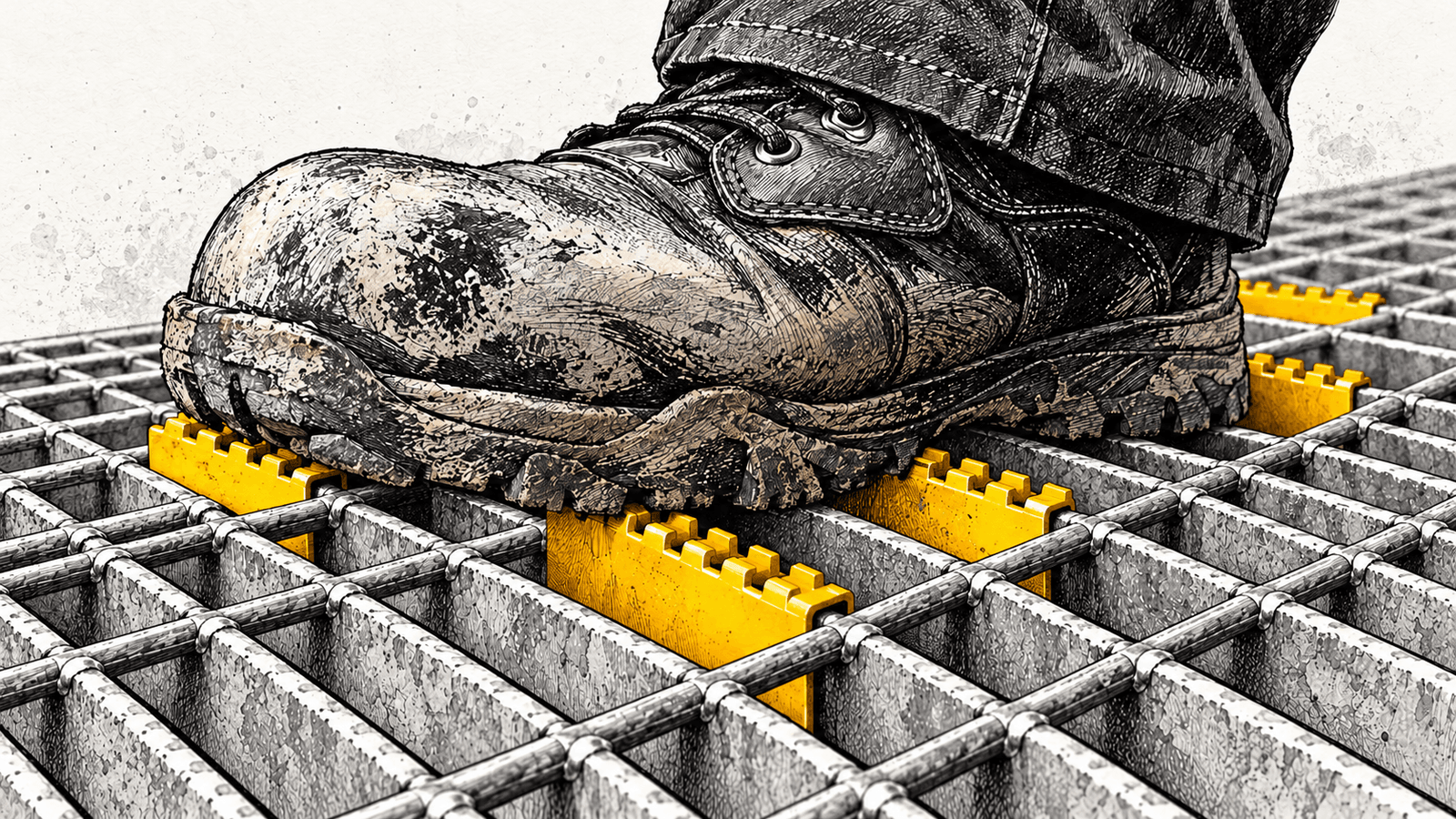
Mechanically attached traction fits the regulatory shape of the problem. Titan Safety Anti-Slip Clips are knock-on cleats that lock onto the bearing bars of steel bar grating with no nuts, bolts or hot work, so they go on during normal operation with no shutdown and no permit. The raised abrasive contact surface sits above the plane of the grating and keeps working after oil, frost or dust has filled the voids below. Powder-coated steel clips in high-visibility yellow or red mark stair nosings and platform edges while adding traction, restoring the leading-edge visibility that old 1910.24(f) once required. Composite clips in green or yellow serve corrosive and non-sparking areas where steel hardware would rust or is prohibited, and blue anti-microbial clips suit food and beverage washdown zones. Because each clip is a discrete, countable component, it drops straight into the 1910.22(d) routine: count them, check them, replace the ones that wear.

Retrofit traction changes something the compliance checklist never measures: whether a surface that passes on paper holds a boot when it is wet.
Building an Inspection Program for Grating and Stairs
1910.22(d) hands the employer three decisions: what to inspect, how often, and what record to keep. OSHA requires no written record, but "regularly" is impossible to demonstrate without one. A defensible program looks like this.
What to check on grating:
Corrosion and section loss on bearing bars, especially at supports and under drip points
Panels that rock, shift or lift underfoot; missing or loose hold-down fasteners
Open or partially covered holes where panels have been removed
Serrations worn smooth along the walk path; paint, product or ice filling the serrations
Standing liquid, blocked drainage or new leak sources overhead
Traction retrofits present, seated and intact
New equipment or stored material that exceeds the panel's rated load
What to check on stairs:
Handrails and stair rails continuous, at height, and rigid under hand pressure
Riser and tread uniformity, including after mats, added nosings or poured curbs change a step
Tread condition and a leading edge the eye can find
Vertical clearance after new conduit, pipe or duct has been run
Door and gate swings onto landings
Lighting at nosings and landings
How often. OSHA leaves the interval to the employer, so tie it to exposure. High-traffic routes and contaminated zones (washdown, oil, outdoor) deserve a monthly look. General platforms and stairs can run quarterly. Every surface gets a check after a freeze, a spill, a process change or a near miss. Put the route in the CMMS as a PM with a checklist so completion is recorded automatically.
What the record shows. The chain a compliance officer wants to follow is: route completed on date, hazard found, surface guarded, work order raised, repair completed by a qualified person where structure was involved, surface released. Date-stamped photos at each step cost nothing and settle arguments. A facility that can produce that chain for the last 12 months has met 1910.22(d) in substance and in spirit.
Training Requirements Under 1910.30
1910.30 is narrower than many plants assume. The fall hazard training duty in 1910.30(a) applies to employees who use personal fall protection systems and to employees other Subpart D provisions specifically require to be trained, such as those working in designated areas or using rope descent systems. Walking across a guarded platform on its own triggers no training requirement.
In a grating-heavy plant, the trigger arrives fast anyway. The technician who lifts a panel and ties off to work the opening, the crew that removes a guardrail section to rig a motor, and anyone on an unguarded edge above 4 feet are all inside 1910.30(a). For them, a qualified person must cover:
The nature of the fall hazards in the work area and how to recognize them
The procedures to minimize those hazards
The correct procedures for installing, inspecting, operating, maintaining and disassembling the personal fall protection systems they use
The correct use of the equipment in 1910.28, including hook-up, anchoring, tie-off and inspection per the manufacturer
1910.30(b) adds an equipment duty: before an employee uses equipment covered by the subpart, such as ladders or dockboards, the employer must train them in its proper care, inspection, storage and use. Retraining is required when workplace changes make earlier training obsolete, when the fall protection equipment changes, or when an employee shows they have not retained the material. All of it must be delivered in a manner the employee understands.
The standard requires no training records. A compliance officer will still ask for them, because a signed roster with dates and topics is the only practical proof the training happened. Recording the training in the same system that holds the inspection route keeps the two halves of Subpart D compliance in one place.
Meeting OSHA Walking-Working Surfaces Requirements Is the Starting Line
Subpart D is a good standard. It tells a plant how high the rail goes, how deep the tread runs, how much the panel must carry, who may repair it and how often someone must look. A facility that follows it will have fewer falls to lower levels, which is where most of the deaths occur.
It says nothing about how much friction a grating surface delivers when it is wet, which is where most of the injuries occur. That gap is the employer's to close, using the performance language OSHA left in place: inspect the surface, treat lost traction as the hazard it is, and correct it with a method that survives the environment. For steel grating that cannot be replaced on this year's budget, a mechanical retrofit installed on a Tuesday afternoon does more for the night shift than any dimension in Table D-1.
OSHA walking-working surfaces requirements set the floor. Traction is what keeps people standing on it.
Frequently Asked Questions
What OSHA standard covers walking-working surfaces?
29 CFR 1910 Subpart D, sections 1910.21 through 1910.30, covers walking-working surfaces in general industry. It includes general surface requirements, ladders, stairways, dockboards, scaffolds, fall protection duties and training. Construction work falls under 29 CFR 1926 Subparts M and X instead.
At what height does OSHA require fall protection in general industry?
4 feet. Under 1910.28(b)(1), any employee on a walking-working surface with an unprotected side or edge 4 feet or more above a lower level must be protected by a guardrail system, safety net or personal fall protection system. Fall protection is also required above dangerous equipment regardless of height.
How often does OSHA require walking-working surfaces to be inspected?
1910.22(d) requires inspection "regularly and as necessary" and sets no interval. The employer chooses a frequency adequate to find hazards before they cause injury, and must also inspect after events such as spills, freezes, process changes or incidents. A documented route in the CMMS is the simplest way to demonstrate regularity.
Does OSHA require stair treads or grating to be slip resistant?
The current rule contains no explicit tread traction requirement. The pre-2017 fixed industrial stairs standard, 1910.24(f), required treads to be reasonably slip-resistant with nonslip nosings, and that language was removed in the 2016 rewrite. Slick surfaces remain a hazard under 1910.22(a)(3) and must be corrected under 1910.22(d), so the duty survives in performance form.
What are the OSHA requirements for standard stairs?
Standard stairs must be installed at 30 to 50 degrees from horizontal, with a maximum riser height of 9.5 inches, a minimum tread depth of 9.5 inches and a minimum width of 22 inches between vertical barriers. Risers and treads must be uniform between landings, and each stair must support five times the anticipated live load and never less than a 1,000-pound concentrated load. Stairs installed before January 17, 2017 are exempt from the riser and tread limits if they meet Table D-1 or the angle requirement.
Is open bar grating considered a hole under OSHA?
No. 1910.21 defines a hole as a gap at least 2 inches in its least dimension, and the openings in standard bar grating fall below that. A removed or displaced grating panel is a hole, and the opening must be covered or guarded under 1910.28(b)(3) until the panel is back in place and secured.