How to Turn Maintenance Data Into Decisions That Improve Reliability

When Everyone Blames the CMMS
In many maintenance meetings, different departments discuss the same problems and challenges, but each sees them from a different perspective.
The technician complains that data entry takes too much time. The planner says work orders are incomplete. The maintenance manager does not fully trust the system reports. The operations team still faces repeated equipment failures, and the reliability engineer finds that the available data is not sufficient for analysis. The IT team says the software was set up based on the company's requirements.
In this situation, replacing or upgrading the software may be one of the first solutions considered. However, before making this decision, we should return to the main purpose of using CMMS/EAM systems: supporting better maintenance decisions.
This brings us to an important question:
Are the organization's processes, data structure, and information foundation reliable and consistent enough for the software to help us achieve this goal?
Closing the Maintenance Information Loop
In an incomplete maintenance process, a work order is created, executed, and closed. The related information is also recorded and stored in the CMMS. However, simply collecting and storing data does not create much value. The real value comes when this information is used for analysis, decision-making, and improving maintenance activities or strategies. The results should then be reviewed and used to improve the maintenance process.
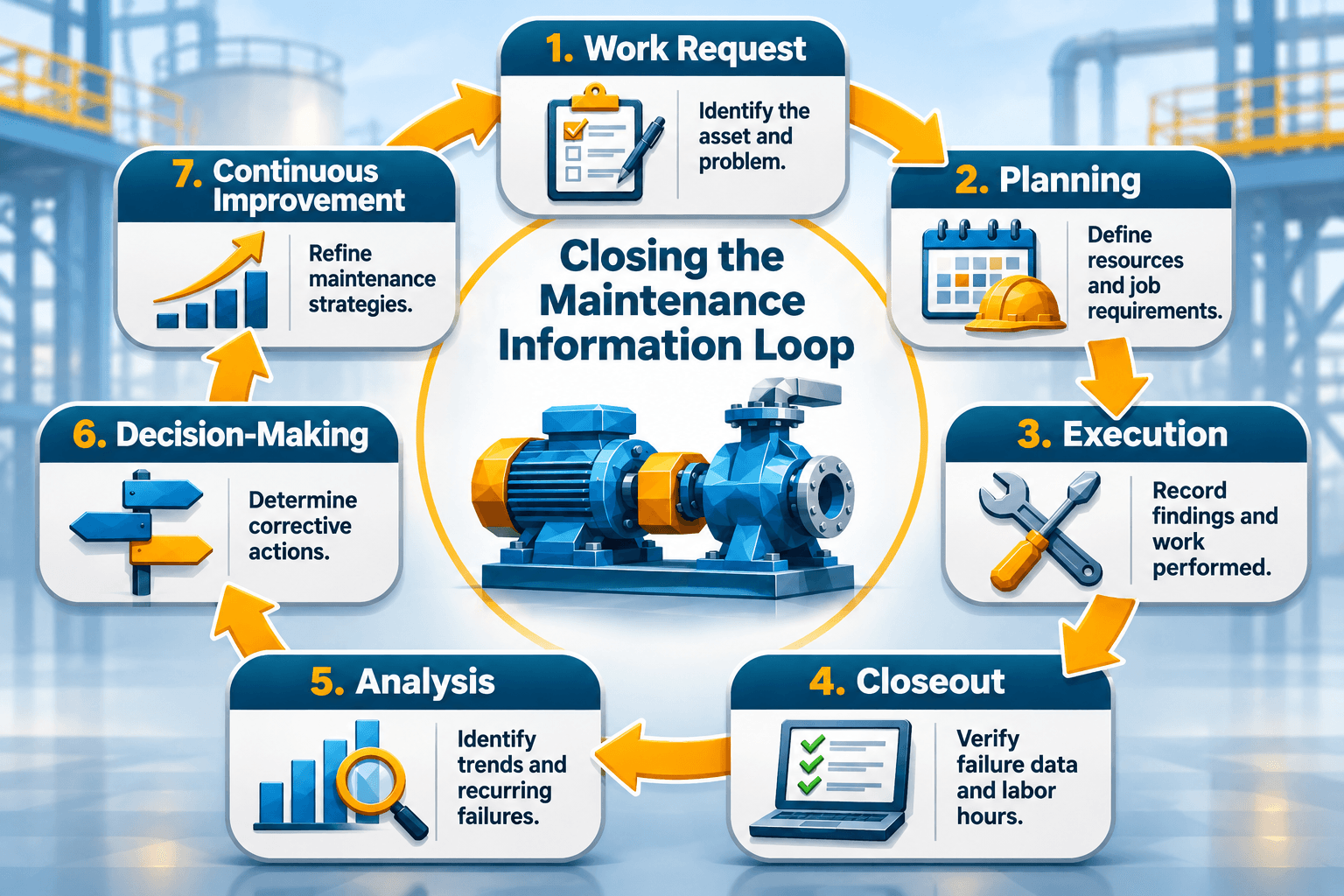
During the work order lifecycle, information is collected and completed step by step. When a work request is submitted, we may only know the asset, location, reported problem, and priority. During planning, the work type, required resources, and job plan are defined. During execution, the technician records the findings, equipment condition, and work performed. At work order closeout, failure information, actual labor hours, and completion status are recorded or verified.
The goal is not more data. The goal is reliable information for better decisions.
This information can then support failure trend analysis, Root Cause Analysis (RCA), Reliability-Centered Maintenance (RCM) reviews, KPIs, and maintenance strategy optimization.
In this way, maintenance data becomes more than just records stored in the CMMS. It becomes a reliable source for continuous improvement in maintenance decisions and activities.
Building a Reliable Data Foundation
To make maintenance records easier to compare and analyze, organizations need a common language and structure to identify equipment and record related events. ISO 14224 can help build this common structure, along with company requirements, Original Equipment Manufacturer (OEM) information, and other technical references.
The first area is Equipment Taxonomy. This structure defines the different levels of assets in an organization and helps determine where equipment information should be recorded and analyzed.
The second area is Equipment Boundary. It defines which components are included within each equipment unit. For example, when recording and analyzing pump failures, we need to know which components belong to the pump and whether the driver is considered a separate equipment unit. This affects how failures are recorded and how reliability and maintainability KPIs, such as MTBF and MTTR, are calculated.
The third area is Failure and Maintenance Data Classification. For example, one technician may report "vibration," another may write "bearing problem," and another may simply record "pump issue." Without common definitions and standard codes, it becomes difficult to identify failure patterns and compare maintenance records.
The real value comes when this information is used for analysis, decision-making, and improving maintenance activities or strategies.
Using standard codes and clear definitions for Failure Mode, Failure Mechanism, Failure Cause, Detection Method, and Maintenance Activity can improve data consistency and make records easier to compare. Free-text descriptions can still be used to provide additional details.
Designing Data Collection with People in Mind
As mentioned earlier, information is collected and completed step by step during the work order lifecycle. Therefore, data quality is not only about data structure and standard codes. People who inspect equipment, perform maintenance activities, and record and verify information play an important role in this process and support better decision-making.
At the end of a work shift, a technician may face repeated fields, complicated forms, and requests for information without understanding why it is needed or how it will be used. In this situation, resistance does not always mean a lack of cooperation. It may be a sign that the data collection process is not designed well.
Making data entry easier is only part of the solution. Users also need to see how their information is used.
We should not ask users to enter the same amount of information for every asset and maintenance activity. The type of failure, asset criticality, safety and quality requirements, and the purpose of the data should help define what information is needed. For example, a high-risk asset may require more detailed records and documentation. For lower-criticality assets, simpler but useful information may be enough, as long as all requirements are met.
Making data entry easier is only part of the solution. Users also need to see how their information is used. When technicians and other users see how their records support failure analysis, PM routine reviews, or management decisions, they can better understand how their daily work contributes to continuous improvement.
A Practical Roadmap - Start Small, Learn, and Expand
For organizations that collect a large amount of maintenance data but still cannot get reliable results, starting improvement and standardization with a large data cleanup project may create unnecessary costs and complexity. A more practical approach is to select a pilot area and focus on clear and measurable goals.
The first step is to select a system, equipment group, or operating unit as the pilot area and define the expected goals. Then, activities such as reviewing and updating the equipment list, improving Equipment Taxonomy, reviewing Equipment Boundaries, and reviewing PM routines should be planned and scheduled based on the pilot goals.
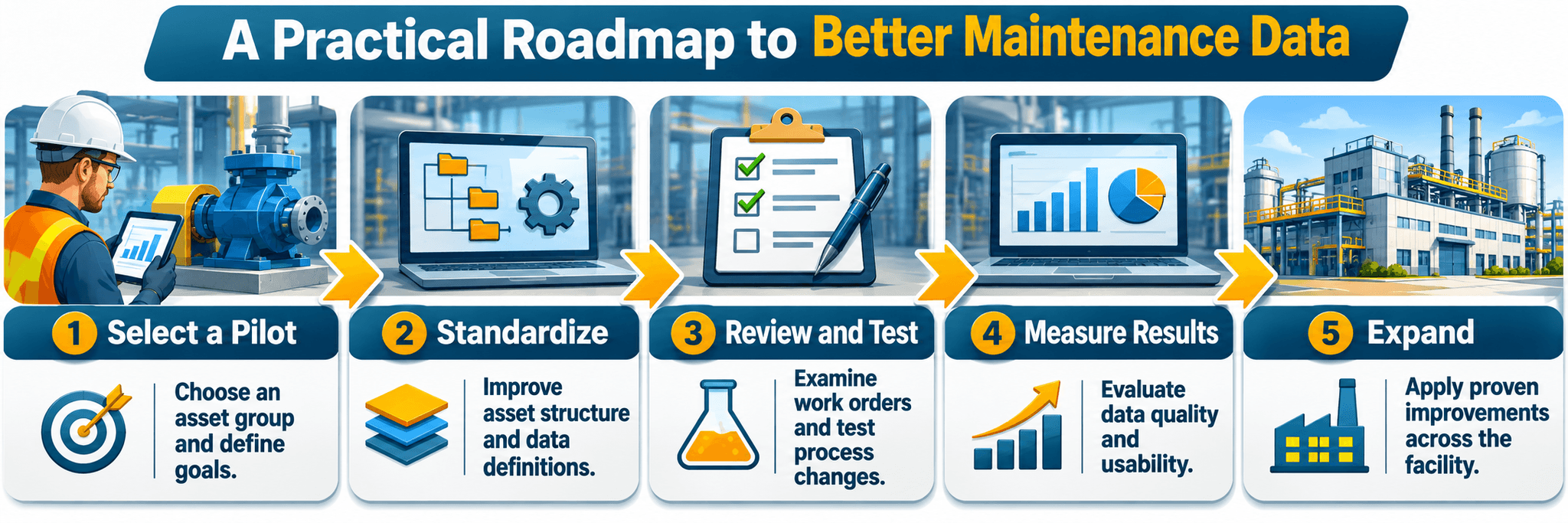
The next step is to review a number of actual work orders, from the initial work request to work order closeout. This helps identify problems with data entry, workflow, data quality, and other practical challenges. The findings can then be used to improve processes and test changes within the pilot area, with support from users and other teams.
To evaluate the pilot results, we can use measures such as the completeness of required data, consistency of failure codes, time needed for data entry, ability to analyze failure trends, and how the information is used for decision-making and corrective actions.
If the data foundation is weak, new technologies may simply help us create and record unreliable data faster, without improving the quality of maintenance decisions.
The pilot results, lessons learned, and improvements made can then help develop a practical framework to gradually expand this approach to other systems, equipment groups, or operating units across the organization.
The Supporting Role of AI in the Process
After building a proper data structure, Artificial Intelligence (AI) tools can help reduce the time and effort needed to record and classify maintenance information. For example, AI can use technicians' observations to suggest failure codes or values for data fields.
However, these suggestions must be consistent with the asset structure, Equipment Boundaries, and standard definitions approved by the organization. They should also be reviewed and verified by responsible personnel before being saved in the CMMS.
If the data foundation is weak, new technologies may simply help us create and record unreliable data faster, without improving the quality of maintenance decisions.
The main principle is simple: AI suggests. People validate.
Reliable Information for Better Decisions
Improving maintenance decisions does not always start with replacing or upgrading software or collecting more data. First, we need to define clear goals, establish a proper structure for equipment and other maintenance information, and make sure the required data is recorded and completed step by step during the work order lifecycle.
People should also understand how the information they record will be used. This information should then support analysis, decision-making, and corrective actions. The results should go back into the maintenance improvement process.
A practical starting point is to select one asset, system, or operating unit as a pilot and follow the information from the initial work request through work order closeout, analysis, decision-making, and evaluation of the results.