
Every fall, OSHA announces a preliminary list of its ten most frequently cited standards, and the finalized ranking follows later. It is the closest thing the field has to an annual scorecard of where workplaces fall short, and a large share of the list is maintenance-relevant. This page pulls out the maintenance-related standards, gives the final citation figures, and flags the sourcing details that most reproductions of this list get slightly wrong.
OSHA’s Top 10 most-cited standards, FY2025
The list below is OSHA’s finalized ranking for fiscal year 2025 (October 1, 2024 to September 30, 2025), with final citation counts drawn from OSHA Information System data pulled on April 15, 2026.
| Rank | Standard | CFR | Citations (final FY2025) |
|---|---|---|---|
| 1 | Fall Protection, general requirements | 1926.501 | 6,992 |
| 2 | Hazard Communication | 1910.1200 | 3,010 |
| 3 | Ladders | 1926.1053 | 2,842 |
| 4 | Control of Hazardous Energy (Lockout/Tagout) | 1910.147 | 2,562 |
| 5 | Respiratory Protection | 1910.134 | 2,294 |
| 6 | Scaffolding | 1926.451 | 2,286 |
| 7 | Fall Protection, training requirements | 1926.503 | 2,216 |
| 8 | Powered Industrial Trucks | 1910.178 | 2,150 |
| 9 | Eye and Face Protection | 1926.102 | 1,965 |
| 10 | Machine Guarding | 1910.212 | 1,498 |
Bold rows are the three standards with the strongest direct maintenance connection. In the preliminary data OSHA released in September 2025, Scaffolding and Fall Protection Training sat in the opposite order at ranks 6 and 7; the finalized data reversed them. Most reproductions of this list online still show the preliminary counts.
The ten standards together accounted for 27,815 citations. Fall protection held the top spot for the 15th year running.
Which of these are maintenance violations?
LOTO is directly maintenance-centered. Machine guarding and powered industrial trucks have important maintenance connections, while respiratory protection includes respirator-maintenance requirements. Lockout/Tagout (rank 4) is the central one: the standard governs the control of hazardous energy during servicing and maintenance, so citations under this standard arise from servicing or maintenance activity within its scope. Machine Guarding (rank 10) has a maintenance connection because guards may be removed for servicing or troubleshooting and not reinstalled. Powered Industrial Trucks (rank 8) covers forklifts; the standard includes inspection and maintenance requirements, though the largest share of citations involves operator training and evaluation rather than truck maintenance. Respiratory Protection (rank 5) is primarily a general-industry exposure-control standard, but it explicitly includes the cleaning, maintenance, and repair of respirators in its requirements.
Lockout/Tagout: the maintenance safety standard
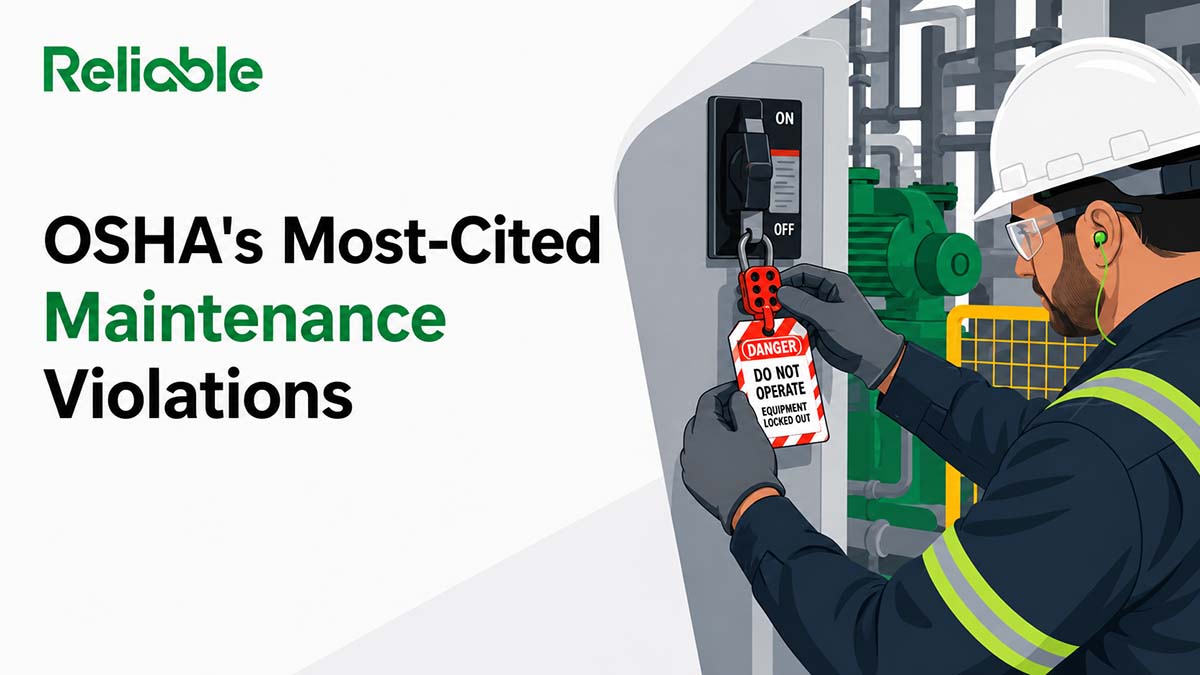
If there is a single OSHA standard that belongs to maintenance, it is 1910.147. It exists to keep equipment from starting up or releasing stored energy while someone is working on it. In FY2025 it drew 2,562 citations and ranked 4th, and it is a perennial Top 10 standard. OSHA’s longstanding estimate is that compliance with the lockout/tagout standard prevents roughly 120 fatalities and 50,000 injuries a year.
Common compliance failures include:
- Missing or inadequate machine-specific energy-control procedures, except where OSHA’s narrow documentation exception applies.
- Authorized and affected employees not trained, or training not documented and refreshed when equipment or processes change.
- Failure to provide compliant lockout/tagout hardware, or to ensure authorized employees apply properly identified devices.
- No periodic inspection of the energy-control procedures.
- Failure to verify isolation and de-energization before work begins.
Machine guarding: the maintenance connection people miss
Machine guarding (1910.212) rounded out the Top 10 with 1,498 citations. It belongs on a maintenance list because of a failure pattern OSHA warns about: guards are sometimes removed for adjustments, cleaning, troubleshooting, or jam clearing and then not restored, or are bypassed with defeated interlocks and improvised modifications. The FY2025 data do not break out how many guarding citations came from that specific pattern, but it makes guarding a maintenance-discipline issue as well as a design one, and it overlaps directly with good lockout/tagout practice.
What an OSHA violation costs
Federal OSHA’s current maximum penalties are $16,550 per serious or other-than-serious violation and $165,514 per willful or repeat violation. OSHA normally adjusts these maximums for inflation each January, but the 2026 adjustment was cancelled because the required October 2025 inflation data was unavailable, so the 2025 amounts carry over into 2026. Beyond the dollar amount, the most serious cases can lead to OSHA’s Severe Violator Enforcement Program, which uses specific qualifying criteria rather than applying automatically and carries mandatory follow-up inspections.
How to read this data
Two things keep the figures honest. First, citation counts are not injury rates. They measure how often inspectors wrote up a given standard, which is shaped by how many inspections happened, which industries were targeted, and how common the equipment is, not purely by how dangerous the hazard is. The list is a strong indicator of where compliance gaps are common, not a ranking of risk. Second, construction standards dominate the raw list (fall protection, ladders, scaffolding, eye and face protection), which can mask how concentrated the general-industry maintenance standards are. Lockout/Tagout, machine guarding, and powered industrial trucks are the maintenance-relevant general-industry entries, and they are where a maintenance and reliability team has the most direct control.
Frequently asked questions
What is OSHA’s most-cited maintenance-related violation?
Control of Hazardous Energy, known as Lockout/Tagout (29 CFR 1910.147), is the most-cited standard tied directly to maintenance. It governs how hazardous energy is controlled during servicing and maintenance, and it ranked 4th on OSHA’s finalized FY2025 Top 10 with 2,562 citations.
Where does lockout/tagout rank on OSHA’s Top 10?
Lockout/Tagout ranked 4th in fiscal year 2025 and is a perennial Top 10 standard. It recorded 2,562 citations in the finalized FY2025 data.
What are OSHA’s Top 10 most-cited standards for FY2025?
In OSHA’s finalized FY2025 ranking: Fall Protection general requirements (1926.501), Hazard Communication (1910.1200), Ladders (1926.1053), Lockout/Tagout (1910.147), Respiratory Protection (1910.134), Scaffolding (1926.451), Fall Protection Training (1926.503), Powered Industrial Trucks (1910.178), Eye and Face Protection (1926.102), and Machine Guarding (1910.212).
Why is machine guarding a maintenance issue?
OSHA notes that guards are sometimes removed for maintenance, cleaning, or troubleshooting and not reinstalled, or are bypassed with defeated interlocks, which makes guarding a maintenance-discipline issue as much as a design one. The FY2025 data do not quantify how many citations came from that pattern. Machine guarding (1910.212) ranked 10th in FY2025 with 1,498 citations.
How much does an OSHA violation cost?
Federal OSHA’s current maximum penalties are $16,550 per serious violation and $165,514 per willful or repeat violation. OSHA normally adjusts these each January, but the 2026 adjustment was cancelled for lack of the required inflation data, so the 2025 amounts remain in effect for 2026.
How many injuries does lockout/tagout prevent?
OSHA’s longstanding estimate is that compliance with the lockout/tagout standard prevents roughly 120 fatalities and 50,000 injuries a year.
Related guides
- The Real Cost of a Workplace Injury
- Preventive Maintenance Guide
- Steam Trap Failure Rate Statistics
- Maintenance & Reliability Glossary
Sources
- OSHA: Top 10 Most Frequently Cited Standards, Fiscal Year 2025 (official finalized ranking)
- Safety+Health Magazine (National Safety Council): OSHA reveals final Top 10 data for FY 2025 (final per-standard citation counts)
- OSHA: Control of Hazardous Energy (Lockout/Tagout) (standard requirements and prevention estimate)
- OSHA: Machine Guarding (standard requirements)
- OSHA: OSHA Penalties (maximum civil penalty amounts)
- OSHA: 29 CFR 1910.147, The Control of Hazardous Energy (Lockout/Tagout) (regulation text)
- OSHA: 2026 Annual Adjustments to OSHA Civil Penalties (cancellation of the 2026 inflation adjustment)
- OSHA: Severe Violator Enforcement Program (SVEP) (program qualifying criteria)
Citation counts and ranking are OSHA’s final FY2025 figures (OSHA Information System data pulled April 15, 2026). Penalty amounts are federal OSHA’s current maximums, in effect since January 2025 and continuing through 2026 after the annual inflation adjustment was cancelled.