
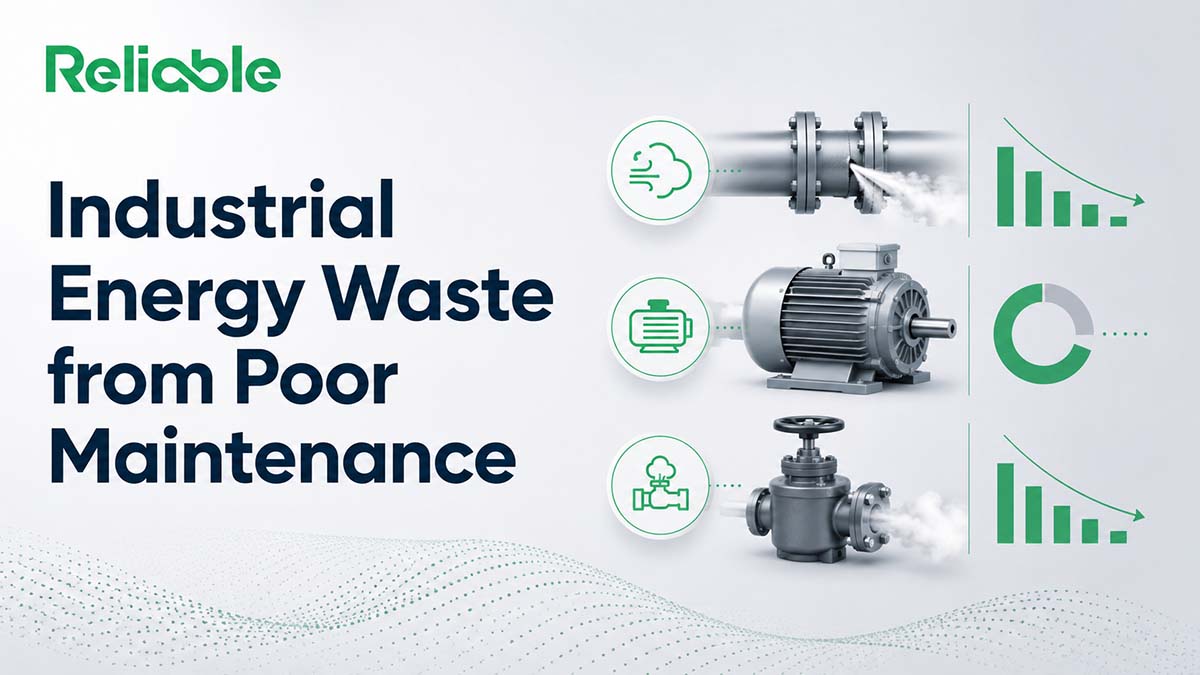

Three systems quietly waste energy in many industrial facilities, and most teams can’t tell you how much. Compressed air slips out of bad fittings. Motors run a little less efficiently after a sloppy rewind. Steam traps stick open and blow live steam into the condensate line for years.
The figures attached to all this get repeated everywhere. “Leaks waste 30% of your compressor.” “A failed trap costs thousands a year.” “Every rewind drops your efficiency a few points.” Some of those numbers come straight from the Department of Energy. One comes from a trade group and gets re-labeled as DOE on the way around the internet. One is mostly folklore.
We pulled the most-cited energy-waste claims for compressed air, motors, and steam, traced each one to its actual source, and scored it. The useful part is knowing which of three things you’re holding: a benchmark estimate, an engineering calculation, or an aggregate estimate.
What these numbers measure, and where they come from
Energy waste from poor maintenance is not one metric. It’s a handful of separate measurements that get blended together in marketing copy.
A benchmark estimate describes a condition commonly found in neglected systems. DOE’s “leaks can waste as much as 20% to 30% of compressor output” is one of these. So is “15% to 30% of traps may have failed after three to five years without maintenance.” These are experience-based ranges, not constants, and DOE is careful with the conditional language. They tell you what to expect in a system that has been ignored. They do not tell you your number.
An engineering calculation is what you get once you specify the inputs. Flow through an opening of a known size at a known pressure is calculable. So is the dollar cost, once you add operating hours and an energy price. These figures can be mathematically sound under stated assumptions and still mislead when those assumptions go undisclosed.
Motor waste sits a little apart. The framing stat (machine drives use most of manufacturing electricity) is solid and current. The maintenance-specific claim, that repairing a motor degrades its efficiency, has been tested directly and mostly debunked, with one real caveat about repair quality.
Here’s how each claim scores.
| Claim | Figure | Reliable Confidence | What It Really Means |
|---|---|---|---|
| Compressed air leaks waste a share of compressor output | 20% to 30% | HighDOE benchmark, conditional | From DOE Compressed Air Tip Sheet #3, worded as “can often waste as much as.” It’s a benchmark for neglected systems, not a site fact. DOE names 5% to 10% of system flow as a typical cost-effective reduction target. |
| Poorly run US compressed air systems waste this much per year | ~$3.2 billion | Lowtrade-group estimate, often miscredited to DOE | The figure is from the Compressed Air and Gas Institute, not DOE. The cited CAGI page gives no base year, dataset, or calculation method. Use it as a rough order of magnitude, and attribute it correctly. |
| A single continuous leak’s annual energy cost | ~$2,400 (1/8″) to ~$9,700 (1/4″) | Mediumcalculation, inputs must be shown | Sound arithmetic once you fix pressure, opening size, geometry, hours, and energy price. Not a universal per-leak figure. See the worked example below for the exact assumptions. |
| Machine-drive systems’ share of US manufacturing electricity | ~52% | High2022 EIA MECS | Verified directly: 1,652 of 3,182 trillion Btu net electricity demand in the 2022 MECS. This is the “machine drive” end-use category, motor-driven equipment, not a motor-only count. |
| Motor systems’ share of global industrial electricity | ~60% to 70% | Mediumolder, scope-dependent | A UNIDO estimate: about 60% of global industrial electricity consumption, close to 70% of industrial electricity demand. A different scope from the US manufacturing figure, and larger than motors’ share of all electricity worldwide. Pick the right scope for your audience. |
| “Every rewind permanently cuts motor efficiency 1% to 5%” | 1% to 5% loss | Lowfolklore | EASA/AEMT controlled testing found good-practice rewinds changed efficiency by about −0.5 to +0.3 percentage points (average −0.1), within the lab’s ±0.2-point test repeatability. Good-practice rewinds can preserve efficiency; poor repair practices are what raise losses. |
| Steam traps failed in a system unmaintained 3 to 5 years | 15% to 30% | HighDOE benchmark, conditional | From DOE Steam Tip Sheet #1. A maintained system should have fewer than 5% leaking traps. A strong benchmark for neglected systems, not a current universal rate. |
| One stuck-open 1/8″ trap at 150 psig, annual steam loss | ~$6,640 | MediumDOE worked example, not a typical | DOE’s own illustration at $10 per 1,000 lb of steam, 8,760 hours, 75.8 lb/hr through a 1/8″ opening. Sound arithmetic under those assumptions. It is not an average trap cost. |
The Big Takeaway
The distinctions that matter are benchmark estimates, engineering calculations, and aggregate estimates.
The DOE percentages are benchmarks. They describe what neglected systems tend to look like, in conditional language, drawn from field experience. Quote them as “DOE estimates that leaks can waste as much as 20% to 30%” and you’re on solid ground. Quote them as “your plant is losing 30%” and you’ve turned a benchmark into a claim it can’t support.
Dollar figures fall into two groups: engineering calculations with stated inputs, and aggregate estimates whose methodology may be unclear. A failed trap’s cost depends on steam price. A leak’s cost depends on opening size, geometry, run hours, and power rate. DOE’s $6,640 trap is honest arithmetic with its assumptions printed right next to it. CAGI’s $3.2 billion is an aggregate estimate with no publicly disclosed methodology, and it gets miscredited to DOE. Two kinds of number, very different transparency.
Treat the percentages as conditional benchmarks, not site facts. Treat each dollar claim for what it is: a calculation needs its assumptions disclosed, and an aggregate estimate needs a transparent methodology.
So lead with the percentage, then build your own dollar figure from your own rates and your own equipment. Don’t borrow someone else’s total and drop the assumptions on the floor.
A transparent leak example
This is what “show your assumptions” looks like in practice.
DOE’s airflow table puts a 1/8-inch opening at 100 psig near 25 cfm, and a 1/4-inch opening near 101 cfm, before any correction for opening shape. DOE says to multiply those by 0.61 for a sharp-edged opening or 0.97 for a well-rounded one.
Run the sharp-edged case at 8,760 operating hours, $0.10/kWh, and roughly 18 kW per 100 cfm of supply, and the 1/8-inch leak costs about $2,400 a year. The 1/4-inch leak costs about $9,700.
CAGI’s published example runs higher. For a 1/4-inch leak at 100 psi, CAGI uses 104 cfm, a value close to DOE’s uncorrected table flow, drawing about 25 hp, and arrives at more than $17,000 a year at $0.10/kWh, 8,760 hours, and 94% motor efficiency. Same physics. Different inputs. That’s exactly why the dollar figure needs its assumptions attached.
One caveat on all of these: they estimate the generation cost attributable to the leak. The kilowatt-hours you save depend on how the compressor controls respond, and DOE notes that compressor run time usually has to be adjusted down after leak repair to capture the savings.
Why the numbers vary or disagree
The biggest source of confusion is misattribution. The “$3.2 billion a year” compressed air figure shows up on dozens of vendor pages credited to the Department of Energy. It traces to the Compressed Air and Gas Institute, a trade association, and the cited page shows no base year, dataset, or methodology. When a number gets laundered through enough blog posts, the citation upgrades itself.
The second source is input sensitivity. A failed trap’s annual cost depends on steam price, which ranges widely by fuel and region. DOE’s $6,640 example assumes $10 per 1,000 lb. Change the steam price and the headline moves with it. The trap didn’t change. The math behind the number did.
The third is the motor-efficiency myth. For years the accepted wisdom was that every rewind shaved a percent or more off a motor’s efficiency, and that the losses stacked with each repair. EASA and the AEMT tested this at an independent accredited lab. The group’s average change of -0.1 percentage point fell within the laboratory’s ±0.2-point repeatability, and individual measured changes ranged from -0.5 to +0.3 points. The myth survives because bad rewinds are real. The blanket version of the claim is not.
How to use these numbers safely
Quote the percentages as conditional benchmarks. “DOE estimates leaks can waste as much as 20% to 30% of compressor output” is defensible. “Your system is wasting 30%” is not, until you’ve measured it.
Match the stat to the geography and the scope. For a US audience, machine drives are about 52% of manufacturing electricity, per the 2022 EIA MECS. The 60% to 70% figure is a global industrial range from UNIDO, a different and larger denominator than motors’ share of all electricity worldwide. Mixing these is a small error that a sharp reader will catch.
Run the dollar math with your own inputs. DOE’s $6,640 trap and the leak figures above are templates. Plug in your steam price, power rate, opening sizes, and operating hours before you put a number in front of a CFO, and show the assumptions when you do.
Treat per-leak dollar figures as calculations, not averages. A 1/8-inch and a 1/4-inch leak differ by roughly 4x in flow. A single “average leak costs $X” claim hides that spread.
Where teams go wrong
The most common mistake is treating a worked example as a survey result. DOE’s steam-trap dollar figure is an illustration with stated assumptions, and people cite it as if it were the measured average across industry. It isn’t.
The second mistake is skipping the survey and trusting the percentage. Knowing that 15% to 30% of traps may have failed tells you to go count yours. It does not tell you your number. A system with a real testing program can have fewer than 5% leaking traps. Steam trap testing can use ultrasonic or other acoustic methods, temperature measurement, visual inspection, or electronic monitoring, and the right method depends on trap type, application, load, and operating condition. Condition monitoring on critical traps can identify failures sooner, rather than letting them run for a year.
The third is buying the rewind myth in either direction. Assuming every rewind ruins a motor pushes teams toward premature replacement. Assuming every shop does clean work ignores the actual finding, which is that the repair process determines whether efficiency survives. The right move is to qualify the shop, not to fear the repair.
Methodology
Every figure here was traced to a named primary or strongly authoritative source, and the source was confirmed to resolve. The compressed air and steam percentages come from DOE Advanced Manufacturing Office tip sheets, published in 2004 and 2012 and still hosted in DOE’s resource library. The steam-trap discharge rates in DOE’s example are adapted from the Boiler Efficiency Institute, not independently measured by DOE. The machine-drive electricity share comes directly from the 2022 EIA Manufacturing Energy Consumption Survey, Table 5.4. The motor-rewind findings come from the EASA and AEMT repair studies, with before-and-after testing performed at an independent accredited laboratory.
Claims were rated on two things at once: how reliable the source or calculation is, and how safely the number transfers to another plant. A figure can be everywhere and still rate Low if its origin is an undocumented estimate. A calculation can be exact under its own assumptions and still be a poor generic benchmark, which is why DOE’s $6,640 trap rates Medium rather than High. A corrective finding can rate High when it rests on controlled testing, which is why the rewind myth scores Low while the corrected version holds up.
Where a number is arithmetic that depends on local inputs (steam price, power rate, opening size, operating hours), it is rated Medium and flagged as a calculation rather than a measured average.
Frequently asked questions
How much energy do compressed air leaks waste?
DOE’s Compressed Air Tip Sheet #3 estimates that leaks can often waste as much as 20% to 30% of a compressor’s output in a poorly maintained system. DOE names 5% to 10% of total system flow as a typical cost-effective target after a leak-reduction program. The 20% to 30% range is a benchmark for neglected systems, not a measured rate for any specific plant.
Is the $3.2 billion compressed air leak figure from the DOE?
No. It comes from the Compressed Air and Gas Institute, a trade association, and is widely miscredited to the Department of Energy. The cited CAGI page provides no base year, dataset, or calculation method, so treat it as a rough order of magnitude and attribute it to CAGI.
How much does a failed steam trap cost per year?
DOE’s Steam Tip Sheet #1 gives a worked example: a 1/8-inch trap stuck open on a 150 psig line, with steam valued at $10 per 1,000 lb and running 8,760 hours, loses about $6,640 a year. That is an illustration with stated assumptions, not a typical cost. Your number changes with steam price and opening size.
What percentage of steam traps fail without maintenance?
DOE’s Steam Tip Sheet #1 estimates that 15% to 30% of installed traps may have failed in a system left unmaintained for three to five years. A system with a regular testing program should have fewer than 5% leaking traps.
Does rewinding a motor reduce its efficiency?
Not inherently. In the EASA/AEMT studies, efficiency changes after a good-practice rewind ran from about -0.5 to +0.3 percentage points, averaging -0.1, within the test method’s ±0.2-point repeatability. Efficiency losses can appear with repair-process deviations such as excessive core temperature, mechanical core damage during coil removal, reduced conductor area, or winding changes. The often-repeated “1% to 5% loss per rewind” is not supported for quality repairs.
What share of industrial electricity do electric motors use?
In the 2022 EIA Manufacturing Energy Consumption Survey, machine-drive systems accounted for about 52% of net electricity demand in US manufacturing (1,652 of 3,182 trillion Btu). Globally, UNIDO literature puts motor systems at roughly 60% to 70% of industrial electricity, which is a different scope from the US manufacturing figure.
How much does a single compressed air leak cost?
It depends on opening size, pressure, run hours, and power rate. Using DOE’s airflow table with a sharp-edged correction, 8,760 hours, $0.10/kWh, and about 18 kW per 100 cfm, a 1/8-inch leak at 100 psig costs roughly $2,400 a year and a 1/4-inch leak roughly $9,700. CAGI’s published 1/4-inch example runs higher (more than $17,000 a year) because it uses about 104 cfm, a value close to DOE’s uncorrected table flow, drawing 25 hp at 94% motor efficiency.
The Short Version
The percentages are the trustworthy part, as long as you keep them conditional. DOE estimates leaks can waste as much as 20% to 30% of compressor output, and that 15% to 30% of steam traps may fail in a system left unmaintained for years. Both are benchmarks for neglected systems. They tell you to go measure, not what you’ll find.
The dollar figures fall into two groups. The $3.2 billion national air-waste number is a CAGI aggregate estimate with no disclosed methodology, not a DOE finding, and the per-trap and per-leak costs are calculations that swing with steam price, power rate, opening size, and run hours. Lead with the percentage, attribute the trade-group numbers correctly, and build your own dollar figure from your own bills with the assumptions shown.
And the rewind myth can go. In the EASA/AEMT studies, good-practice rewinds did not meaningfully reduce efficiency. Poor repairs can. Qualify the shop.
Sources
U.S. Department of Energy, Advanced Manufacturing Office. Compressed Air Tip Sheet #3: Minimize Compressed Air Leaks. DOE/GO-102004-1964. https://www.energy.gov/sites/prod/files/2014/05/f16/compressed_air3.pdf
U.S. Department of Energy, Advanced Manufacturing Office. Steam Tip Sheet #1: Inspect and Repair Steam Traps. DOE/GO-102012-3401. https://www.energy.gov/sites/prod/files/2014/05/f16/steam1_traps.pdf
U.S. Energy Information Administration. 2022 Manufacturing Energy Consumption Survey, Table 5.4: End uses of fuel consumption, 2022. https://www.eia.gov/consumption/manufacturing/data/2022/pdf/Table5_4.pdf
EASA and AEMT. The Effect of Repair/Rewinding on Motor Efficiency (2003) and the 2019 premium-efficiency/IE3 follow-up study. https://easa.com/resources/resource-library/good-practice-guide-to-maintain-motor-efficiency
EASA/AEMT rewind study, stage results as documented in ACEEE 2003 Summer Study proceedings. https://www.aceee.org/files/proceedings/2003/data/papers/SS03_Panel4_Paper_04.pdf
United Nations Industrial Development Organization (UNIDO). Efficiency Solutions for Motor-driven Systems. https://decarbonization.unido.org/wp-content/uploads/2020/07/corrected-motors_brochure_3-dic.pdf
Compressed Air and Gas Institute. Working with Compressed Air. https://www.cagi.org/working-with-compressed-air