

Over the course of my career, I have participated in, advised, or observed hundreds of improvement initiatives. Some focused on reliability improvement. Others involved maintenance excellence, operational excellence, business transformation, ERP implementations, EAM implementations, digitalization efforts, or some combination of the above. While each organization was unique, a recurring pattern eventually emerged.
The organizations that achieved the greatest gains rarely began with technology.
At first glance, that observation seems counterintuitive. Modern organizations are surrounded by increasingly sophisticated technologies. Enterprise Asset Management systems, Enterprise Resource Planning systems, Artificial Intelligence, Connected Worker platforms, predictive analytics, digital twins, condition monitoring technologies, and countless other tools promise to improve performance.
Yet despite unprecedented access to technology, many organizations continue to struggle with reliability, productivity, cost control, planning effectiveness, inventory optimization, safety performance, and other fundamental business challenges.
The explanation is neither mysterious nor particularly complicated. Technology is extraordinarily effective at scaling existing behaviors. Unfortunately, it scales poor behaviors just as effectively as good ones.
Over the years, I have found Figure 1 to be a useful way to think about the relationship between business processes, technology, and value creation.
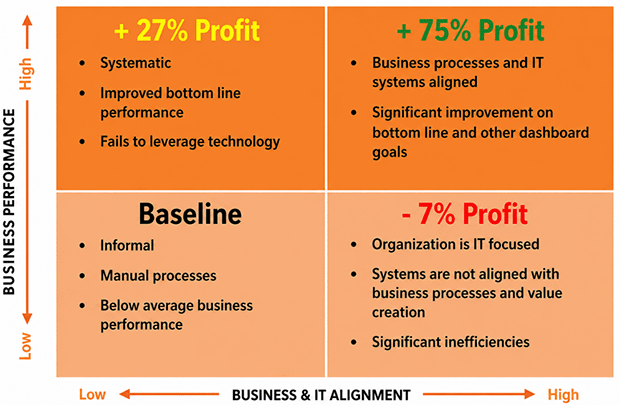
Figure 1 – Investments in technology only yield benefit when they support optimized business processes. When they don’t, they simply add cost (Ref: Brynjolfsson, Wiremen).
The Technology Trap
Organizations operating in the lower-left quadrant typically rely upon informal processes, tribal knowledge, and highly manual ways of working. Performance is often inconsistent, heavily dependent upon individual experience, and difficult to sustain. Most organizations begin their improvement journey somewhere in this vicinity.
Many organizations improve performance by moving upward. Processes become more structured. Standards emerge. Governance improves. Accountability becomes clearer. Reliability improves. Costs decline. Safety performance improves. These organizations often realize significant gains without making substantial investments in technology because they have improved the way work is performed.
The lower-right quadrant is considerably more interesting. This is where many organizations unintentionally find themselves following major ERP, EAM, and digital transformation initiatives.
Significant investments have been made in technology. Systems have been configured. Data has been migrated. Dashboards have been developed. Reports have been automated. Yet the underlying business processes remain largely unchanged. In some cases, organizations discover they have simply digitized existing inefficiencies. The software functions as intended, but the business case remains elusive.
Technology is extraordinarily effective at scaling existing behaviors. Unfortunately, it scales poor behaviors just as effectively as good ones.
The highest-performing organizations occupy the upper-right quadrant. Here, business processes and digital capabilities are intentionally aligned around value creation. Standards define how work should be performed. Governance reinforces those standards. Information supports decision-making. Technology enables the operating model rather than dictating it. The result is not simply better technology utilization. The result is materially better business performance.
This distinction is particularly important in large ERP and EAM programs. Traditional implementations frequently begin with software selection, architecture design, configuration decisions, data migration, and deployment planning. The implicit assumption is that if the technology is implemented successfully, the business benefits will naturally follow.
Experience suggests otherwise.
The organizations realizing the greatest returns tend to reverse the sequence. They begin by defining the outcomes they seek to achieve. Only after establishing those objectives do they define the processes, standards, governance requirements, and information needs required to achieve them. Technology then becomes an enabler of a deliberately designed operating model rather than the centerpiece of the transformation itself.
Defining Success Before Digitizing Success
Once an organization recognizes that technology should enable the business rather than define it, a more difficult question emerges:
What exactly should the technology enable?
Most organizations have no shortage of improvement opportunities. Profitability can often be improved. Safety performance can frequently be strengthened. Environmental performance can almost always be enhanced. Customer service levels may require improvement. Reputational risks may need to be reduced. The challenge is not identifying opportunities. The challenge is determining which business practices, decisions, standards, and behaviors must change to capture them.
This is where many transformation efforts begin to struggle.
Despite being justified by business objectives, ERP and EAM programs are frequently managed as technology projects. Discussions quickly shift toward software selection, system architecture, configuration decisions, data migration, integrations, testing, and deployment schedules. While these activities are necessary, they often distract organizations from a more fundamental question:
What does excellence actually look like?
If the organization cannot clearly define how work should be performed, how decisions should be made, what standards should govern execution, and what outcomes constitute success, it becomes difficult for any technology platform to create meaningful value. At best, the organization automates existing practices. At worst, it institutionalizes existing weaknesses.
Figure 2 illustrates the difference between these two approaches.
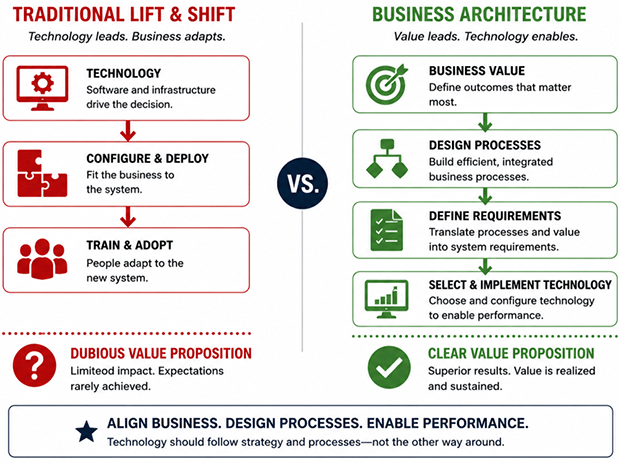
Figure 2 – The traditional “lift & shift” fails to examine the business process to determine where the technology provides a lever for creating value (Ref: D. Troyer and A. Callen).
Why Lift-and-Shift Falls Short
In a traditional “lift and shift” implementation, technology leads, and the business adapts. Existing processes are migrated into a new platform, users are trained on new transactions, and the organization hopes the expected benefits will follow. Frequently, the software functions exactly as designed while the business case remains largely unrealized.
A business architecture-driven approach reverses the sequence. The organization begins by defining the outcomes it seeks to improve and then determines the business processes, decision-making practices, governance mechanisms, and performance standards required to achieve them. Technology is subsequently configured to enable the desired operating model rather than define it.
The distinction is important because technology does not create excellence. It enables excellence. Excellence must first be defined.
Historically, organizations have become highly proficient at analyzing failure. When a significant incident occurs, a reliability problem emerges, a production target is missed, or a safety event takes place, teams conduct Root Cause Failure Analysis (RCFA) to identify the underlying causes. Corrective actions are developed and implemented to prevent recurrence.
This approach is valuable and necessary. Organizations that fail to learn from their mistakes rarely improve.
However, failure represents only half of the learning opportunity.
Learning From What Goes Right
Within nearly every organization, there are individuals, teams, assets, production lines, shifts, departments, and facilities that consistently outperform their peers. They operate more safely. They achieve better reliability. They execute work more effectively. They control costs more successfully. They consistently produce superior business outcomes.
Unfortunately, organizations often celebrate these successes without fully understanding them.
The highest-performing organizations approach success with the same rigor they apply to failure. Rather than simply asking why something went wrong, they ask why something went exceptionally well. They identify the conditions, behaviors, practices, standards, and decisions that produced superior outcomes. They then convert those insights into organizational knowledge.
Failure represents only half of the learning opportunity.
This process, which I refer to as Root Cause Success Analysis (RCSA), complements traditional RCFA. One seeks to eliminate defects, variation, and shortcomings. The other seeks to identify, standardize, and replicate the practices that create superior performance.
Together, these disciplines provide the foundation for defining excellence.
The objective is not merely to solve problems. The objective is to create standards. Once successful practices are clearly understood, they can be standardized, governed, measured, taught, and ultimately embedded into business processes. Only then should digital requirements be defined and technology configured to support them.
In other words, organizations should digitize success—not merely digitize current practice.
That distinction may seem subtle. In reality, it often determines whether a transformation produces lasting business value or simply results in new software supporting old behaviors.
From Opportunity to Standard to Performance
Most improvement initiatives begin with a problem. A safety incident occurs. Reliability deteriorates. Costs increase. Production falls short of expectations. Inventory levels rise. Customer complaints increase. An investigation follows, corrective actions are identified, and the organization attempts to improve performance.
There is nothing inherently wrong with this approach. In fact, many organizations become quite effective at identifying problems and implementing corrective actions. The challenge is that improvements are often temporary. A few months later, performance drifts back toward its previous state and the organization finds itself solving many of the same problems again.
The reason is straightforward. Solving a problem does not necessarily change the way an organization operates.
Sustainable performance improvement requires more than corrective action. It requires learning, standardization, governance, and ultimately the institutionalization of better ways of working.
The process begins by identifying the outcomes that matter most. In my experience, virtually every improvement opportunity ultimately relates to one or more of five business objectives: profitability, safety, environmental stewardship, customer satisfaction and service reliability, or reputation protection. These outcomes establish direction and define the opportunity.
Once the desired outcome is understood, performance must be examined from two perspectives.
The Two Questions That Define Excellence
The first is familiar to most organizations. Where performance falls short of expectations, Root Cause Failure Analysis (RCFA) is used to identify and eliminate the underlying causes of defects, variation, inefficiency, and risk. RCFA seeks to answer a simple question: What is preventing us from achieving the desired outcome?
The second perspective is less common but equally important. Within every organization, there are examples of superior performance. Certain assets outperform their peers. Some teams consistently achieve better results. Certain facilities operate more safely, more reliably, or more efficiently than others.
Rather than simply celebrating these successes, high-performing organizations seek to understand them. Root Cause Success Analysis (RCSA) identifies the practices, decisions, behaviors, and conditions that enable exceptional performance. It seeks to answer a different question: What is enabling us to achieve superior results?
Figure 3 illustrates the relationship between these two disciplines.
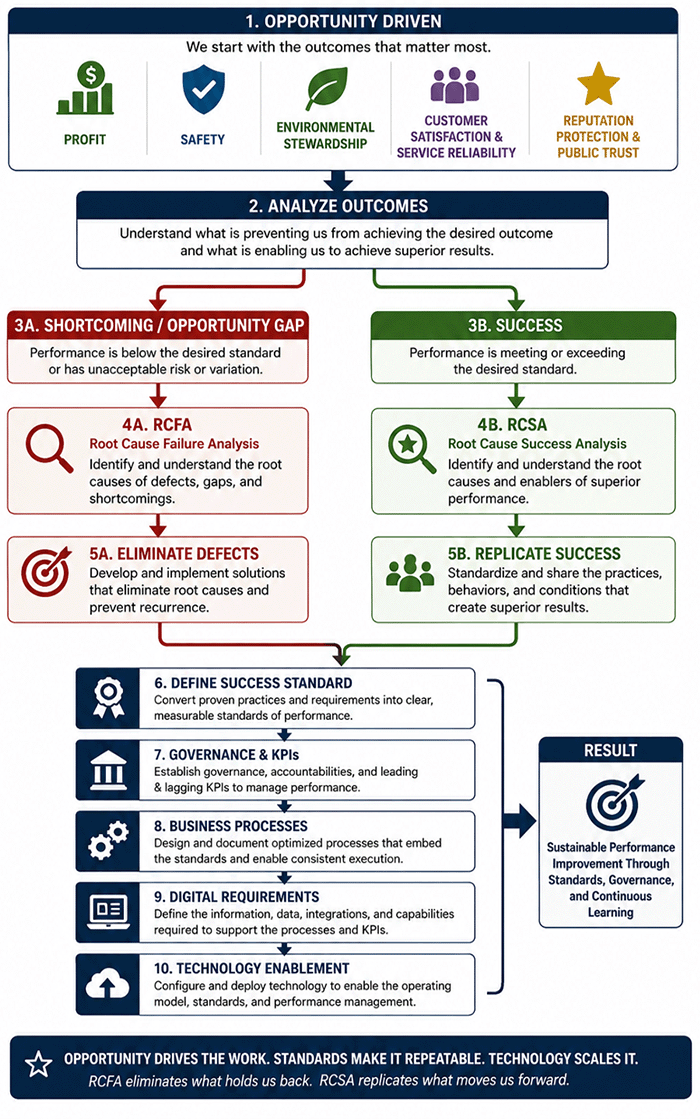
Figure 3 – Root Cause Analysis can be employed to understand and replicate success and to eliminate defects. Both scenarios drive business process optimization BEFORE installing or configuring any software or systems.
RCFA and RCSA serve different purposes, but they ultimately lead to the same destination. RCFA eliminates what holds the organization back. RCSA identifies what moves the organization forward. One removes barriers to performance. The other identifies the practices that should be replicated. Together, they provide the raw material required to define what good looks like.
This is where many organizations stop too soon.
They solve a problem, complete an improvement initiative, or recognize a successful team, but they fail to convert what they have learned into organizational standards. As a result, the improvement remains dependent upon the individuals involved. It may persist for a period of time, but it rarely scales and seldom survives organizational change.
The highest-performing organizations take the additional step of converting lessons learned into clearly defined standards. Those standards establish expectations, define required behaviors, clarify accountabilities, and create a common framework for decision-making and execution. Once standards have been established, governance systems and KPIs can be developed to monitor adherence and effectiveness. Business processes can then be designed to embed those standards into day-to-day work.
Only after standards, governance, and business processes have been defined should digital requirements be established. At that point, technology no longer determines how the organization operates. Instead, technology enables the operating model the organization has deliberately chosen to adopt.
The sequence matters.
Organizations that digitize existing practices often institutionalize existing weaknesses.
Organizations that digitize proven standards create a foundation for sustainable improvement and scalable performance.
Opportunity drives the work.
Standards make it repeatable.
Technology scales it.
From Standards to Sustainable Execution
Defining excellence is essential, but standards alone do not create value. Value is created when people apply those standards consistently in the field, day after day, across thousands of decisions and activities. The challenge facing every organization is therefore the same: How do we convert standards into repeatable execution?
Maintenance provides an excellent example.
Whether an organization operates a mine, refinery, pharmaceutical facility, paper mill, manufacturing plant, railway, or power station, the maintenance process follows a remarkably similar pattern. Assets are surveyed for signs of abnormal conditions. Potential issues are identified and documented. Work is prioritized, planned, scheduled, and resourced. The work is executed, results are verified, and lessons are captured for future improvement. While terminology may vary from one organization to another, the underlying workflow is remarkably consistent.
Figure 4 illustrates this concept through what I refer to as the 0-9 Intelligent Workflow.
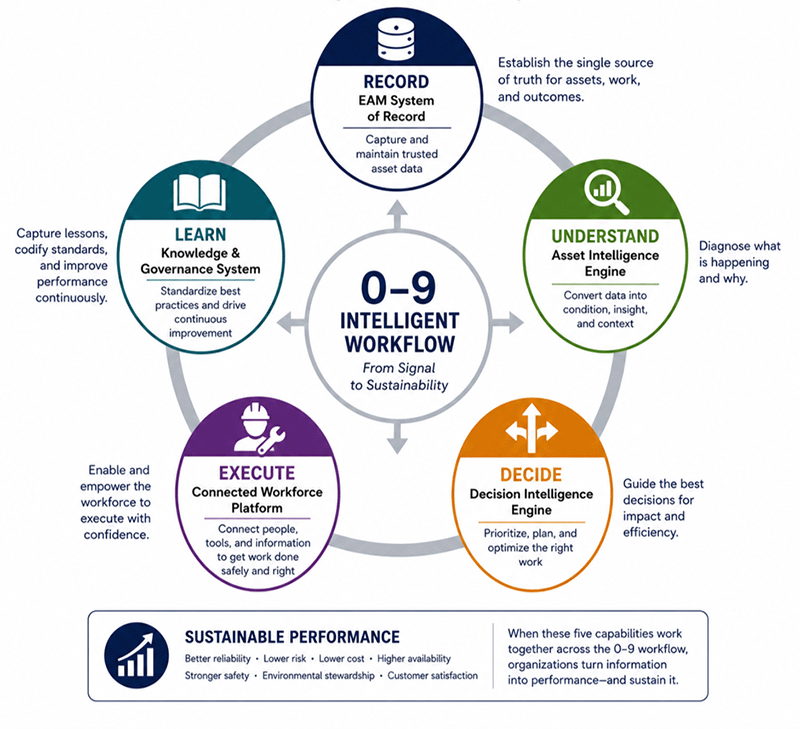
Figure 4 – The maintenance process, from asset surveillance to lessons learned, provides an excellent example of a process and system that must be people-focused.
Where Standards Become Daily Work
The workflow begins with asset surveillance. Operators, maintainers, inspectors, engineers, and monitoring technologies continuously observe asset condition and performance. The objective is not simply to detect failures. The objective is to identify opportunities to improve reliability, reduce risk, improve safety, and avoid future cost.
Once a condition is recognized, it must be identified, documented, prioritized, planned, scheduled, coordinated, executed, verified, and ultimately incorporated into organizational learning. While these individual steps are familiar to most maintenance organizations, the quality of execution at each step is heavily influenced by the information, knowledge, decision support, and guidance available to the people performing the work.
Viewed individually, the steps appear straightforward. Collectively, they represent one of the most complex business processes within industrial organizations. Success requires information, knowledge, decisions, coordination, and execution to work together seamlessly across multiple functions, disciplines, and levels of the organization.
This is where the capability ecosystem surrounding the workflow becomes important.
Systems Should Serve the Frontline
The EAM System of Record establishes the authoritative source of truth for assets, work history, costs, materials, and performance information. The Asset Intelligence Engine transforms data into understanding by helping personnel recognize developing conditions, emerging risks, and opportunities for intervention. The Decision Intelligence Engine supports prioritization, planning, scheduling, and resource allocation decisions. The Connected Workforce Platform places procedures, standards, training, and guidance into the hands of workers at the point of execution. The Knowledge and Governance System captures standards, lessons learned, and institutional knowledge so that improvements can be sustained and replicated.
Importantly, these capabilities do not exist primarily to satisfy management reporting requirements.
Too many digital transformation efforts are designed around dashboards, reports, scorecards, and executive visibility. While these capabilities are valuable, they are not where value is created. Value is created when an operator recognizes an abnormal condition before it becomes a failure. Value is created when a planner develops an effective work package. Value is created when a scheduler aligns work with operational requirements. Value is created when a technician executes a repair safely and correctly the first time. Value is created when a supervisor removes obstacles that prevent productive work.
The purpose of the system is to help the people closest to the work make better decisions and perform better work.
The purpose of the system is therefore not simply to inform management. The purpose of the system is to help the people closest to the work make better decisions and perform better work.
When frontline personnel succeed, the business succeeds. Reliability improves. Safety improves. Environmental performance improves. Customers are better served. Financial performance follows. The resulting outcomes naturally appear in dashboards and reports, but those reports are the result of effective execution – not the cause of it.
The most effective organizations understand this distinction. They design standards, governance systems, business processes, and technologies around the needs of the people who create value. In doing so, they create something far more important than better information systems.
They create sustainable performance.
Conclusion
Over the years, I have observed organizations invest enormous amounts of time, money, and effort implementing ERP systems, EAM systems, digital platforms, and countless other technologies. Some achieved extraordinary results. Others struggled to justify the investment. More often than not, the difference was not the technology itself. It was the degree to which the organization had clearly defined how it intended to operate before configuring the technology intended to support it.
Technology does not create excellence. It enables excellence.
Organizations that consistently outperform their peers understand what good looks like. They learn from both failure and success. They convert those lessons into standards. They govern those standards, embed them into business processes, and enable their people to execute them consistently.
The ultimate measure of success is not the quality of the system. It is the ability of frontline operators, maintainers, planners, supervisors, and engineers to make better decisions and perform better work.
Opportunity drives the work.
Standards make it repeatable.
People create the value.
Technology scales it.